
These are my weekly pastoral emails to my church.
Friday 19 April 2024


Saturday 13 April 2024
THIS IS HOW AN EXPERT SUCCESSFULLY FOUGHT SPIRITUAL WARS
 The distance between the spiritual dimension and our earthly-material dimension is a lot thinner than most people realise! This means that there is a direct correlation between the state of your emotional, spiritual, intellectual, health and your physical health. As part of my ongoing PhD research into aspects of this phenomena I have been struck by how disconnected many people view these realms, and even more so by how many ancients saw it clearly! The forces of darkness who have, in the words of Jesus the Christ, “come to steal, kill, and destroy” (John 10:10) often do so literally—that is, physically and materially. Perhaps I am even more struck by how many today fail to recognise that they way to deal with such spiritual attacks often requires very physical and material solutions. When Jerusalem laid in ruins a hundred years or so after the Babylonians destroyed it, Nehemiah was charged with the rebuilding project. Almost immediately upon his arrival in ruins of Jerusalem he as confronted by three evil men who deceptively did everything they could to hinder him. Nehemiah knew these men were under the evil influence of dark powers. And while he certainly prayed to God for divine help to overcome these forces, he also set about to do something very physical involving much material interaction. Six hundred years before Nehemiah engaged in spiritual warfare in this manner, the young military leader, David, also employed a similar strategy. The result of David’s spiritual warfare was a very physical interaction with evil forces – so much so that he was forbidden by GOD to oversee the construction of the Temple because of it (1Chron. 28:3). But without David’s role in that spiritual war the Jerusalem Temple could never have been built. David was an expert in spiritual warfare and we today can learn much from him about how we should engage in spiritual warfare.
¶ And David spoke to the LORD the words of this song on the day when the LORD
delivered him from the hand of all his enemies, and from the hand of Saul. He said,
“The LORD is my rock and
my fortress and my deliverer,
my God, my rock, in whom I take refuge,
my shield, and the horn of my salvation,
my stronghold and my refuge,
my Saviour; you save me from violence.
Second Samuel 22:1-3
This portion of Scripture (2Sam. 22:1-3) occurred at a time after he had been delivered from an impossible situation where the army of the then king (King Saul) had brought his army out to capture David and execute him. After David had been delivered from this threat he recounted what he had prayed to God. In Second Samuel we get a glimpse of what he had been praying. But later, after David had become king, he wrote out his prayer in more detail in Psalm 18. Here’s a summary of Psalm 18 and why it is a great insight into how we should undertake spiritual warfare as well.
Some scholars have wondered why there is so little references to demons in the Old Testament—especially compared with Christ’s ministry described in the Gospels. There are three references to demons in the Old Testament (Lev. 17:7; Deut. 32:17; Ps. 106:37) and one reference to an evil spirit (Judg. 9:23) and three references to a harmful spirit (1Sam. 16:14; 18:10; 19:9). In regard to the references to a harmful spirit they each have a context to David as an exorcist – that is, David had the spiritual power to cast out demons! Thus, when David was violently pursued by King Saul and his murderous agenda, he of all people had every reason to understand that there were demons fuelling Saul’s hatred. With this in mind, consider how Psalm 18 reveals how David engaged with this spiritual warfare:
- Psalm 18:1-6 ~ David wrote a poetic prayer celebrating God’s faithfulness.
- Psalm 18:7-15 ~ David’s poetically praises GOD.
- Psalm 18:16-24 ~ David’s poetically declares his testimony to those looking to him for leadership.
- Psalm 18:25-30 ~ David utters worship of God poetically.
- Psalm 18:31-39 ~ David continues to share his testimony poetically.
- Psalm 18:40-50 ~ David poetically praised God for his goodness.
You’ll notice that I have emphasised that David wrote poetically. This is deeply significant. Poetry requires thoughtfulness. Poetry involves the careful selection of choice words. It is almost impossible for good poetry to be produced spontaneously. It would take an infinite intelligence to utter such great poetry spontaneously (which only God has and repeated is recorded as having done so according to the Scriptures).
He trains my hands for war,
so that my arms can bend a bow of bronze.
You have given me the shield of Your salvation
Psalm 18:34-35a
HOW DAVID ENGAGED IN DEMONICALLY-FUELLED
SPIRITUAL WARFARE
Psalm 18 provides some shocking insights into how spiritual warfare was conducted by David. While Second Samuel 22 describes David’s near-to-the-event poetic response, Psalm 18 was obviously written much later and with greater reflection. The insights that we can gain from a consideration of David’s method of dealing with spiritual attack are pertinent for believers today – who all-too-often have been misled into impotent methods of spiritual fancy rather than the truth prescribed in God’s Word.
For you equipped me with strength for the battle;
you made those who rise against me sink under me.
You made my enemies turn their backs to me
Psalm 18:39-40a
Firstly, when David was under attack, he worshiped GOD. Many Christians too easily abandon their duty to come together and worship GOD when they perceive that are under spiritual attack. If this is you, you are playing into our enemy’s hands!
Secondly, David was considerate of those he influenced and led and he reminded them about the times of GOD’s faithfulness and rescue. The enemy wants you to not recall GOD’s faithfulness and displays of greatness in your life because if you do you are more likely to exercise victorious faith!
Thirdly, David prayed to GOD, not against the enemy or even addressing the enemy! Too many believers are deceived into thinking that true spiritual warfare is simply shouting (loudly) at the devil!
Fourthly, David recognised that spiritual battles involved fighting with natural efforts. Believers today often fail to understand how susceptible our minds are to spiritual malnutrition and poisoning from such things as social media. Similarly we often fail to recognise that physical effort/discipline/exercise is also integral to genuine spiritual warfare. We need to learn from David the spiritual warfare expert and simultaneously heed what the apostle Paul taught about this:
For though we walk in the flesh, we are not waging war according to the flesh.
For the weapons of our warfare are not of the flesh but have divine power to destroy strongholds.
We destroy arguments and every lofty opinion raised against the knowledge of God,
and take every thought captive to obey Christ, being ready to punish every disobedience, when your obedience is complete.
Second Corinthians 10:3-6
Amen!
 Your Pastor,
Andrew
Let me know what you think below in the comment section and feel free to share this someone who might benefit from this Pastor’s Desk.
Saturday 30 March 2024
THE 'NOTHING' OF EASTER SATURDAY
 ‘Nothing’ is often something. How many times has God been accused of “doing nothing”? Even Christ’s disciples seemed to accuse Jesus of this when He was asleep in the boat in the midst of ferocious storm. But what appears to us to be ‘nothing’ may actually be the very thing that needs to be happening. The late Eugene Peterson tells in his book, The Contemplative Pastor, when he was invited to a basketball game to watch the Chicago Bulls – in particular, to watch Michael Jordan. Pastor Peterson’s host had been raving about Jordan and how he could do what no other player had thought possible. But when they went to the game the pastor saw Michael just standing there doing nothing. What’s the big deal? he thought. “I could do that – and I don’t even play basketball!” Then suddenly the ball came down the end of the court where Jordan was and in a flash MJ sprung into action with a slam dunk. Peterson later reflected, I want to do nothing just like Michael Jordan does nothing!
I think we live in a world were “busy” is a badge of honour. “Been busy?” “Yeah, flat-out!” we reply. I suspect that we think far too little about nothing. (Try answering that same question with, “No, I’ve been doing nothing lately” and notice the puzzled look that comes over the questioner.) Time was when nothing to do was the seed-bed for children’s imaginative play-time. Time was when there’s nothing I can do about it now opened up a world of creative innovation. Time was when several hundred stranded Allied soldiers on the beaches of Dunkirk faced the prospect that there was nothing the British government could do to rescue them from certain annihilation but King George VI persuaded the reluctant Prime Minister Winston Churchill to call the entire nation to a day of prayer because nothing was impossible for God.
Gardeners are busy in spring. Flowers bloom. Trees bud. Vegetables grow. But winter is a different story for gardeners. It’s as if nothing happens in a garden during winter. If you ever should try to tell an experienced gardener that, they will think you’re joking. They know that while it appears that nothing is happening in their gardens in winter, beneath the surface of the soil there is a hive of activity taking place. All of this ‘invisible’ activity is the very thing needed for the spring harvests and flower shows! Many of life’s most precious moments are also invisible which gives the impression to some that nothing is happening. Some of these precious moments are when a childless couple who have longed for a baby and must endure a season of nothingness. Even the initial stages of their long-awaited eventual pregnancy can go unnoticed – as if nothing was happening. But there was a day when it seemed to everybody that nothing had happened. But everybody was wrong.
On the first Good Friday, in the wee hours of the morning, Christ was tried, condemned, crucified, executed, and buried in a hewn tomb. Despite the next day – now known as Easter Saturday – the first “Easter Saturday” originally seemed to all to be a day of dashed hopes, gutted dreams, and terrifying consequences. It was a day when it appeared that nothing happened. Yet, while Christ’s body lay shrouded in that garden tomb, Christ was travelling through two other dimensions: hades and heaven. In Hades the Apostle Peter tells us that the Lord Jesus preached to those traitorous, fallen, former-heavenly superbeings (1Cor. 3:9). Then, in heaven, Christ entered into the real Holy of Holies and presented His blood to the Father as the redemption payment for our sins (Heb. 9:24). After this ‘nothing’ Saturday, the Holy Spirit brought the soul of Christ back into His battered and crucified body – now riddled with rigor mortis. The Holy Spirit then re-filled Christ and began the task of restoring, repairing, and re-energising Christ – and then refilling His cardiovascular system with fresh blood. His heart began to pump this new blood. His parasympathetic nervous system drew the oxygen of this blood and began to fill His previously pierced lungs with air. Bio-electricity began to re-ignite the neurological system in His cranial lobes allowing His brain to engage His hearing, His eyesight, His olfactory system, and His nervous system. As this was happening angels came to roll the two-tonne rock away from the entrance of the hewn tomb and delivered fresh clothes for their Lord and Captain. In the early hours of the first Easter Sunday morning these angels stood to attention beside the quickening body of Christ as He eventually lifted His arms and removed His face cloth. As Christ sat up on His stone bed and folded His face cloth and grave clothes.
And the face cloth, which had been on Jesus’ head, not lying with the linen cloths but folded up in a place by itself.
John 20:7
I hope you can now see why the First Easter Saturday was not a nothing day! I hope you also might come to see that in those moments when it seems that God is doing nothing in response to your prayers, there is a very good chance that you are wrong. And when you come to realise this, I hope it causes you to realise that the way you take your seat now in “heavenly places” is by praying with confidence for Christ to be glorified in our community through everyone coming to repentance and surrendering love for Christ as their Saviour.
Happy Easter.
Your Pastor,
Andrew
Let me know what you think below in the comment section and feel free to share this someone who might benefit from this Pastor’s Desk.
Friday 22 March 2024
"HE WAS A DEEPLY KIND AND CHARITABLE MAN"
WHO WAS KENNETH TYNAN?

 You’ve probably never heard of Kenneth Tynan. I hadn’t. I was introduced to him while conducting some research for my current PhD program on C.S. Lewis. In Prof. Alan Jacob’s 2005 book, The Narnian – the life and imagination of C.S. Lewis, he tells the little known story of Kenneth Tynan’s interactions with C.S. Lewis during his days at Oxford University as a student of Lewis. Prof. Jacob wrote, “One of the most extraordinary figures of the British theater in the last century was Kenneth Tynan, a flamboyant, irrepressibly gifted man who electrified almost everything he touched” (p. 309, HarperCollins. Kindle Edition). Tynan had risen to prominence in 1950 when, as a twenty-three-year-old, he begin writing about the state of the British theatrical landscape which led to him being offered a position with the Spectator Magazine as their ‘drama critic’. By 1963, Tynan was appointed as England’s National Theatre Company’s Literary manager. Alan Jacob described the young Tynan as someone who, “From adolescence onward, [he] was both flamboyant and delicate” (p. 310). Although Tynan was married twice, Prof. Jacob goes on to describe him as “all his life he was sexually adventurous and promiscuous.” Previously at Oxford he had been known as one the great “characters”. Despite his fame and prominence in Britain, then later Los Angeles where he moved to, it was his life-changing interactions with C.S. Lewis which was largely unknown, until his funeral in 1980 after he had died at the age of fifty-three.
In the same way, let your light shine before others,
so that they may see your good works
and give glory to your Father who is in heaven.
Matthew 5:16
KENNETH WAS A LONELY,
CONFUSED, TRAUMATISED, YOUNG MAN.
Kenneth Peacock Tynan was born in Birmingham, April 2nd, 1927. In 1940 during an air-raid by German bombers where “parachute” landmines were dropped in which the eight-year old Kenneth was “within inches” of being killed. The bomb which landed in his street destroyed six houses and the Tynan family had to remove pieces of the bomb's parachute from their own chimney. This traumatic experience combined with all of the uncertainties of the war-years left an indelible mark on the young Kenneth. He was always a delicate, sensitive, somewhat sickly, young man. He entered Oxford to study English literature. Many years later during an interview in 1974 in which he was quizzed about his interactions with C.S. Lewis. The interviewer was hoping to write a new biography about Lewis. Kenneth later wrote in his journal about this interview: “If I were ever to stray into the Christian camp, it would be because of Lewis’s arguments as expressed in books like Miracles.” (C.S. Lewis’s book, Miracles, is a profoundly difficult book to understand in which the first half is about how to think and how to test any truth claim.)
In their case the god of this world has blinded the minds of the unbelievers, to keep them from seeing the light of the gospel of the glory of Christ, who is the image of God…For God, who said, “Let light shine out of darkness,” has shone in our hearts to give the light of the knowledge of the glory of God in the face of Jesus Christ.
Second Corinthians 4:4, 6
A few years after Tynan had commenced his Oxford studies, in 1948, Tynan says:
“Once in the summer of 1948 I came to him in despair: Jill Rowe-Dutton had jilted me on the eve of what was to have been our marriage, and I had spent most of the term in and out of bed with bronchial diseases that I was sure would soon culminate in TB [tuberculosis]. I brought my troubles to Lewis, asking him whether I could postpone my final examinations until Christmas. To this he at once agreed: after which he got on with the Christian business of consolation. [In an interview Tynan added that he had told Lewis that he saw no reason to go on living.] He reminded me how I had once told him about the parachuted landmine…But for that hair’s-breadth—a matter of inches only—I would already (Lewis gently pointed out) have been dead for eight years. Every moment of life since then had been a bonus, a tremendous free gift, a present that only the blackest ingratitude could refuse. As I listened to him, my problems began to dwindle to their proper proportions; I had entered the room suicidal, and I left it exhilarated” (Jacob, p. 311).
What is remarkable about this journal entry from Kenneth Tynan is that he goes on to say that he met with C.S. Lewis who patiently assisted him with his course work without any comment about his lifestyle, or sign of judgment. Not any point did Lewis try to convert him to Christianity. After Tynan sat for his final exams, he did not attain the first-class honours degree that he was striving for. C.S. Lewis then wrote to him and told him not to be disheartened by this. “Don’t let it become a trauma! It signifies comparatively little” Lewis wrote to him. With this encouragement wrote the book about England’s theatrical scene that ultimately led to him rising to such prominence in Britain.
The Son of Man came eating and drinking, and they say,
‘Look at him! A glutton and a drunkard, a friend of tax collectors and sinners!’
Yet wisdom is justified by her deeds.”
Matthew 11:19
THE SEEDS OF DEEP KINDNESS
WERE DEEPLY PLANTED IN KENNETH TYNAN
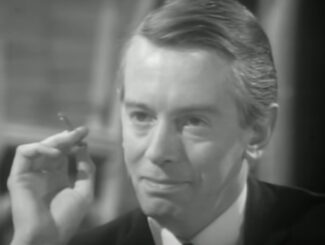 It was only after the years had passed and Kenneth had been reading much of what C.S. Lewis had written about Christianity that he became aware that in his darkest hour in 1948 that C.S. Lewis himself was going through a much darker hour. Doctors had become increasingly concerned with the deteriorating condition of Lewis’s heart (which would eventually fatally fail him in 1963). Added to this, Lewis was being heavily emotionally and financially taxed. His war-time vow to Paddy Moore to look after the late Paddy’s mother, Jane, if Paddy should die (which he did) was made all the more difficult because she had become an invalid needing of Lewis’s full-time care. As if this wasn't enough, C.S. Lewis’s live-in brother, Warnie, had become an alcoholic. The revelation of this dark season in Lewis’s life must have had a powerful impact on Kenneth Tynan as his health began to fail through the 1970s and eventually lead to his death in 1980. This is evident from that journal entry in 1975 where he wrote of C.S. Lewis, “He was a deeply kind and charitable man.”
Interestingly, although Tynan read most of what Lewis wrote – including all of his apologetic arguments God and Christianity – for it wasn’t these arguments that particularly impacted Tynan. It was, Tynan wrote, that “C.S.L. works as potently as ever on my imagination.” We also get a clue as to what was going through Kenneth Tynan’s mind when we read his diary entry, “As ever, I respond to his powerful suggestion that feelings of guilt and shame are not conditioned by the world in which we live but are real apprehensions of the standards obtaining in an eternal world.” It was thoughts like this from the writings of C.S.L. that Tynan didn’t always understand — but what he did understand was the vision that C.S.L. gave his imagination of goodness and beauty.
On July 26th, 1980 Kenneth Tynan died at the age of fifty-three. It was his last request for his body to be buried in the grounds adjacent to the College where C.S. Lewis was his tutor. In a note he left for his wife Kathleen he also included a sentence in French: Âme étonneée, et receuvez-vous dansle sein de votre miséricorde (“At the hour of my death, may You be the Refuge of my astonished soul, and receive it into Your merciful breast”).
At his funeral at Holy Cross Anglican church, Oxford, the rector, Austin Farrer remarked about the impact that C.S. Lewis had had on Kenneth. He said in his sermon that Lewis had an ability not merely to give proofs for God and His Kingdom, but Lewis had an ability to describe God and His Kingdom in a way that it felt like home and made his readers feel like it was their true home as well. At the graveside where Kenneth Peacock Tynan was buried his thirteen-year-old daughter, Roxana, read three sentences from C.S. Lewis’s last sermon, The Weight of Glory:
The books or the music in which we thought the beauty was located will betray us if we trust to them; it was not in them, it only came through them, and what came through them was longing. These things—the beauty, the memory of our own past—are good images of what we really desire; but if they are mistaken for the thing itself, they turn into dumb idols, breaking the hearts of their worshippers. For they are not the thing itself; they are only the scent of a flower we have not found, the echo of a tune we have not heard, news from a country we have never yet visited.
Jacobs, Alan. The Narnian: The Life and Imagination of C. S. Lewis (p. 314). HarperCollins. Kindle Edition.
Did Tynan respond to C.S. Lewis’s invitation to turn to Christ as his Lord? We may never know. But one thing we can be sure of is that the life, the character, and the devotion to Christ exhibited by C.S. Lewis who faithfully attended his local Anglican church every Sunday made a deep and lasting impression on the confused, lonely, and traumatised Kenneth Tynan. And, who knows? Every Sunday when your next-door neighbours see you leave to go to join your church family, what impact does it eventually have on them? Perhaps it might actually be having a deep impact? We can only wonder and imagine.
Your Pastor,
Andrew
Let me know what you think below in the comment section and feel free to share this someone who might benefit from this Pastor’s Desk.
Friday 8 March 2024
ADVICE WORTH MORE THAN GOLD OR A MOUNTAIN OF CASH ABOUT HOW TO USE REJECTION TO BECOME AN EVEN BETTER, WISER, STRONGER YOU!
 For several reasons I am qualified to help people deal with acute and chronic pain. Some acute and chronic pain can be resolved medically. Some pains can go a long way to being resolved with the help of a psychologist. Some pains can be resolved with a hug from mum. But there is a pain that a doctor cannot cure, a psychologist cannot counsel, a mother’s hug cannot alleviate. It is a pain that goes deep – beyond the defences of our integumentary system, our neurological system (including our para-sympathetic nervous system), our muscular system, our skeletal system, our lymphatic system, our renal system, gastro-intestinal system, our respiratory system, our cardio-vascular system, our hormonal system, and our half-share of a reproductive system. It is a pain that wounds: our memory, our sense of self, our estimation of our worth, our confidence, and our ability to connect meaningfully with others (our ability to love and be loved). It is the pain of rejection. It not only effects who we are (our identity) but it also leaches symptomatically into each of these ten-and-a-half biological systems which every human being possesses. I am going to offer all those who have experienced the pain of rejection how they can be healed from its wound, and actually become stronger, wiser, more confident, as a result.
A UNIVERSAL EXPERIENCE
We have, or will, all experience rejection. Rejection is painful. But its pain ranges from slight to intense depending why we are being rejected and by whom. Sales-people are trained to process rejection. Not every potential customer will buy. Good sales-people understand this (great sales-people learn from this). If you are a Christian, you and your message will be rejected (Matt. 5:11; 10:14). Mature Christians understand this and learn from it.
YOUR IDENTITY
Your identity does not come from those who reject you—and neither does it come from those who accept you! We are each created by God to belong to a community. This begins with our father and mother – biological family. It is this foundational connection with others that contributes to our identity. Sadly, not everyone is blessed with this kind of beginning. Yet, the truth still stands: Your identity does not come from those who reject you—neither does it come from those who accept you. Perhaps it will take years of processing for some to understand to this. In the meantime such vulnerable people are susceptible to the lie that their identity is defined by who accepts them.
THE PROBLEM WITH YOU IS…
In preparing couples for marriage I spend a lot of time with them helping them both to understand how to argue.This involves certain rules including: Identify the issue as the problem, not the person as the problem. This rule also goes to the heart of how to deal with rejection: Don’t confuse rejection based on your lack of abilities with rejection of you. One of the most powerful examples of this is the story of José Hernandez. He suffered rejection after rejection after rejection. But each time, and with great help later on from his wife, he was able to understand that he wasn’t being rejected – but his limited abilities for the task were being rejected. He then made a list of each of the criticisms he received as to why he was being rejected by NASA for their astronaut program and set about to gain each of the skills that NASA said he didn’t have. It is one of the greatest examples I can think of that illustrates how to process rejection in a healthy way.
YOU CAN NOT APPEAL TO EVERYONE
You could be the nicest, most caring, most loving, most helpful person in the world, and still be rejected! Jesus was.
He was despised and rejected by men,
a man of sorrows, and acquainted with grief;
and as one from whom men hide their faces
He was despised, and we esteemed Him not.
Isaiah 53:3
And He began to teach them that the Son of Man must suffer many things
and be rejected by the elders and the chief priests and the scribes and be killed,
and after three days rise again.
Mark 8:31
One of the most injurious things you can do to yourself is to begin to define who you are by what those who reject – or accept – you, say you are. Follow Christ’s example instead. His identity, who He truly was, came from His heavenly Father – and so does ours!
PROCESSING REJECTION AS THE PATHWAY TO BECOMING A BETTER, MORE CONFIDENT, WISER, STRONGER, YOU
Here are five principles for processing rejection well:
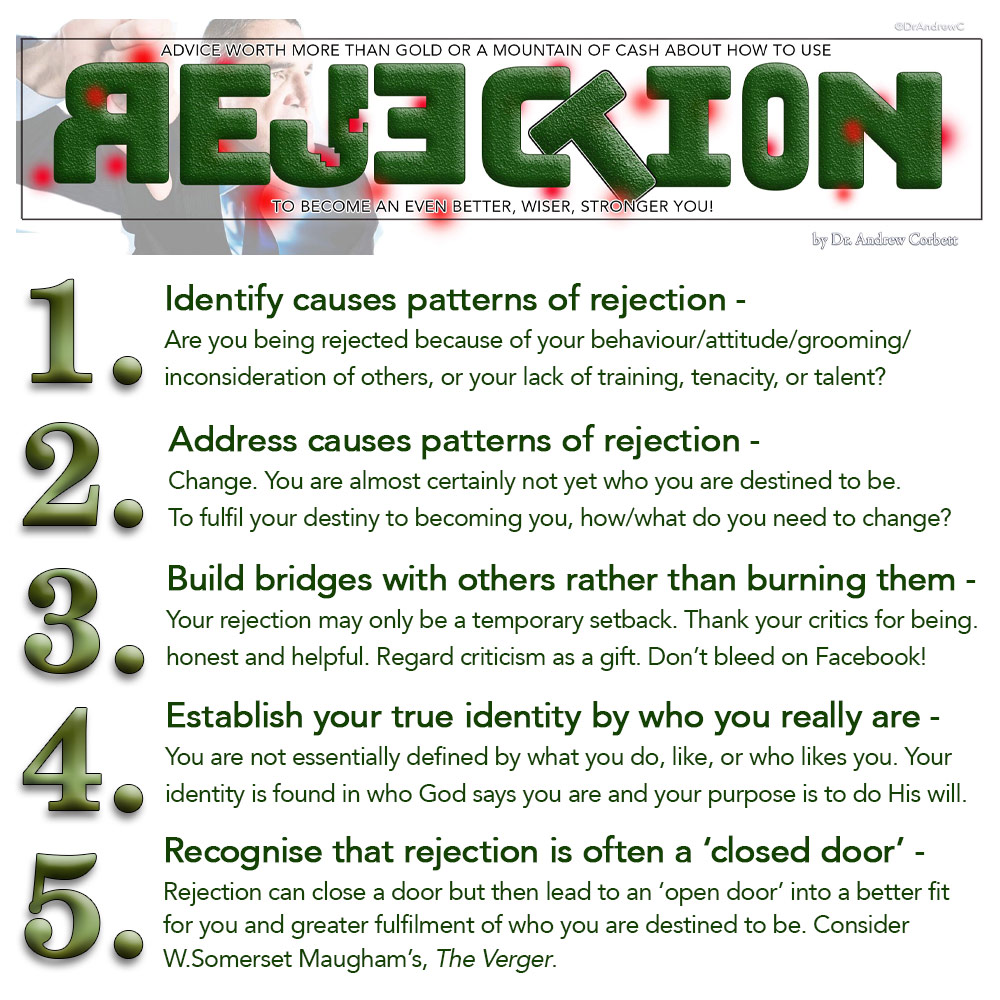
{Read W. Somerset Maugham’s THE VERGER}
There is of course one overarching principle that must also be employed to process rejection properly: forgiveness. It is one of the main ministries of a pastor to help people to firstly receive forgiveness, then secondly to extend it to others. The words of Christ in Matthew 6 which come immediately after The Lord’s Prayer should startle every unforgiving Christian. Sometimes the pain of rejection hurts so much that we forget these sombre words of Christ and the eternal jeopardy they forewarn:
¶ For if you forgive others their trespasses,
your heavenly Father will also forgive you,
but if you do not forgive others their trespasses,
neither will your Father forgive your trespasses.
Matthew 6:14-15
This warning comes from Jesus who has experienced rejection like none other:
He came to His own people, and even they rejected Him.
John 1:11 NLT
May God grant you the grace that you need to process rejection, to offer forgiveness and thereby grow wiser, stronger, more confident and become a better you.
Amen.
Your Pastor,
Andrew
Let me know what you think below in the comment section and feel free to share this someone who might benefit from this Pastor’s Desk.
Subscribe to:
Posts (Atom)