
By Dr. Andrew Corbett, 24 May 2026, from Melbourne, Victoria, Australia
I introduced this series with a claim. I claimed that the culminating reference in the creation account of Genesis 1, reveals that God created humans as the imago Dei, and established this as a predominant theme for the remainder of the Book of Genesis. Many Bible commentators have suggested that since Genesis 1 does not define the imago, the best that can be done to understand what the imago Dei means is to reason philosophically to what might be concluded are the consequences of being made in the image of God. That is, rather than the imago having any essence or ontological constitution, as is intimated in Genesis 2:7 (“then the LORD God formed the man of dust from the ground and breathed into his nostrils the breath of life, and the man became a living creature”), there has been a list of verbs made which describe how it is thought that humans are distinct from all other creatures and are to image God and resemble His likeness. Yet, if this is what defines the imago Dei then we have seen that the unfolding story of humanity throughout Genesis is a disappointing failure.
Genesis and the Disappearing God
As Genesis progresses two things are evident but not explicitly. The first one I have just reminded us of: human beings, created in the image of God, increasing these humans who called to reflect God’s goodness but mostly failed to do so.
The expectation at creation is that the creational intent of likeness to God
will increasingly become a reality in the lives of people. [57]
-John F. Kilner
Secondly, God’s interactions with humans seems to diminish as Genesis unfolds. God appears to become increasingly silent and distant. Brent Strawn cites two theologians, W. Lee Humphreys[58] and Jack Miles,[59] who have both written about their observations of this literary phenomena of God’s apparent recession throughout Genesis. Strawn notes that these two scholars both consider that the opening chapter’s establishment of the imago motif is a biblical bookend introduction – not merely one belonging to Genesis. They refer to other biblical characters such as Job and Nehemiah as exemplary examples of virtuous imagines who both experienced God’s direct intervention in their lives:[60]
These citations show that Humphreys thinks that the character God recedes in the course of Genesis a recession or removal that might be seen as a disappearance, gradual or otherwise, from the human scene. He is not alone, with Richard Elliott Friedman tracking the mystery of God’s disappearance in Scripture, and Jack Miles asking, at the conclusion of his own literary reading, does God lose interest?[62] In Miles own words:
The Lord God’s life in the Tanakh begins in activity and speech and ends in passivity and silence.
Why does this work take the form of a long decrescendo to silence?
Why does it, so to speak, begin with its climax and decline from there?[63]
Strawn disagrees with the conclusion of these two scholars about the Genesis 1:26-27 ‘ending bookend’ being absent from Genesis. His counter argument is that God does not increasingly disappear or become silent throughout Genesis because . Strawn’s thesis is that from Genesis 30, God is very imminent through the birth of Joseph and his rise to preeminence as the Governor of Egypt and the saviour of God’s chosen people.
Imagines are People of Peace
Brent Strawn notes that in the beginning, the human imagines are primordially nonviolent toward animals (1:29; 2:16; 9:4) and also, ideally, toward humans (9:5 6; cf. 4:10).[64] But as Genesis describes the spread of the imagines it corresponds to the spread of violence against fellow imagines. Rather than seeing God as absent, Strawn invites us to recognise that this is God responding to this unacceptable conduct by not being violent Himself. He concludes two points from this: first is the nonviolent nature of God’s activities and powers and how this nature may come to be in the imago Dei in humanity.[65] While we may despair that this seems unimaginable, Strawn contends that Genesis concludes by offering an imago as an exemplar of this divine nature. “When humans fail to image God rightly, there is usually a calling to account, which is often accompanied by a new strategy, as it were, in the divine plan.”[66]
When a Crisis Arises, God’s Answer is Always a Baby
In 1914 the most acclaimed Christian essayist, F. W. Boreham, wrote:
When a wrong wants righting, or a work wants doing, or a truth wants preaching, or a continent wants opening, God sends a baby into the world to do it. That is why, long, long ago, a babe was born at Bethlehem.
F W Boreham, ‘The Baby’ Mountains in the Mist (London: Charles H Kelly, 1914), 169.
As we consider how the imago has been presented throughout the book of Genesis to this point, we have seen that the imagines failed miserably to live up to their commission to be like God. But then, the observation of Dr. F. W. Boreham about God’s means of righting a wrong, ensuring that a work gets done, a truth needs preaching, “God sends a baby into the world.” This is why Genesis 30 makes a major turning point in the Genesis narrative.
“Or, again, there is the obedience of Abraham,
quite mixed at the start and at several points along the way,
but decisive, though devastating, in the end (Gen. 22:12).
And then there is Joseph.”
-Brent Strawn
¶ When Rachel saw that she bore Jacob no children, she envied her sister.
She said to Jacob, “Give me children, or I shall die!”
Jacob’s anger was kindled against Rachel, and he said,
“Am I in the place of God, who has withheld from you the fruit of the womb?”
Genesis 30:1-2
What becomes clearer about the imago Dei as the bible unfolds into the New Testament is that Jesus is the imago Dei. All human beings are created ‘in’ ‘according to’ the imago Dei – whereas Christ is the imago Dei. That’s the revelation that Joseph the son Jacob was a shadow of Christ and shared at least ten similarities to Him. Consider the following.
¶ Then God remembered Rachel, and God listened to her and opened her womb.
She conceived and bore a son and said, “God has taken away my reproach.”
And she called his name Joseph, saying, “May the LORD add to me another son!”
Genesis 30:22-24
The first thing we notice about Joseph was that his birth came about by divine intervention. This is similar to but not the same as Christ’s birth.
Now Israel loved Joseph more than any other of his sons,
because he was the son of his old age.
And he made him a robe of many colours.
Genesis 37:3
The second thing we notice about Joseph was that he was especially loved by his father. In the same, the Scriptures record that Jesus was especially loved by His Father also.
And a cloud overshadowed them, and a voice came out of the cloud,
“This is my beloved Son; listen to him.”
Mark 9:7
(But when his brothers saw that their father loved him more than all his brothers,
they hated him and could not speak peacefully to him.)
Genesis 37:4
The third thing we notice about Joseph was that he despised and rejected by his brothers. The Scriptures record that Jesus also was despised and rejected by His kin.
He was in the world, and the world was made through Him,
yet the world did not know Him.
He came to His own, and His own people did not receive Him.
John 1:10-11
The fourth thing we notice about Joseph was that he demonstrated a deep spirituality from his youth. As did Jesus as a youth.
(5)¶ Now Joseph had a dream, and when he told it to his brothers they hated him even more.
(6) He said to them, “Hear this dream that I have dreamed:
(7) Behold, we were binding sheaves in the field, and behold,
my sheaf arose and stood upright.
And behold, your sheaves gathered around it and bowed down to my sheaf.”
(8) His brothers said to him, “Are you indeed to reign over us?
Or are you indeed to rule over us?” So they hated him even more for his dreams and for his words.
(9) ¶ Then he dreamed another dream and told it to his brothers and said,
“Behold, I have dreamed another dream. Behold, the sun, the moon,
and eleven stars were bowing down to me.”
(10) But when he told it to his father and to his brothers, his father rebuked him and said to him,
“What is this dream that you have dreamed?
Shall I and your mother and your brothers indeed come to bow ourselves to the ground before you?”
And his brothers were jealous of him, but his father kept the saying in mind.
Genesis 37:5-10
As did Jesus as a youth:
(42) And when he was twelve years old, they went up according to custom.
(43) And when the feast was ended, as they were returning,
the boy Jesus stayed behind in Jerusalem. His parents did not know it,
(46) After three days they found him in the temple,
sitting among the teachers, listening to them and asking them questions.
(47) And all who heard him were amazed at his understanding and his answers.
Luke 2:42-47
The fifth thing we notice about Joseph was that he was taken to down Egypt (Gen. 37:18-28). Similarly, Jesus was also taken down to Egypt.
¶ Now when they had departed, behold, an angel of the Lord appeared to Joseph in a dream and said,
“Rise, take the child and his mother, and flee to Egypt, and remain there until I tell you,
for Herod is about to search for the child, to destroy him.”
And he rose and took the child and his mother by night and departed to Egypt
and remained there until the death of Herod. This was to fulfill what the Lord had spoken by the prophet,
“Out of Egypt I called my son.”
Matthew 2:13-15
Sixthly, we notice that Joseph was regarded as dead. In a similar way, after Jesus betrayed, crucified, and buried He was thought of as dead – except that He actually was!
Then Jacob tore his garments and put sackcloth on his loins and mourned for his son many days.
All his sons and all his daughters rose up to comfort him, but he refused to be comforted and said,
“No, I shall go down to Sheol to my son, mourning.” Thus his father wept for him.)
Genesis 37:34-35
Seventhly, we see that Joseph refused to yield to temptation.
(6) So he left all that he had in Joseph’s charge,
and because of him he had no concern about anything but the food he ate.
¶ Now Joseph was handsome in form and appearance.
(7) And after a time his master’s wife cast her eyes on Joseph and said, “Lie with me.”
(8) But he refused and said to his master’s wife,
“Behold, because of me my master has no concern about anything in the house,
and he has put everything that he has in my charge.
(9) He is not greater in this house than I am, nor has he kept back anything from me except you, because you are his wife. How then can I do this great wickedness and sin against God?”
(10) And as she spoke to Joseph day after day,
he would not listen to her, to lie beside her or to be with her.
(11) ¶ But one day, when he went into the house to do his work
and none of the men of the house was there in the house,
(12) she caught him by his garment, saying, “Lie with me.”
But he left his garment in her hand and fled and got out of the house.
Genesis 39:6-12
— as Christ also did.
(1)¶ Then Jesus was led up by the Spirit into the wilderness to be tempted by the devil.
(2) And after fasting forty days and forty nights, he was hungry.
(3) And the tempter came and said to him,
“If you are the Son of God, command these stones to become loaves of bread.”
(4) But he answered, “It is written,
“‘Man shall not live by bread alone, but by every word that comes from the mouth of God.’”
(5) ¶ Then the devil took him to the holy city and set him on the pinnacle of the temple
(6) and said to him, “If you are the Son of God, throw yourself down, for it is written,
“‘He will command his angels concerning you,’
¶ and “‘On their hands they will bear you up, lest you strike your foot against a stone.’”
(7) ¶ Jesus said to him, “Again it is written, ‘You shall not put the Lord your God to the test.’”
(8) Again, the devil took him to a very high mountain and showed him all the kingdoms of the world and their glory.
(9) And he said to him, “All these I will give you, if you will fall down and worship me.”
(10) Then Jesus said to him, “Be gone, Satan! For it is written,
“‘You shall worship the Lord your God and him only shall you serve.’”
(11) ¶ Then the devil left him, and behold, angels came and were ministering to him.
Matthew 4:1-11
The eighth thing we notice about Joseph is that minister to the captives in prison:
(6) When Joseph came to them in the morning, he saw that they were troubled.
(7) So he asked Pharaoh’s officers who were with him in custody in his master’s house,
“Why are your faces downcast today?”
(8) They said to him, “We have had dreams, and there is no one to interpret them.”
And Joseph said to them, “Do not interpretations belong to God? Please tell them to me.”
(9) ¶ So the chief cupbearer told his dream to Joseph and said to him,
“In my dream there was a vine before me, (10) and on the vine there were three branches.
As soon as it budded, its blossoms shot forth, and the clusters ripened into grapes.
(11) Pharaoh’s cup was in my hand, and I took the grapes and pressed them into
Pharaoh’s cup and placed the cup in Pharaoh’s hand.” (12) Then Joseph said to him,
“This is its interpretation: the three branches are three days.
(13) In three days Pharaoh will lift up your head and restore you to your office,
and you shall place Pharaoh’s cup in his hand as formerly, when you were his cupbearer.
(14) Only remember me, when it is well with you, and please do me the kindness to mention me to Pharaoh,
and so get me out of this house. (15) For I was indeed stolen out of the land of the Hebrews,
and here also I have done nothing that they should put me into the pit.”
(16) ¶ When the chief baker saw that the interpretation was favourable, he said to Joseph,
“I also had a dream: there were three cake baskets on my head,
(17) and in the uppermost basket there were all sorts of baked food for Pharaoh,
but the birds were eating it out of the basket on my head.” (18) And Joseph answered and said,
“This is its interpretation: the three baskets are three days.
(19) In three days Pharaoh will lift up your head—from you!—
and hang you on a tree. And the birds will eat the flesh from you.”
Genesis 40:6-19
– As did Jesus to those fallen heavenly beings held captive in a spiritual prison according to First Peter 3:19 :
(18) ¶ For Christ also suffered once for sins, the righteous for the unrighteous,
that he might bring us to God, being put to death in the flesh but made alive in the spirit,
(19) in which he went and proclaimed to the spirits in prison,
(20) because they formerly did not obey, when God’s patience waited in the days of Noah,
while the ark was being prepared, in which a few, that is,
eight persons, were brought safely through water.
First Peter 3:18-20
The ninth thing we notice about Joseph after he is released from prison is that his appearance was refreshed:
¶ Then Pharaoh sent and called Joseph, and they quickly brought him out of the pit.
And when he had shaved himself and changed his clothes, he came in before Pharaoh.
Genesis 41:14
– And in a similar after Jesus was released from the realm of the dead His resurrected body was also refreshed:
(13) ¶ That very day two of them were going to a village named Emmaus,
about seven miles from Jerusalem, (14) and they were talking with each other
about all these things that had happened. (15) While they were talking and discussing together,
Jesus himself drew near and went with them.
(16) But their eyes were kept from recognizing him. (17) And he said to them,
“What is this conversation that you are holding with each other as you walk?”
And they stood still, looking sad. (18) Then one of them, named Cleopas, answered Him,
“Are you the only visitor to Jerusalem who does not know the things that have happened there in these days?”
(19) And he said to them, “What things?” And they said to him,
“Concerning Jesus of Nazareth, a man who was a prophet mighty in deed and word before God and all the people,
(20) and how our chief priests and rulers delivered Him up to be condemned to death, and crucified Him.
(21) But we had hoped that he was the one to redeem Israel.
Yes, and besides all this, it is now the third day since these things happened.
(22) Moreover, some women of our company amazed us. They were at the tomb early in the morning,
(23) and when they did not find His body, they came back saying that they had even seen a vision of angels,
who said that He was alive. (24) Some of those who were with us went to the tomb and found it just as the women had said,
but Him they did not see.” (25) And He said to them, “O foolish ones, and slow of heart to believe all that the prophets have spoken!
(26) Was it not necessary that the Christ should suffer these things and enter into his glory?”
(27) And beginning with Moses and all the Prophets, He interpreted to them in all the Scriptures the things concerning himself.
(28) ¶ So they drew near to the village to which they were going. He acted as if he were going farther,
(29) but they urged him strongly, saying, “Stay with us, for it is toward evening and the day is now far spent.”
So he went in to stay with them. (30) When he was at table with them,
He took the bread and blessed and broke it and gave it to them.
(31) And their eyes were opened, and they recognized Him. And He vanished from their sight.
Luke 24:13-31
The tenth thing we notice about Joseph is that after he had been unduly punished he was highly exalted to be the governor of Egypt.
(41) And Pharaoh said to Joseph, “See, I have set you over all the land of Egypt.”
(42) Then Pharaoh took his signet ring from his hand and put it on Joseph’s hand,
and clothed him in garments of fine linen and put a gold chain about his neck.
(43) And he made him ride in his second chariot. And they called out before him,
“Bow the knee!” Thus he set him over all the land of Egypt. (44) Moreover,
Pharaoh said to Joseph, “I am Pharaoh, and without your consent no one shall lift up hand or foot in all the land of Egypt.”
Genesis 41:40-44
Similarly, after Christ was unduly punished for our sins He was highly exalted:
(9) Therefore God has highly exalted Him and bestowed on Him the name that is above every name,
(10) so that at the name of Jesus every knee should bow, in heaven and on earth and under the earth,
(11) and every tongue confess that Jesus Christ is Lord, to the glory of God the Father.
Philippians 2:9-11
And, the final thing we notice about Joseph is that showed mercy and grace to his brothers after they had bowed in surrender before him:
(15) ¶ When Joseph’s brothers saw that their father was dead, they said,
“It may be that Joseph will hate us and pay us back for all the evil that we did to him.”
(16) So they sent a message to Joseph, saying, “Your father gave this command before he died:
(17) ‘Say to Joseph, “Please forgive the transgression of your brothers and their sin, because they did evil to you.’”
And now, please forgive the transgression of the servants of the God of your father.”
Joseph wept when they spoke to him. (18) His brothers also came and fell down before him and said,
“Behold, we are your servants.” (19) But Joseph said to them, “Do not fear, for am I in the place of God?
(20) As for you, you meant evil against me, but God meant it for good,
to bring it about that many people should be kept alive, as they are today.
(21) So do not fear; I will provide for you and your little ones.”
Thus he comforted them and spoke kindly to them.
Genesis 50:15-21
Similarly, Christ shows mercy and grace to all who humbly approach Him in surrender:
(15) For we do not have a high priest who is unable to sympathize with our weaknesses,
but one who in every respect has been tempted as we are, yet without sin.
(16) Let us then with confidence draw near to the throne of grace,
that we may receive mercy and find grace to help in time of need.
Hebrews 4:15-16
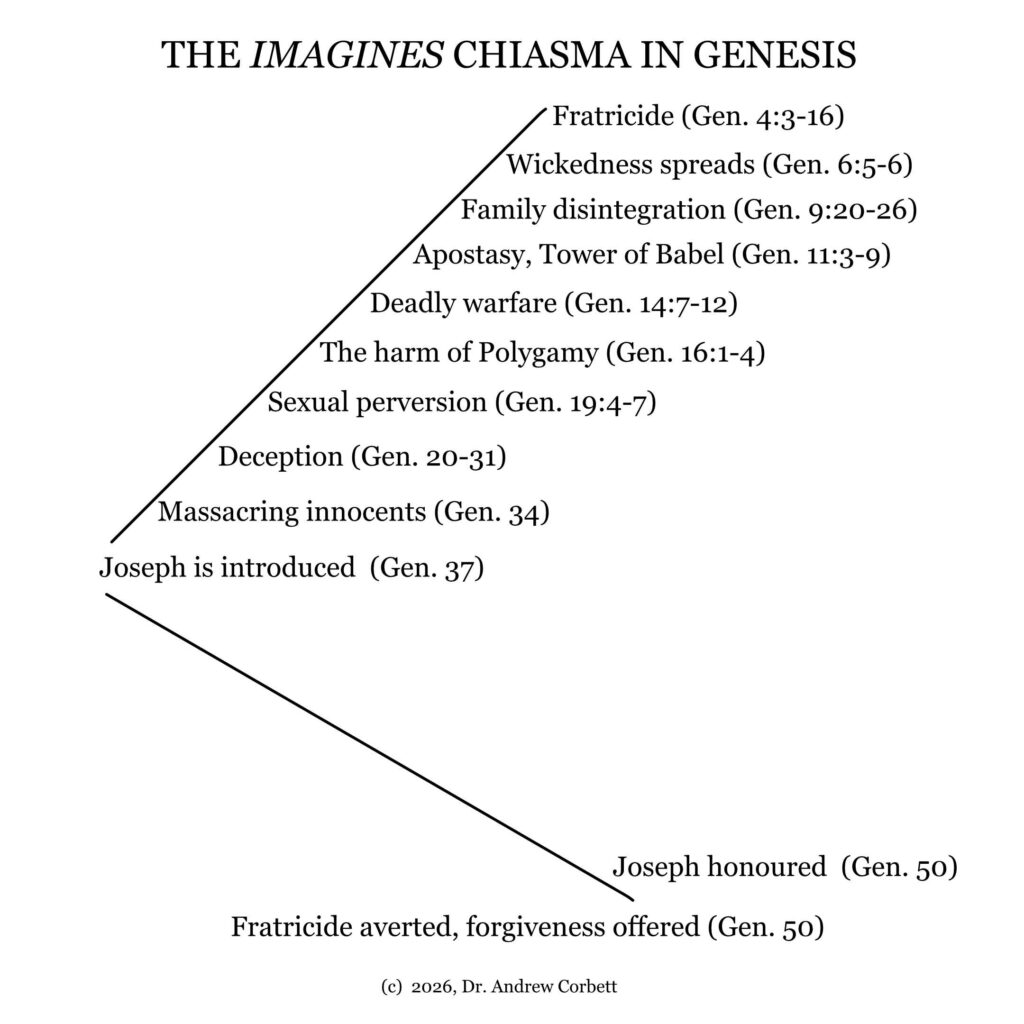
In this way Genesis bookends its introduction about humankind being created in the imago Dei – with Joseph as the preeminent example of what an imagine can look like: faithful to God, filled with the Spirit, kind to others, and humble. These are the virtues that all imagines should, by the grace of God and the strength of the Holy Spirit, strive to live like. And Christ offers you His mercy and grace still. You may feel a million miles away from GOD, but because of what His Son, Jesus Christ — The True Imago Dei has done — you are now just one prayer away from living your life as an imagine of God.
Amen.
© 2026 Dr. Andrew Corbett, writing from Melbourne, Victoria.
Article 1 | Article 2 | Article 3 | Article 4 | Article 5 | Article 6
__________________________________
[57] John F. Kilner, Dignity and Destiny: Humanity in the Image of God (Grand Rapids, MI; Cambridge, U.K.: William B. Eerdmans Publishing Company, 2015), 131.
[58] W. Lee Humphreys, Emeritus Professor Religious Studies, The University of Tennessee, KnoxvilleTN. and author of, The Character of God in the Book of Genesis: A Narrative Appraisal. Louisville: Westminster John Knox, 2001
[59] Jack Miles, won the 1996 Pulitzer Prize for his book, God: A Biography. New York: Alfred A. Knopf, 1995.
[60] Arnold B. T., ed. The Cambridge Companion to Genesis. Brent A. Strawn, Chapter 10, “From Imago to Imagines: The Image(s) of God in Genesis,” 211-235. (Cambridge, UK: Cambridge University Press; 2022), 225-26.
[61] [fn.58 in Strawn] Humphreys, Character, 237, 240, 246, and 271 n. 1. Humphreys’s identification of this literary movement is correct (e.g., 254), but his interpretation of why it is present (i.e., why God would self-remove) is unconvincing to my mind. I hold the same judgment for Miles. See further below.
[62] [fn. 59 in Strawn] See Richard Elliott Friedman, The Disappearance of God: A Divine Mystery (Boston: Little, Brown & Company, 1995); Miles, God, 397 408. The idea precedes both Friedman and Miles; see, e.g., Erich Fromm, You Shall Be as Gods: A Radical Interpretation of the Old Testament and Its Tradition (New York: Henry Holt, 1991 [1966]).
[63] Miles, God, 402. Miles goes on to posit both Job (404: “God s most perfect image”) and Nehemiah (406: “the perfect reflection, the comprehensive self-image, the quasi incarnation”) as images of God.
[64] There are further exhibits of divine nonviolence: God does not execute capital punishment on the first human couple, despite their transgression (Gen 2:17), neither does God take Cain s life (4:15). In both of these cases, the Deity spares the offenders, proving both patient and merciful. Brent A. Strawn, Chapter 10, “From Imago to Imagines: The Image(s) of God in Genesis,” 211-235. Cambridge University Press; 2022, 222. https://doi.org/10.1017/9781108529303.010.
[65] See Jerome F. D. Creach, Violence in Scripture, Interpretation (Louisville: Westminster John Knox, 2013), 26: to bear God’s image means not to act imperialistically and coercively. More extensively, see Middleton, Liberating Image.
[66] Arnold B. T., ed. The Cambridge Companion to Genesis. Brent A. Strawn, Chapter 10, “From Imago to Imagines: The Image(s) of God in Genesis,” 211-235. Cambridge University Press; 2022, 227-28. https://doi.org/10.1017/9781108529303.010
[67] Arnold B. T., ed. The Cambridge Companion to Genesis. Brent A. Strawn, Chapter 10, “From Imago to Imagines: The Image(s) of God in Genesis,” 211-235. Cambridge University Press; 2022, 228. https://doi.org/10.1017/9781108529303.010

