Saturday, 22 May 2021

THE BUSY FOOLS’ ARGUMENT WITH THE BUSY WISE

 THE BUSY FOOLS’ ARGUMENT

WITH THE BUSY WISE

Been busy?” I’m not sure if women get asked this question as often as men do (although my guess is that women more frequently ask, “How have you been?” more than they ask “Have you been busy?”). The ‘busy question’ seems to be a badge of honour for men—especially when they stick to the unwritten script and respond with either option A (“Yeah, flat out!”) or option B (“Yeah, I’ve been {insert details here}!”). Even retired men still refer to the modified retirement script with variations of the “Since I’ve been retired, I’ve never been busier!” response. As a student and practitioner of the art of busy I have discovered that there is a type of being busy that is worthwhile and there is another type that is not – but its practitioners are convinced that it is. 


THE DOWNSIDE OF BUSY

But busy has its downside. When people are always filling their schedules and adding to their To-Do lists, they run the spiritual risk of neglecting the godly discipline of ceasing their normal activity and resting. This is the basis of the principle of  the sabbathCeaserest from normal activity, breathecontemplate (declutter your mind), worshipre-focus on Godreset, and remember. If you have heard  Pastor Phil Hills preach as often as I have, you would know that he often repeated his ministry maxim (and even though he is retired, I’m sure he still repeats it), “We work from rest rather than resting from work!” What Pastor Hills was affirming the principle of treating the sabbath as a spiritual discipline. This is something that the unwisely busy should consider. It is also why they should consider attending church each Sunday as a spiritual discipline that should not be neglected. 

So then, there remains a Sabbath rest for the people of God…And let us consider how to stir up one another to love and good works, not neglecting to meet together, as is the habit of some, but encouraging one another, and all the more as you see the Day drawing near.
Hebrews 4:910:24-25


A DIFFERENT TYPE OF BUSY

Most of us are aware that someone can be busy but not productive. Those who are highly productive often don’t appear to be as busy as the busy-yet-not-productive. These highly-productive-and-busy people have learned to incorporate rest into their lifestyles — but their moments of apparent idleness should not be interpreted as a inefficiency. I recently learned an amazing example of ‘apparent idleness’ being essential for productivity when I took a course on how the brain works. What I discovered was that before we had the technology to measure brainwave activity, we used to think that when we slept, our brain also took a break. But it turns out that when we “idly” go to sleep (especially when we reach REM sleep) our brain is actually hard at work reorganising its information and deepening its long-term memory which ends up helping us to think more clearly when we awake. That’s why you can go to sleep at night with an unsolved problem on your mind and then wake up knowing what the solution is.  Added to these scientific insights, we know from Scripture that God frequently gets people’s attention while they slept.

But God came to Laban the Aramean in a dream by night and said to him, “Be careful not to say anything to Jacob, either good or bad.”
Genesis 31:24

Coincidentally, those who are unwisely busy often regard sleep as a waste of time. They brag about only needing four hours sleep a night even though their restless brains need at least seven hours to do their nightly routine properly.


RECRUITING BUSY WISE LEADERS

I’ve been thinking through for many years what it would take to see Christ’s Great Commission fulfilled in our valley-city. In 2007 I gathered some of the key Christian leaders for a meeting and posed just one question for discussion: If we could fulfil Christ’s Great Commission in our valley-city, what would it look like? Each of these busy leaders were committed to fulfilling the Great Commission in our valley, but not many of them had thought about what it would end up looking like. The problem with not having a clear vision of what you’re trying to achieve is that it can lead to unproductive busyness. The more I’ve thought about it, the clearer the picture has become to me. And the clearer the picture has become to me, the clearer pathway has also become. This pathway involves strong and united local churches. It involves a commitment to evangelism and multiplication discipleship. It involves sharing a common objective that gives the Christians of our city the courage to be bold witnesses. And it involves outside help from those those who are gifted to assist us. Thus, when I was approached by the Billy Graham Evangelistic Association with an offer to come to our city and help us — at no cost to us (!) — I was very keen to be involved. The result has been the birth of the Tasmania Celebration journey. At this point in the journey we are now recruiting and appointing various coordinators for the key responsibilities involved. Each of these coordinators, without exception, are already busy. On Thursday morning this week I met with a prospective team member who told me that he was too busy to be involved and was already serving on seven executive boards. I said, “Good! We only want busy people on our team!” I went on to explain what I meant and I will now try and explain it to you…


THE PARABLE OF THE BUSY WISE

 “Then the Kingdom of Heaven will be like ten bridesmaids who took their lamps and went to meet the bridegroom. Five of them were foolish, and five were wise. The five who were foolish didn’t take enough olive oil for their lamps, but the other five were wise enough to take along extra oil. When the bridegroom was delayed, they all became drowsy and fell asleep. ¶ “At midnight they were roused by the shout, ‘Look, the bridegroom is coming! Come out and meet him!’ ¶ “All the bridesmaids got up and prepared their lamps. Then the five foolish ones asked the others, ‘Please give us some of your oil because our lamps are going out.’ ¶ “But the others replied, ‘We don’t have enough for all of us. Go to a shop and buy some for yourselves.’ ¶ “But while they were gone to buy oil, the bridegroom came. Then those who were ready went in with him to the marriage feast, and the door was locked. Later, when the other five bridesmaids returned, they stood outside, calling, ‘Lord! Lord! Open the door for us!’ ¶ “But he called back, ‘Believe me, I don’t know you!’”
Matthew 25:1-12 NLT

This parable highlights the difference between the foolish and busy, and the wise and busy. The foolish bridesmaids were busy doing things that didn’t matter. They were ignoring their primary responsibilities in the midst of their busyness. The wise bridesmaids took their responsibilities seriously and tended to their oil-lit lamps by securing adequate oil for their lamps. Their busyness was focused on doing what they were supposed to be doing. When it became obvious to the foolish bridesmaids that they had neglected their responsibilities they resorted to blaming the wise bridesmaids for not giving them some of their lamp oil. What we can learn from the busy and wise bridesmaids is that productive work involves: planning, preparation, persistence, and prayerfulness. Prayerfulness? Interestingly, at the end of this parable Jesus sums up its point with an injunction for His followers to ‘watch’ – which is a term used for praying (Matt. 26:41).

Watch therefore, for you know neither the day nor the hour.
Matthew 26:41

The busy-wise bridesmaids were commended and honoured for their diligent work by being admitted to the wedding feast and seated at the head table with the bride and groom. All followers of Christ must know that we are not saved from our sins because of our efforts. Our salvation, redemption, and divine adoption are gifts of God’s grace through the merit of Christ’s finished work of atonement. 

For by grace you have been saved through faith. And this is not your own doing; it is the gift of God, not a result of works, so that no one may boast.
Ephesians 2:8-9

And all followers of Christ must know that this same grace enables us to be busy-wise in the service of Christ and His Church.

For we are His workmanship, created in Christ Jesus for good works, which God prepared beforehand, that we should walk in them.
Ephesians 2:10

We need not sit in the waiting-room of Christ’s servants as if Jesus is yet to figure out what we are to do! Christ prepares beforehand the tasks that He wants His followers to do. Yield to Christ and you will soon find Jesus opening doors of service. Don’t immediately expect these doors to be particularly big or likely to gain you much attention or even appreciation. (It would be worth noting the parable immediately following the ten bridesmaids parable in Matthew 25:15-28 where the point is faithfulness rather than fame.) As we examine each of Christ’s last parables retold by Matthew in chapter 25 we are struck by Christ commending His faithful followers to be wisely busy in His service. And for those who don’t feel that their ability to serve Christ and His Church is particularly glamorous you should take heart in Christ’s appreciation for those who feed the hungry, clothe the naked, visit the shut-ins (and prisoners), tend to the ill and sick, and show hospitality to strangers (Matt. 25:35-36).

For I was hungry and you gave Me food, I was thirsty and you gave Me drink, I was a stranger and you welcomed Me, I was naked and you clothed Me, I was sick and you visited Me, I was in prison and you came to Me.’
Matthew 25:35-36

What makes our busyness wise busyness? It’s when our busyness is doing what Christ wants for the reasons that He wants it done. It’s when we are busy without neglecting the priorities of spiritual disciplines and our obligations to those we are responsible to and for. This is why, when Christ calls someone to take on a greater responsibility in His Kingdom it is almost certain that they are already busy. I am not at all suggesting that a Christ-follower needs to be frenetic in their busyness for Christ, or that they should never sabbath (two points I have tried to make clear in this Pastor’s Desk by contrasting the busy wise with the busy foolish). But I am hoping that those who have been following and serving Christ for some seasons will recognise the doors of opportunity that Christ will enable them to walk through wisely. And as they do, and we do together, may we begin to see glimpse of the Great Commission being fulfilled in our valley-city.

Your pastor,


Andrew

Let me know what you think below in the comment section and feel free to share this someone who might benefit from this Pastor’s Desk.

Friday, 14 May 2021

IN LIGHT OF ETERNITY


Do you remember the biggest problem you faced when you were 9 years-old? Unless you had a traumatic event take place at that time, chances are that you can’t. The problems that we had to deal with when we were children seemed enormous at the time and probably resulted in many frustrating tears. But years later, looking back, they more than likely now look either trivial or long-forgotten. Actually, you probably don’t even have to try and recollect back to your childhood to now see the problems you had just a few years or even months ago in a different light which now makes them look a lot smaller than they appeared at the time. The passage of time tends to give us a different perspective on life and our priorities.

¶ have been young, and now am old,
yet have not seen the righteous forsaken
or his children begging for bread.
Psalm 37:25

TAKING A LONG-TERM VIEW

It’s difficult when you’re young to think too much about the future. When we’re young we tend to focus on the now. On the other hand, when you’re old it’s too easy to look back over the years of your youth with a host of “If only” regrets. If only I’d…saved my money…listened to my parents…gone to university…said yes…said no…not eaten so much…learned the piano…made more time with those I care about… You can tell when a person has become wise by how they regard their future. A wise person will always take a long-term view of their life. It’s not that they don’t make mistakes now, or even seem to waste time or money occasionally. A wise person takes a long-term view of their life and adjusts their perspective on their present challenges accordingly.

The plans of the diligent lead surely to abundance,
but everyone who is hasty comes only to poverty.
Proverbs 21:5

LIFE IS SHORT

The other week I saw a childhood schoolfriend of one of my children whom I hadn’t seen for quite a while. Four days or so after I had seen him I received a phone call from one of his other friends that on the weekend their mutual schoolfriend had been killed in an horrific accident. Today, someone came to see me to tell of a friend of theirs whose child had committed suicide this week. Both of these lives ended tragically and prematurely. When we say, “Life is short” –  it’s easy to think of such youthful tragedies. But the reality is, everyone’s life is short!

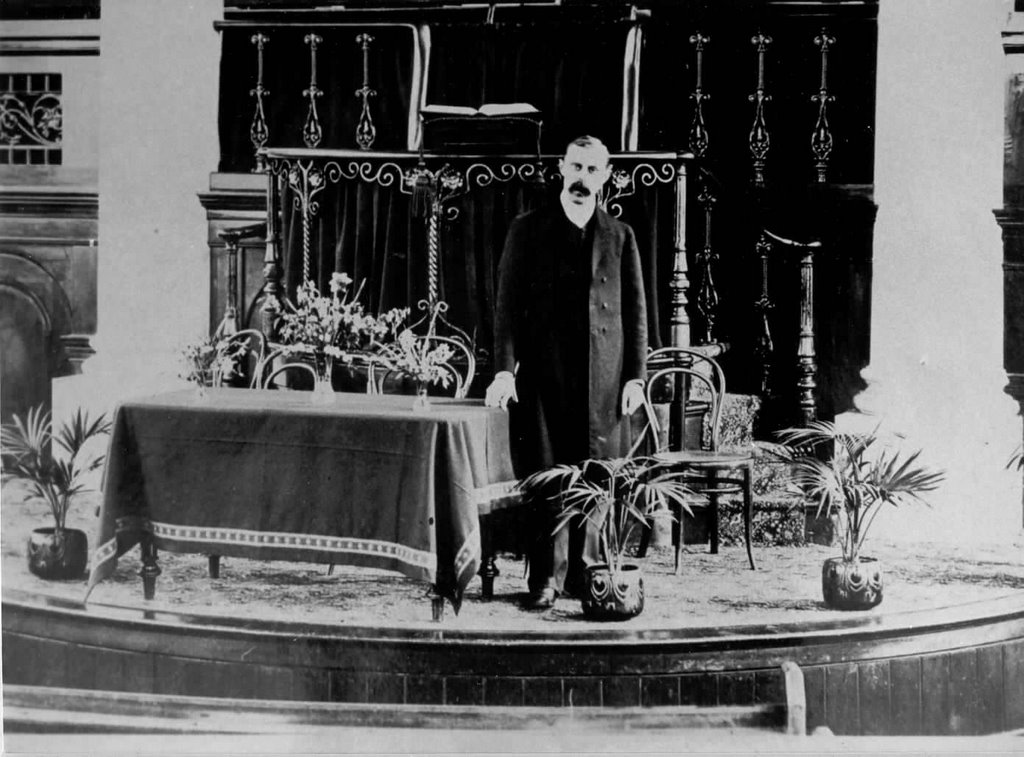
F.W. Boreham in 1908 in Hobart Baptist Church where he was the pastor

F.W. Boreham in 1908 in Hobart Baptist Church where he was the pastor

My hero, F.W. Boreham, was fond of writing in series. He wrote a five volume series on Texts That Changed The World that became a best-seller and still inspires millions of people even today. When he turned 40, he began to write a series in which the first instalment was entitled, On Turning Forty. He wrote the second instalment when he turned 50. He wrote the third when he turned 60. He wrote the fourth when he turned 70, and he wrote his last when he turned 80. As he got older he increased his reflections on some of his regrets. Even though he was one of the world’s most acclaimed preachers and Christian authors – whose books have possibly led thousands to Christ – he said that he had one big regret toward the end of his life and career as a preacher. “I did not preach enough about God!” he lamented. To be sure, he had preached about God’s deeds and acts, the attributes of God’s grace and love, and other peripheral topics associated with the doctrine of God, but he felt great sorrow that he had not preached more about God himself! If only, he said, if only I had presented God for who He truly is then surely more people would have come to see Him as the most beautiful being in the universe whose magnificence and wonderfulness would melt the hardest heart and soften the most resistant. His regret spurs me on to make sure that I know who God truly is and love Him for who He truly is and serve Him because He is who He is. And I daren’t waste a moment in this holy quest because life is short.

¶ A voice says, “Cry!”
And I said, “What shall I cry?”
All flesh is grass,
and all its beauty is like the flower of the field.
The grass withers, the flower fades
when the breath of the LORD blows on it;
surely the people are grass.
Isaiah 40:6-7


IN THE END

As F.W. Boreham approached the end of his life, he longed to know God more richly and deeply. This was also the quest of the apostle Paul as he approached his end. He wrote to the Philippians from a jail cell. Even though it appears that he held out hope for an early release from his imprisonment after he was to be brought before Caesar, this hope was not realised.

Indeed, I count everything as loss because of the surpassing worth of knowing Christ Jesus my Lord. For His sake I have suffered the loss of all things and count them as rubbish, in order that I may gain Christ and be found in Him, not having a righteousness of my own that comes from the law, but that which comes through faith in Christ, the righteousness from God that depends on faith—that I may know Him and the power of His resurrection, and may share His sufferings, becoming like Him in His death.
Philippians 3:8-10

“That I may know Him!” Fancy that! The apostle who was struck from his horse by the radiant glory of Christ while on the Persecutor’s Road to Damascus; the apostle whom the resurrected Christ appeared to in a vision and spoke directly to him (Acts 18:9-10); the apostle whom Christ used to raise people from the dead and to heal many people miraculously; and, the apostle who testifies that he was caught up to heaven and saw things too wonderful to reveal — this apostle gets toward the end of his life and states that he doesn’t yet know Christ the way he should! This apostle, the apostle Paul, toward the end of his life begins to see his life and his troubles in the light of eternity. And I am thus assured that in this light many of the problems that we face today will fade from our gaze and vanish as we fix our eyes on the Source of eternity’s Light.

For what will it profit a man if he gains the whole world and forfeits his soul? Or what shall a man give in return for his soul?
Matthew 16:26


Your pastor,

Andrew

Let me know what you think below in the comment section and feel free to share this someone who might benefit from this Pastor’s Desk.

Friday, 7 May 2021

WHY EXCUSES CAN BE BAD, REALLY BAD, FOR YOUR SOUL

I happened to walk past a TV when there was one of those quiz game-shows on. The compere’s question was,  “What is the most common excuse?” The most common answer was, “Sorry I can’t come, I’m not well.” There are variations of this excuse that most of us always use, especially if you’re a parent. The propensity to make excuses for things we don’t want to acknowledge or accept dates back to Adam. When God visited the Garden of Eden just after Adam and his wife Eve had betrayed God, the first thing that Adam did was to make an excuse by blaming Eve. It seems that from the beginning, when people have resisted God’s will, they have made excuses for it. Perhaps this is why Jesus addressed excuse-making directly in His parables. As we read His parables we can not miss His frustration at human excuse-making and must wonder why He was just so frustrated?

But he said to him, “A man once gave a great banquet and invited many. And at the time for the banquet he sent his servant to say to those who had been invited, ‘Come, for everything is now ready.’ But they all alike began to make excuses. The first said to him, ‘I have bought a field, and I must go out and see it. Please have me excused.’ And another said, ‘I have bought five yoke of oxen, and I go to examine them. Please have me excused.’ And another said, ‘I have married a wife, and therefore I cannot come.’
Luke 14:16-20

This parable reveals the heart of God; and, Christ was telling us how upset His Father feels when people make excuses in response to His gracious invitation to dine with Him. But this is not the end of the parable. 


THE ESSENCE OF AN EXCUSE


The essence of an excuse is the word, no. If we get invited to a party that we don’t to go to and we make a polite excuse to decline the offer, in essence we are saying “No, I will not come to your party.” This is the gist of the parable that Christ told in Luke 14 about His Father who sent His Son as His Servant to personally invite those who had already received an invitation to come to a great banquet. (It’s interesting how Jesus describes His Father’s heaven as a great banquet.) By saying “No” to the great banquet invitation those who were declining this invitation were saying that they had a better offer. What offer could be better than dining with the Source of Life, Joy, Peace, and Power, as His special guest in His luxurious mansion? What happens next in this parable also says a lot about how God feels when people make excuses to decline His offer to dine.

So the servant came and reported these things to his master. Then the master of the house became angry and said to his servant, ‘Go out quickly to the streets and lanes of the city, and bring in the poor and crippled and blind and lame.’ And the servant said, ‘Sir, what you commanded has been done, and still there is room.’ And the master said to the servant, ‘Go out to the highways and hedges and compel people to come in, that my house may be filled. For I tell you, none of those men who were invited shall taste my banquet.’”
Luke 14:21-24


IT SEEMS THAT SOME EXCUSES CAN BE HARMFUL TO YOUR SOUL

People sometime ask, “How could a good, loving God send anyone to Hell?” Perhaps we might respond with a better question (and one easier to answer), “Why would any rational, reasonable, person decline God’s offer of eternal forgiveness, bliss, supreme joy and fulfilment, and salvation from eternal condemnation — and willingly choose to experience the consequences of their rebellion against God forever and ever?” I’ve even heard of people who have made the excuse that they cannot accept God’s offer, because the consequences of not doing so sound so incredibly unfair! But the truth is, this is an extremely weak excuse because in reality the only consequence that is incredibly unfair is God’s offer of eternal life/forgiveness/joy/peace/happiness/adoption! This offer is incredibly unfair in our favour! Why unfair? Because fairness has to do with deservedness (it’s only fair that you get what you deserve). But God’s offer is infinitely unfair because none of us deserve it! We have done nothing to deserve it. We can do nothing to deserve it. We are in fact undeserving of it! The Bible calls this unfairness, grace. Someone who was profoundly effected by God’s grace, wrote this-

¶ For while we were still weak, at the right time Christ died for the ungodly. For one will scarcely die for a righteous person—though perhaps for a good person one would dare even to die—but God shows His love for us in that while we were still sinners, Christ died for us. Since, therefore, we have now been justified by His blood, much more shall we be saved by Him from the wrath of God. For if while we were enemies we were reconciled to God by the death of His Son, much more, now that we are reconciled, shall we be saved by His life.
Romans 5:6-10

Of course, some excuses are quite reasonable. Your priorities should help you to determine which of two invitations involving the same time-frame you should accept and which one you have to therefore decline. If you’re invited to your child’s wedding at the same time as someone has invited you for a coffee, hopefully you’ll excuse yourself from going for coffee. But your highest priority should determine your highest quest. Our highest quest must be to please and know the God who made us for Himself. In C.S. Lewis’s classic book, Mere Christianity, he concludes by discussing man’s greatest quest – 

It is even doubtful, you know, whether the whole universe was created for any other purpose. It says in the Bible that the whole universe was made for Christ and that everything is to be gathered together in Him…What we have been told is how we men can be drawn into Christ – can become part of that wonderful present which the young Prince of the universe wants to offer to His Father – that present which is Himself and therefore us in Him. It is the only thing we were made for.
Excerpt From: Lewis, C.S. “Mere Christianity.” Apple Books.

And for those whose best excuse for not accepting God’s lavish offer of eternal life and bliss is that God did not reveal Himself to them, you might need to come up with a better one based on what God has said in Romans 1 – 

For His invisible attributes, namely, His eternal power and divine nature, have been clearly perceived, ever since the creation of the world, in the things that have been made. So they are without excuse…Therefore you have no excuse!
Romans 1:202:1a


Your pastor,

Andrew

Let me know what you think below in the comment section and feel free to share this someone who might benefit from this Pastor’s Desk.
Friday, 9 April 2021

SOMETHING FOR SLUGGARDS (AND THE REST OF US) TO CONSIDER

 SOMETHING FOR SLUGGARDS (AND THE REST OF US) TO CONSIDER

¶ Go to the ant, O sluggard;
consider her ways, and be wise.
Proverbs 6:6

It seems to me that when God wants something done, He calls a busy person to do it. There was a time, not that long ago, where most people were busy by default. All of their time and efforts from sun-up to sun-down were spent just trying to survive. But as our civilisation and its economy developed and we increasingly mechanised tasks done by people working manually. This advancement in an economy comes with many benefits. Rather than everyone simply trying to provide for the basics of life, they can now focus on those things that also advance and the well-being of a society. This includes education, the arts, leisure, health-care, and sport. It also allows for people to specialise and focus on, their trade, skill or profession so that they no longer have to grow their own crops or graze their own cattle for milk or meat. Theoretically, it therefore means that people have more time to do things other than work such as those just listed. Yet, rather than being less busy, many people are busier than ever and often these busier-than-ever people feel they are not necessarily getting much done. This general busy-ness has presented challenges for those of us who work in the not-for-profit volunteer sector who rely on the availability of volunteers to help run their organisations and think the Proverbial ant might have something for us to consider about this.

Without having any chief, officer, or ruler, she prepares her bread in summer and gathers her food in harvest.
Proverbs 6:7-8


TWO TYPES OF BUSY

I’m involved with a big project that involves leaders from other churches around our city. None of these people have time to spare and especially do not have time to waste. Each of them are busy people. They each bring a set of skills and a connection with a network of others that is enabling us to plan and manage one of the biggest city-wide Christian celebrations in the history of Launceston. In observing each of these leaders in this newly formed team, I notice that while they are each busy, and already involved in their own major projects, they are still able to manage to contribute their time into this joint effort. This has helped me to realise that there are two types of busy. We have already introduced the busy person who doesn’t seem to get much done, and now I have introduced a different type of busy person who does seem to be able to get done what needs to be done.

¶ Four things on earth are small, but they are exceedingly wise: the ants are a people not strong, yet they provide their food in the summer;
Proverbs 30:24-25


PRODUCTIVE AND BUSY


Busy-yet-productive people are like ants in many ways. They have learned how to use their time efficiently and effectively. Like ants, they have learned how to work independently and with others. Like ants, in doing this they seem to be lift objects above their own body weight, and when they work with other similarly busy-yet-productive people, they can do so in ways that seem to defy the laws of physics. Nearly all (if not actually all) of these busy-yet-productive people are people who have been stretched and along that journey have come to realise two important things about being busy-yet-productive:

  1. Focus on the important rather than the urgent.

  2. Remember the Sabbath to keep it holy.

Busy-frantic people get caught up in the urgent instead of focusing on the important. Busy-yet-productive people nearly always commence their weeks with a plan — they carry a diary which contains their weekly to do lists and they hold themselves accountable to it. They seem to make time for the important as a priority over the urgent. This is why #2 is actually a restating of #1 — they sabbath. They make the setting aside of time from their usual activity to sabbath. They recognise the importance of sabbathing and what it involves – worshiping God with God’s assembled people, prayerfully surrendering to God, allowing the preached Word to wash and renew their soul, and physically/mentally resting.

For we are His workmanship, created in Christ Jesus for good works, which God prepared beforehand, that we should walk in them.
Ephesians 2:10


CONSIDER ANTS

The Book of Proverbs warns against laziness and instructs readers to consider the ant (Prov. 6:6). In considering the ant we notice that they always live within a colony (a community). Within that colony they each have assigned roles (a purpose). Together they pool their efforts to achieve a common goal (a mission). They intuitively plan and prepare for the future so that they can leave a legacy. They go about their work methodically which seems to resemble good training (a work ethic). No wonder God tells us to consider the ant! Their example is a great benchmark for how a society, a community, and a church is to function. As we read through the New Testament instructions for Christian living we read some very “ant-like” directives for believers-


Rather, speaking the truth in love, we are to grow up in every way into Him who is the head, into Christ, from whom the whole body, joined and held together by every joint with which it is equipped, when each part is working properly, makes the body grow so that it builds itself up in love.
Ephesians 4:15-16

When we yield to Christ our desires and priorities are transformed. Just as the ant is created by God to “know” what they are to do, the believer finds himself or herself having their will shaped by God resulting in a desire to work for the benefit of others.

for it is God who works in you, both to will and to work for His good pleasure.
Philippians 2:13

The ant-like nature of a Spirit-filled believer is most evident in two ways: their attitude and their supernatural strength to serve. Note these two aspects of a busy-yet-productive believer-

Whatever you do, work heartily, as for the Lord and not for men, knowing that from the Lord you will receive the inheritance as your reward. You are serving the Lord Christ.
Colossians 3:23-24


GOD ALWAYS STRENGTHENS THOSE HE STRETCHES

There are those who look busy but are not very productive. There is a difference between riding a rocking-horse and riding a horse! There are those who are busy yet are highly productive because they’ve learned to work like an ant which involves managing that their time is focused on (i) maintaining their important relationships, (ii) taking regular sabbaths, (iii) prioritising the important over the urgent, and (iv) cooperating with others. These busy people have learned to recognise God’s open doors and have confidence that the Apostle Paul had – that it is God who gives them supernatural energy to toilstruggle and work to get things done when no-one else thought it possible. If you want to stop being busy and become busy-yet-productive, then learn these lessons from the ant!

For this I toil, struggling with all His energy that He powerfully works within me.
Colossians 1:29


Your pastor,

Andrew

Let me know what you think below in the comment section and feel free to share this someone who might benefit from this Pastor’s Desk.