Showing posts with label ecclesiology. Show all posts

Thursday, 5 June 2025

ECCLESIOLOGY Part 11 - DEVELOPING A HEALTHY CHURCH CULTURE


Every local church has a culture. Culture is a sociological term. It encompasses what a community regards as: proper, acceptable, and honourable. Sociologists refer to these as morēs. Conversely, culture conveys what is: not proper, not acceptable, and is disgraceful and shameful. Sociologists refer to this negative behaviour as deviant. Culture celebrates what a community regards as important, and, what it frowns on. Every local church as a culture, but sometimes that culture is not entirely healthy. In this instalment in the Ecclesiology series, I am sharing some of the insights that we deal with in my church leadership seminar.


WHAT HEALTHY CULTURE ACHIEVES

The other week I saw a YouTube video of a Western tourist in Japan who showed a video of passengers on a Tokyo train. The passengers sat in an orderly fashion and were seated in silence. The tourist wondered if there was a Japanese law requiring the passengers to sit silently on the train. He found out that there was not. The reason the Japanese passengers sat on the train in silence was due to their culture. They didn’t need to be told to sit quietly – they just knew that it was the proper thing to do. This kind of positive culture is something any local church can achieve, if it works on the following two principles.

When I Kim and speak at a church for an extended weekend it is our mission to serve that church community and to help them to be even more effective in their mission to reach their community. This involves sharing on a Friday night with their youth or young adults about relationships; then sharing on a Saturday morning with Kim speaking to the ladies and myself speaking to the men; then a mid-morning leadership seminar with Board members/elders/team leaders;  a Saturday night dinner with the pastor/s elder/s; and on Sunday sharing in the morning service/s followed by an open (for anyone attend) Q&A luncheon. In the church leaders’ seminar we look at what makes for a healthy church. It is in this interactive seminar that we discuss the elements of what makes for a positive culture in a church. In essence, from my study, and the feedback we have received from these seminars, I can reduce what is needed are these two factors: firstly, the leader, and secondly, the attitude of the church.   


1. THE INDISPENSABLE RÔLE OF THE LEADER

The leader of a local church may be identified as the elder, pastor, senior pastor, senior minister, rector, or even the leader. Their title is not necessarily a critical issue. What is indispensable though is that they lead. It simply can not be overstated just how important their role is. The leader carries the weight of responsibility for the tone of a local church’s culture. It is not only the leader’s preaching which contributes to their culture-setting. It is their example –

  • How they treat people, how they deal with interruptions,
  • How they speak to their spouse and child/ren,
  • How they interact with their staff and/or volunteers,
  • How they manage their time,
  • How they admit their mistakes,
  • How they take correction,
  • How they deliver correction,
  • How they respond to tragedy,
  • How they they open their home to show hospitality,
  • How how they use those who are better than them,
  • What they laugh at – or – what they get angry at, and,
  • How they strive to improve their strengths and weaknesses. 


2. THE ATTITUDE OF THE CHURCH

While the leader is ultimately responsible for teaching sound doctrine and to exposit the Scriptures, as critically essential as this, it is not enough to ensure a positive and healthy church culture. It must be supplemented with a demonstrated explication of sound doctrine and the Scriptures. That is, a preacher can be a brilliantly powerful preacher who is an amazing teacher of God’s Word – but this is almost irrelevant if this preaching and teaching is not reflected in their godly attitude. When a leader consistently models a godly attitude it has an incalculably positive effect on their church’s attitude. Therefore, the senior leader must preach, teach, and model the biblical description of a godly attitude. This description is found in Colossians 3:12-17.

(12) ¶ Put on then, as God’s chosen ones, holy and beloved, compassionate hearts, kindness, humility, meekness, and patience,
(13) bearing with one another and, if one has a complaint against another, forgiving each other; as the Lord has forgiven you, so you also must forgive.
(14) And above all these put on love, which binds everything together in perfect harmony.
(15) And let the peace of Christ rule in your hearts, to which indeed you were called in one body. And be thankful.
(16) Let the word of Christ dwell in you richly, teaching and admonishing one another in all wisdom, singing psalms and hymns and spiritual songs, with thankfulness in your hearts to God.
(17) And whatever you do, in word or deed, do everything in the name of the Lord Jesus, giving thanks to God the Father through Him.
COLOSSIANS 3:12-17

If I was to list these attitude qualities, and then ask you, “How would you feel if your church was described by others as:

+  Compassionate

+ Kind

+ Humble

+ Meek

+ Patient

+ Forebearing

+ Forgiving

+ Loving

+ Harmonious

+ Peaceful

+ Thankful

+ Biblically literate

+ Wise

+ Prayerful and Pious (worshipful)

+ Sincere and holy?

Conclusion: The Gospel informs us that a culture can change. People can change. But what is needed are champions of cultural change who embrace the Church’s God ordained charge to be counter-cultural. When there is a champion of change – and better still – a champion team of change – building a healthy culture within a church is absolutely possible. And as this culture continue to be pursued I suspect that there will be many people who will be attracted to this church’s Christ-fragrance. Please pray that it does!

Amen.


Complementary Audio Podcast

Saturday, 1 March 2025

ECCLESIOLOGY Part 9 - PROBLEMS AND GROWING PAINS

Ecclesiology Part 9 - the relationship of problems to growth
 

I suspect most church leaders want their churches to numerically grow. Such church growth, though, is often elusive to many church leaders. While there is no guaranteed formula for achieving numerical church growth, there are certainly well-established ways for a local church not to grow (which I will refer to shortly). There are some churches that experience rapid growth then, just as rapid, experience decline - and are often bewildered as to why. Perhaps it is not true in every instance, but often this happens because of how these churches process problems. That is, churches which are ill-prepared for dealing appropriately with problems inevitably will probably experience numerical decline. This is why every church which is seeking to sustainably grow numerically must know how to process problems in a healthy way.


SEEING PROBLEMS DIFFERENTLY

The late David Cartledge told me something quite counter-intuitive about what was the measure of a good leader: 

The measure of a leader is determined by the size of the problems they solve!” 

I have never forgotten this gem of wise insight from Dr. Cartledge. This comment has significantly helped me to grow as a leader and to view problems quite differently. Rather than seeing problems as roadblocks, hindrances, distractions, or setbacks - I began to understand the relationship between problems and the growth of a leader. (Every parent understands this problem:growth relationship as they help their young children grow into adults as they help them to learn how to deal with increasingly complex life problems.) By viewing problems as an opportunity for growth, a leader can then approach these problems with the aim of resolving them rather than retreating from them. By seeking to resolve a problem a leader becomes teachable and open to learning new solution strategies. This leads to him or her becoming more equipped to deal with similar but bigger problems next time.

I have noticed that when a church leader stresses too readily over minor setbacks or disappointments, the confidence placed in them by those they lead tends to be diminished. Similarly, when a volunteer, team or department leader is confronted with a problem which is overwhelming them - and their senior pastor shows them how to solve that problem wisely, their confidence in the senior leader grows. Thus, dealing with problems, rather than avoiding or denying them,  is essential if a leader and his or her church wants to grow. However, the problem:growth relationship is also inversely relative...    

Dr. Andrew Corbett speaking at a church leaders conference in Queensland on how to make wise decisions


GROWTH CREATES NEW PROBLEMS!

It’s almost like the classic problem of which came first - the chicken or the egg? Not only does solving problems within a church potentially lead to numerical growth, numerical growth creates problems! The first (and ongoing growth problem) is resistance to change. An anglican church growth consultant used the analogy of retail businesses to illustrate this growth problem. 

1. Consider the mum and dad corner-store. In Australia these used to be called milk bars. They sold bread, milk, newspapers, cold drinks, a few essential grocery items, and confectionary. These stores would have a regular number of customers from around the neighbourhood. The store owners knew many of these customers by name. Churches with up to 70 regular attendees are run like these corner-stores.

2. The independent hardware store. These stores may be privately owned by one owner, but will have a few staff also employed. The owner is known by those who shop in his store, and he knows some of them by name. Churches with 100 to 180 regular attenders are like these stores where there is a senior minister who also employs one or two part-time assistants.

3. The department store. These are larger stores which sell a variety of goods that are organised into departments. The manager of the store is probably not the owner and therefore is not personally known by the customers. There could be around 20 or more employees with some of them working as department managers. Churches with 200 - 700 regular attenders are like these stores where most congregants do not deal directly with the senior minister but do have a pastoral relationship with assistant pastors who oversee a department of the church. 

4. The Shopping Centre. These are the largest retail expressions where nearly everything that is ordinarily sold, is available for purchase. These shopping centres include large department stores, specialty stores, entertainment, dining, and comfortable environs and décor. Customers do not generally know who the centre manager is - and probably do not mind this. Their concern is that they can comfortably shop and get what they want when they want it. These centres cater for people from all backgrounds, ages, and tastes. Churches with a regular attendance of 2,500 - 5,000+ are often like these shopping centres (and are referred to as “mega churches”. The senior minister is probably a gifted orator whose preaching/teaching is what attracts people to the church's Sunday services. But this is also supplemented by professional level worship singers and musicians, a well-run concurrent children's program, professional quality multi-media presentations, and clearly defined discipleship pathways which enable people to get involved and utilise their gifts and ministries. 

Dr. Andrew and Kim Corbett's farewell service at Legana Christian Church, September 2024

Consider these four scales of church growth and consider the challenges that would have been encountered by those leading in #1 to grow to the size of #2. Imagine the circumstances where this growth may have been foisted upon the mum and dad because of overwhelming customer growth and demand. It is not too difficult to imagine that this mum and dad may have been overwhelmed and decided to sell their small business to someone who was not overwhelmed by the prospect of this growth - in fact, the new owner may even look forward to the challenge of restructuring this business so that it could grow. This is a scenario faced by many type #1 churches and pastors.


CONCLUSION

No matter what type of church it is, problems will arise and need to be wisely dealt with. As church leaders and churches grow, commensurate problems will arise. These problems should not thought of as unusual. Consider the narrative through the Book of Acts. In nearly every chapter there is a problem > solution > growth pathway.

Note the problem which led to the initial restructuring of the church's leadership and ministries:

Acts 6:1Now in these days when the disciples were increasing in number, a complaint by the Hellenists arose against the Hebrews because their widows were being neglected in the daily distribution.

Acts 6:3 Therefore, brothers, pick out from among you seven men of good repute, full of the Spirit and of wisdom, whom we will appoint to this duty. Acts 6:4 But we will devote ourselves to prayer and to the ministry of the word.”

Problems force us to humble ourselves and seek the help, assistance, and advice of others. This is an important ingredient in growing stronger. While prayer is essential and important for solving overwhelming problems, too many pastors deny themselves the means of growth that is derived from wise and godly counsel because of pride - or perhaps, ignorance. If you want your church to grow it begins with a willingness to seek it and to be transformed by God's Spirit so that it can happen — which means this growth will commence in you first! I encourage you to seek the kind of growth that strengthens you in wisdom, knowledge and character. And this can only begin to happen when a leader is committed to humbly following Christ and heeding His Word.  

I welcome your feedback below.


Saturday, 2 November 2024

ECCLESIOLOGY Part 1 - SOME SAY CHURCH, BUT I SAY ECCLESIOLOGY

WE NEED TO TALK MORE ABOUT ECCLESIOLOGY 


Ecclesiology is the study of the Church. The reason we need to talk more about ecclesiology is that many people are involved in a church - or even leading a church - and yet they don’t know what GOD intends for a church to be. In the next few posts I will discuss the purpose of a church, the structure of a church, the importance of the assembling of a church, the mission of the church, the ministries of the church, and the propagation of the church. 

I am a student of the Church. Some of my earliest memories involve being in church. In fact, I have no recollection of never going to church on a Sunday. But, before I was a teenager, I knew that I was increasingly bored during the church services. On one occasion, I came up with an ingenious idea on how to get out of going to church. The idea came to me when I realised that if a car's battery went flat, the car could not start. I then reasoned, that if, on a Saturday, if I went to our family car and opened the car’s glove box - so that the little glovebox light would stay on, then, by Sunday morning, the car’s battery would probably become flat by then! The result would be that I wouldn’t have to go to church that Sunday. The next day, my younger brother and sister and I got into the family car to go off to church as usual. Only I knew that the car would not be able to start. But alas. It did start! And off to church we went. My plan had been foiled. Never again would I attempt such a less than genius plan. In fact, it wouldn’t be too long before going to church became one of my greatest delights.  


THE DAY CHAPPO TURNED UP

Before I was fifteen years of age, my church experience involved going into an old, dark building with a huge timber cathedral ceiling held together by hundreds of massive metal bolts. In the duller moments of the church service I would attempt to count the number of these bolts, but never successfully. Then one day, my world changed. The minister, Rev. Peter Payne, invited Canon John Chapman, from Sydney, to be the guest speaker. He spoke in a way that I had never heard anyone speak. He had my attention. Even though I had been going to church all of my life, I had never heard anyone speak like John Chapman. He obviously also had an impact on my parents too because, from that moment, my parents, and that means “we”, all went to church Sunday morning and evening services! 


When I turned 15 after the visit of Canon John Chapman, I went through the preparation for Confirmation. I met with Rev. Payne one-on-one as he unpacked the implications of the gospel. He asked me read Paul's Epistle to the Romans. I did so using the Living Bible, a recent paraphrase by Kenneth Taylor. By the time I finished reading Romans, my heart was transformed and my eyes were opened. Perhaps it was the seeds sown by John Chapman's recent visit, or the pastoral care and discipleship by the prayerful Peter Payne, or the careful reading of Paul's Epistle to the Romans, but the process of preparing for Confirmation was turning point in my life. In the ensuing years I was to have several more turning points, and with each turning point, I was to grow in my understanding of what a ‘Church’ was. The next turning point for me, and for my parents, was how the church seemed to force Peter Payne to leave our church.


WHO IS THAT PREACHER?

I was  probably too young to understand what had happened to Rev. Peter Payne after I was Confirmed. As far as I can recall, he was apparently “too evangelical”. At the time, I didn’t know what evangelical meant, but whatever it meant, it had apparently upset some of the members of the vestry to the extent that they wanted Rev. Payne to leave.

I cannot recall any message that Peter Payne preached. As I said earlier, I do recall Rev. Payne speaking to me during the Confirmation preparation. I also recall him coming around to our home to see my parents who were facing some challenges. Interestingly, it was a few years later, after I had begun the voracious habit of listening to audio cassettes from Bible teachers from the Christian Cassette Lending Library (New South Wales), that I found another cassette in our lounge room that I couldn't identify. I listened to it and was very impressed with the calibre of preacher. In fact, he was amazing. I wanted to hear more from this incredible preacher. I took the cassette out to have a closer look at it for any identification of who this preacher might be. To my astonishment, it was the Reverend Peter Payne! All those years of Sundays that I sat in the church when he was preaching there, and I couldn’t hear him! But after listening to him on that cassette, I realised what I must have actually been missing out on while I sat there during his sermons. Instead of listening, I had been trying to count wooden truss bolts! As a preacher this discovery has taught me the importance of ‘demanding’ that people listen to what I have prepared for the good of their soul in what I am preaching. This is one of the reasons why I have never read my notes during the sermon.

Murray Harkness

CONFIRMATION TO PENTECOST

The first time I visited a Pentecostal church was a Sunday night down the Bellarine Peninsular. My dad had been introduced to a Christian businessman, Murray Harkness, who was also a lay pastor of a small Pentecostal church. I was only 16-years old. My earliest memories of church was the church that I was confirmed in. Therefore, for most of my 16-years, I had only experienced a liturgical church. But this  little Ocean Grove Pentecostal church had no organ, no prayer book, no priest, no choir, and no order of service! I was well and truly out of my comfort zone. I suspect that Murray must have suggested to my parents that if they wanted to go to a Pentecostal church, there was one in downtown Geelong (instead driving all the way out to Ocean Grove). And this is how we came to become a part of the oddly named, Apostolic Church. The contrast between the church I grew up compared with the church that I fell into for nearly 5 years, contributed to my later fascination with what the bible prescribed for what constituted a church. This eventually led to a quest - a quest to understand as much as I could about Christ's plan for His Church. This is how I became a student of the Church and therefore the study of ecclesiology. If you're interested, I have things to share about what constitutes ‘a church’ in the next few posts. 

And Jesus answered him, “Blessed are you, Simon Bar-Jonah! For flesh and blood has not revealed this to you, but my Father who is in heaven. And I tell you, you are Peter, and on this rock I will build my church, and the gates of hell shall not prevail against it. I will give you the keys of the kingdom of heaven, and whatever you bind on earth shall be bound in heaven, and whatever you loose on earth shall be loosed in heaven.”

MATTHEW 16:17-19


Saturday, 24 June 2023

THE STORY GOD IS STILL WRITING

I want to tell you a story. This is a story that you and I are a part of. It was Aristotle who said that every good story has a beginning, a middle, and an end. This story has a beginning, a middle, but its end is yet to happen. Despite its Aristotelian deficiency, this is still a good story. It begins in a mountain top royal garden. The seeds used by the royal gardener included those which produced trees of various kinds, some fruiting some ornamental, vegetables, shrubs, grape vines, flowers of wondrous colours, two sacramental trees as the large centre-pieces, and seeds of ideas that would take millennia to be realised. One of those ideas would be about you. This is the story I want to tell you when one of those most precious idea seeds finally generated. It begins around A.D. 30.


¶ Blessed be the God and Father of our Lord Jesus Christ,
who has blessed us in Christ with every spiritual blessing in the heavenly places,
even as He chose us in Him before the foundation of the world,
that we should be holy and blameless before Him.
In love He predestined us for adoption to himself as sons through Jesus Christ, according to the purpose of His will.
Ephesians 1:3-5

The seeds of God’s plan were sown in the Garden of Eden, but the one which was central to His entire plan was: that His eternal Son would, at just the right time (Gal. 4:4), enter our world as a newborn baby (Gen. 3:15Isa. 7:149:61Pet. 1:20) to be our Saviour (Isa. 53). And then He and His Father would send the eternal Holy Spirit into our world to establish and oversee the Church that Jesus Christ would take as His Bride (Eph. 5:23Rev. 19:7). This foundational Edenic seed was germinated on the Day of Pentecost, described in Acts 2. And this is where we will jump ahead to in our story…


¶ When the day of Pentecost arrived, they were all together in one place.
And suddenly there came from heaven a sound like a mighty rushing wind,
and it filled the entire house where they were sitting.
And divided tongues as of fire appeared to them and rested on each one of them.
And they were all filled with the Holy Spirit and began to speak in other tongues as the Spirit gave them utterance.
Acts 2:1-4


Around AD 30, on the Day of Pentecost, the promised Holy Spirit was “poured out” and the New Testament church was birthed. After the apostle Peter had preached to the massive crowds that had travelled from around the world for this Jewish festival, 3,000 people were converted to Christianity (Acts 2:41). Gatherings of new Christians then formed in the homes of new Christians who lived in and around the walled city of Jerusalem where the teachings of Christ and the messages that He had entrusted to His apostles was shared. These new believers would also gather together regularly in a precinct of the Temple to be taught by the apostles. 

And day by day, attending the temple together and breaking bread in their homes,
they received their food with glad and generous hearts,
praising God and having favour with all the people.
And the Lord added to their number day by day those who were being saved.
Acts 2:46-47

The early Church grew rapidly. But with growth there are always growing pains. And the fledgling Church now had to deal with several serious conflicts…


There was not a needy person among them,
for as many as were owners of lands or houses sold them
and brought the proceeds of what was sold and laid it at the apostles’ feet,
and it was distributed to each as any had need.
Acts 4:34-35

The Church now had a relief ministry which was funded by the great generosity of its wealthier members. But this led to two immediate and dangerous problems. The first was that some wealthy donors were giving with very deceptive motives. In Acts 5 we are told of two such donors who were disciplined by the apostle and the Holy Spirit for their deception (Acts 5:1-10). This result was felt by all the Church.

And great fear came upon the whole church and upon all who heard of these things.
Acts 5:11

But what started out as a good initiative, the distribution of food and aid to those in need, soon became the cause of another conflict in the Church. 

¶ Now in these days when the disciples were increasing in number,
a complaint by the Hellenists [non-Israeli, Greek speaking,
Jewish converts to Christianity] arose against the Hebrews
because their widows were being neglected in the daily distribution.
Acts 6:1

Again, rapid growth of the Church caused further growing pains. Every problem which is solved in life, as well as within a church, leads to further growth. In this instance the apostles realised that they were not the solution. They needed ‘to stay in their lane’ – that is, they needed to keep doing what God had called them to do and let others called to deal with this particular problem be a part of the solution. In this instance the apostles appointed ministers (Greek word, diakonēo from where our word deacon comes from) to practically resolve this food distribution complaint (note that those they selected had Greek [Hellenist] names).

And the twelve summoned the full number of the disciples and said,
“It is not right that we should give up preaching the word of God to serve tables.
Therefore, brothers, pick out from among you seven men of good repute,
full of the Spirit and of wisdom, whom we will appoint to this duty.
But we will devote ourselves to prayer and to the ministry of the word.”
And what they said pleased the whole gathering, and they chose Stephen,
a man full of faith and of the Holy Spirit, and Philip, and Prochorus, and Nicanor,
and Timon, and Parmenas, and Nicolaus, a proselyte of Antioch.
Acts 6:2-5

Growth and success always stirs up sinful attitudes amongst those prone to violate the 10th Commandment – do not covet. The envy of the Jewish religious authorities toward the growth of the Church would create the next greatest problem for the early Christians to deal with: persecution.

Acts church persecution begins


¶ And Stephen, full of grace and power, was doing great wonders and signs among the people.
Then some of those who belonged to the synagogue of the Freedmen (as it was called),
and of the Cyrenians, and of the Alexandrians, and of those from Cilicia and Asia,
rose up and disputed with Stephen.  But they could not withstand the wisdom and the Spirit with which he was speaking.
Then they secretly instigated men who said, “We have heard him speak blasphemous words against Moses and God.”
And they stirred up the people and the elders and the scribes,
and they came upon him and seized him and brought him before the council,
and they set up false witnesses who said, “This man never ceases to speak words against this holy place and the law.
Acts 6:8-13

Stephen, one of the seven original deacons of the Church, faithfully shared the truth of the gospel with these religious leader before whom he was tried and then executed as a martyr (Acts 7:57-60). But as he was being martyred while kneeling, he cried out to God to forgive his persecutors and one of those in charge of this execution was profoundly affected by what Stephen did (Acts 7:60—8:1).  

But Saul was ravaging the church, and entering house after house,
he dragged off men and women and committed them to prison.
Acts 8:3

Far from slowing or stopping the rapid growth of the Church, this wave of persecution actually helped to accelerate it! Christians were scattered from Jerusalem out to the far-flung corners of the Empire and everywhere they went they preached about Jesus (Acts 8:4). And then a strange thing happened, the chief persecutor of the Church, Saul of Tarsus, was dramatically converted to Christianity!  And the impact of his conversion to Christ is why we are Christians today!

Now as [Saul] went on his way, he approached Damascus, and suddenly a light from heaven shone around him. And falling to the ground, he heard a voice saying to him, “Saul, Saul, why are you persecuting me?” And he said, “Who are you, Lord?” And he said, “I am Jesus, whom you are persecuting. But rise and enter the city, and you will be told what you are to do.”
Acts 9:3-6
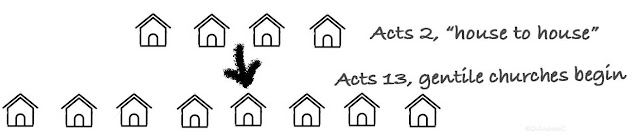


It was always Christ’s intention that His Church be a global Church for people from all nations (Matt. 28:18-20Acts 1:8). When Saul (a Jewish name) changed his name to Paul (a gentile Roman name) the Church began to experience not just growth, but massive multiplication and expansion. Under the apostle Paul’s leadership, gentile churches were planted across the Empire and established in Roman households (which housed quite large family networks with additional servants and stewards). These householder-led family homes provided a ready-made leadership structure for these new churches and provided a stepping stone into the Church’s next stage of growth and globalisation. The apostle Paul would even describe each local church as being a household yet connected with the other churches around the world through adhering to common leadership and doctrine and being built upon Christ and His Word.

So then you are no longer strangers and aliens,
but you are fellow citizens with the saints and members of the household of God,
built on the foundation of the apostles and prophets, Christ Jesus Himself being the cornerstone,
in whom the whole structure, being joined together, grows into a holy temple in the Lord.
In Him you also are being built together into a dwelling place for God by the Spirit.
Ephesians 2:19-22


In the second century, the Church continued to expand across the Empire through the ready-made leadership structure and influence of householders. After the death of the apostles, regional bishops were considered their replacements. Through the ensuing centuries, the bishops would hold several important council meetings whereby statements were formulated or agreed to which several are now referred to as creeds (from the Latin, creedo, which means I believe). These ecumenical (applies to all churches) creeds include: the Nicene Creedthe Apostles’ Creed, and the Athanasian Creed. Then, around AD 312, the would be Emperor of Rome, Constantine, won a decisive military battle which led to him in AD 324. He credited this victory to a dream he had about placing the “chi-rho” cross as an emblem of Christianity on each of his army’s shields. He then secured the Empire under his control after he defeated his contender, Licinius. “In that position … he could now enforce ‘One God, One Emperor, One Church’” (WORLD HISTORY ENCYCLOPAEDIA). 

According to Christian historian Eusebius, the troubled Constantine sought help in prayer to his father’s god.
Constantine then had a vision of a cross of light emblazoned against the sun and saw the words

In hoc signo vinces: “In this sign you will win.” Constantine ordered the monogram of Christ to be painted on his soldiers’ shields.
When he later engaged Maxentius, Constantine won a decisive victory.
CHRISTIAN HISTORY INSTITUTE, David F. Wright

With Emperor Constantine’s conversion to Christianity, an era known as Christendom commenced. Constantine then endowed churches to pay for ministers, build churches and basilicas, and have some bureaucratic roles in his government. But over time this lead to people becoming bishops or bureaucrats who sought power and glory for themselves rather than Christ.  

Church Expansion Through the Centuries


13th-17th_Centuries-Reformation


Pay careful attention to yourselves and to all the flock,
in which the Holy Spirit has made you overseers, to care for the church of God,
which he obtained with his own blood.
I know that after my departure fierce wolves will come in among you, not sparing the flock;
and from among your own selves will arise men speaking twisted things, to draw away the disciples after them.
Acts 20:28-30

The Medieval period is sometimes referred to as the Dark Ages predominantly because much of the Church had become politicised and led by men who did not know God. In this period when the ‘light’ of Christ’s Church largely went dark, God raised up various men and women who remained faithful Christ and His Word.

THE REFORMATION BEGINS

Englishman, John Wycliffe (14th century) is referred to as the Morning Star of the Reformation. He translated the New Testament into English which made it accessible to common people. Later, William Tyndale (15th century) translated the entire Bible into English. Meanwhile, in Italy, Dominican Friar, Girolamo Savonarola (late 15th century) began to publicly preach against the wickedness of the Church’s corrupt bishops and called people to repentance and to turn to faith in Christ. In Germany, another monk, Martin Luther (16th century), had discovered through his lectures to his students from Paul’s Epistle to the Galatians, that the Roman Church had actually been teaching things that did not agree with the Bible. In France, John Calvin (16th century) was inspired by Luther’s sermons and lectures to search the Scriptures for himself and found that much of what the Pope had been promoting was contrary to God’s Word. Then some time after this, Count Nicolaus Ludwig Reichsgraf von Zinzendorf (17th century), the founder of the Herrnhuter Brüdergemeine Christian mission, and leader of what became the Moravian brotherhood, rediscovered what it meant to be a Spirit-filled and Spirit-empowered missionary to those who had never heard of Christ. He played a significant role in leading the Anglican minister, John Wesley (18th century), to Christ. During the Wesleyan revival from 1740 to 1780, hundreds of thousands of people were converted to Christ. His followers played a key role in the decision to send the First Fleet to colonise Australia and establish it as a Christian country. By this time various “denominations” of the Church had been formed under the direction of the Holy Spirit to further help the Church to remain well organised and focused on evangelising and discipling the nations of the world   


During the late 18th century the seeds for what became known as the enlightenment would be sown where much of the Church’s authority and teachings were challenged and rejected by secular-minded thinkers who regarded science and rational thought superior to what they regarded as the superstitious ideas of the Roman Church. But there was also an increased awareness from a growing number of Christian thinkers who considered that what the Official Church had been teaching was not what the Bible actually taught and that its teaching was even often contradicted by the Bible! In addition to this, there was even a campaign in the late 1800s by some ‘enlightenment’ theologians to regard the Bible as not divinely inspired, and that much of its history was actually just mythology rather than factual. This became known as liberalism.


Liberal theologians began to dominate the teaching staff of many seminaries which meant that those training for professional church ministry were now graduating with the belief that the Bible was not divinely inspired, and therefore was not authoritative – which meant that much of its ethical statements, were not really applicable today. The abandonment of the reliability and authority of the Scriptures meant that the Church’s ministry as “salt and light” to its world was replaced by the false notion that people did not need God or His Word to guide their lives. Thus, in the 1960s, the “sexual revolution” began. This resulted in the 1970s decisions by governments around the Western World to introduce such things as no-fault divorce. This was based on the false idea that marriage and sex was about personal happiness rather than holiness (the responsibility to do what is right and good). This then meant that if you were in a marriage that did not make you happy, you could divorce without you or your spouse being “at fault”. With this abandonment of Biblical ethics by societies and their elected legislators, David Rietveld contends in his book, Being Christian After Christendom, that the era which began with Constantine had come to an end.

This may mean that the Church of today in the Western world is now operating in a culture that not only thinks that Christianity is irrelevant, but in the minds of many, is actually “repressive and dangerous” – because we believe that life and its aspects (including sexuality) have been designed by God for a particular four-fold purpose. How then do we now act as Christians – who are committed to Christ and His Word as we are trying to live obediently to God in a cancel-culture world whose leaders are opposed to us?

Do not be conformed to this world, but be transformed by the renewal of your mind,
that by testing you may discern what is the will of God,
what is good and acceptable and perfect.
Romans 12:2


In many respects the Church of today is almost back where we started – obviously not numerically, but in the sense of the cultural climate. The Church of today is at a crossroad. We can either go along with the cultural pressure to abandon God’s Word and no longer consider that what God calls sin and rebellion is actually sin and rebellion; or, we can remain faithful to Christ and His Word and be counter-cultural. Being non-conformist, counter-cultural rebels against the values of worldliness and godless secularisation means that we will not be approved of by the culture and may even be “cancelled”. But I suspect that when we realise that the world is not our audience – God is – that we will find that He will watch over us and sustain us. If I had had the time I would have pointed out that through my brief historical sketch of the Church’s story that there have been many times when the Church has been cancelled and faced the ire of its surrounding culture. Yet, God has always sustained His remnant and blessed their efforts to be faithful and effective witnesses. The historical sketch of the Church’s history clearly validates the Scriptural record that Christ would build His Church and the gates of hell would not prevail against it (Matt. 16:18). I trust that this sketch of the Church has also demonstrated that with each stage of the its growth, expansion, re-structuring, diversification into denominations, and its increasingly broad range of ministries in not only conducting worship services but also supplying relief to the poor, health care to the unfortunate, comfort to the afflicted, fellowship for the lonely, education to the vulnerable, and inspiration to those who long to make a positive difference — is still what each local church contributes to today.

When we meet each Sunday we do so in obedience to Christ’s Word (Heb. 10:24-25). When we sing our worship we do so in obedience to God’s Word (Col. 3:16). When we preach and teach God’s Word we do so in obedience to Christ’s Word (2Tim. 4:1-3). When we together in each others homes for prayer, Bible study, and fellowship, we are doing so to be formed into disciples of Christ as His Word commands us (1Thess. 5:11).

God’s Word describes believers as “brothers and sisters”. This means that those who are part of a local church are like a family. And in a world where family is increasingly becoming a rare experience, our church can be the means by which some of the deepest yet unrealised longings of the human soul can be met — and increasingly so into the future as our culture comes to realise that what they thought would satisfy their deepest longings has not. And this is the story of the Church that God is still writing with you and I being written into it.

Pastor at Large,

Andrew

Let me know what you think below in the comment section and feel free to share this someone who might benefit from this Pastor’s Desk.