
Showing posts with label bible. Show all posts

Thursday, 6 August 2026

The Imago Dei Revealed Through Genesis: Part 5, When The Imagines No Longer Image GOD


by Dr. Andrew Corbett, 13th April 2026, from Melbourne, Australia

Brent Strawn’s thesis about the imago hinges on his argument that it does not refer to one particular original human, but the collective of humans which he refers to ‘imagines’ to refer to the plurality of those in the imago Dei. He states:

“Limited as they [the five Genesis references to the imago Dei] are nevertheless indicates that the “image of God” has two distinct referents: the divine (creator) and the human (creation), each of which is complex. The image of God, that is, is not not even in Genesis all by itself a singular entity but, rather, a plural one. There is not just one imago Dei but many images of God.” [1]

I find Strawn’s terminology elegant. Since he argues that the imago is introduced in Genesis 1 as a preeminent motif he furthers his argument by pointing out that the ongoing Genesis narrative reveals that its account of the imagines is immediately disappointing (as we have discussed when considering the Fall). The Fall and the subsequent stain of sin on humanity separated humankind from GOD and diminished peoples ability to reflect GOD’s character. Genesis describes this. The stain of sin after the Fall is seen immediately in the next chapter, Genesis 4 and forms a starting point for a major chiasma in Genesis. Consideration of the first recorded sin after the Fall is therefore a significant key to understanding how it relates to the conclusion of Genesis. This is why Strawn refers to Genesis 3 to 50 as “the unfolding” of its revelation of the imago through its descriptions of its imagines.

Put differently: if the image of God notion is somewhat unclear in Genesis (which it is), despite the helpful ancient Near Eastern background (which, while helpful, may not be determinative), perhaps the meaning of the imago is answered only in the unfolding of the book. [2]

The First Sin After the Fall

The first recorded sin after the Fall was fratricide – when Cain murder his brother Abel. (A brother murdering his brother is known as fratricide.) Strawn comments, “The most egregious transgression, given its sheer novelty, is Cain’s murder of his brother Abel in Gen 4.” [3]

In the course of time Cain brought to the LORD an offering of the fruit of the ground, and Abel also brought of the firstborn of his flock and of their fat portions. And the LORD had regard for Abel and his offering, but for Cain and his offering he had no regard. So Cain was very angry, and his face fell. The LORD said to Cain, “Why are you angry, and why has your face fallen? If you do well, will you not be accepted? And if you do not do well, sin is crouching at the door. Its desire is contrary to you, but you must rule over it.”
¶ Cain spoke to Abel his brother. And when they were in the field, Cain rose up against his brother Abel and killed him. Then the LORD said to Cain, “Where is Abel your brother?”
He said, “I do not know; am I my brother’s keeper?”
And the LORD said, “What have you done? The voice of your brother’s blood is crying to me from the ground. And now you are cursed from the ground, which has opened its mouth to receive your brother’s blood from your hand. When you work the ground, it shall no longer yield to you its strength. You shall be a fugitive and a wanderer on the earth.”
Cain said to the LORD, “My punishment is greater than I can bear…
Then Cain went away from the presence of the LORD and settled in the land of Nod, east of Eden.
Genesis 4:3-16

The failure of the imagines throughout ‘unfolding of the book’ reveals:

* Fratricide (Gen. 4:3-16, noted above.)

* Wickedness was great (Gen. 6)

¶ The LORD saw that the wickedness of man was great in the earth, and that every intention of the thoughts of his heart was only evil continually. And the LORD regretted that he had made man on the earth, and it grieved him to his heart.
Genesis 6:5-6

* Family disintegration (Gen. 9:20-26)

¶ Noah began to be a man of the soil, and he planted a vineyard. He drank of the wine and became drunk and lay uncovered in his tent. And Ham, the father of Canaan, saw the nakedness of his father and told his two brothers outside. Then Shem and Japheth took a garment, laid it on both their shoulders, and walked backward and covered the nakedness of their father. Their faces were turned backward, and they did not see their father’s nakedness.
When Noah awoke from his wine and knew what his youngest son had done to him, he said,
“Cursed be Canaan;/a servant of servants shall he be to his brothers.”
¶ He also said,/“Blessed be the LORD, the God of Shem;
and let Canaan be his servant.
Genesis 9:20-26

* Apostasy (Tower of Babel) (Gen. 11:3-9)

The expression in Genesis 11:4 about building “a tower with its top in the heavens” is an ominous expression of defiant rebellion against GOD. This is indicated by the statement in Genesis 11:5 about the Lord coming down to inspect what the Babylonians scheming.

And they said to one another, “Come, let us make bricks, and burn them thoroughly.” And they had brick for stone, and bitumen for mortar. Then they said, “Come, let us build ourselves a city and a tower with its top in the heavens, and let us make a name for ourselves, lest we be dispersed over the face of the whole earth.” And the LORD came down to see the city and the tower, which the children of man had built. And the LORD said, “Behold, they are one people, and they have all one language, and this is only the beginning of what they will do. And nothing that they propose to do will now be impossible for them. Come, let us go down and there confuse their language, so that they may not understand one another’s speech.” So the LORD dispersed them from there over the face of all the earth, and they left off building the city. Therefore its name was called Babel, because there the LORD confused the language of all the earth. And from there the LORD dispersed them over the face of all the earth.
Genesis 11:3-9

* Deadly warfare (Gen. 14:7-12)

Warfare is another tragic consequence of the Fall. It also degenerates into murderous and rapacious misconduct making war even more grievous. The first record of war is found early in Genesis which later involved Abram:

Then they turned back and came to En-mishpat (that is, Kadesh) and defeated all the country of the Amalekites, and also the Amorites who were dwelling in Hazazon-tamar.
¶ Then the king of Sodom, the king of Gomorrah, the king of Admah, the king of Zeboiim, and the king of Bela (that is, Zoar) went out, and they joined battle in the Valley of Siddim with Chedorlaomer king of Elam, Tidal king of Goiim, Amraphel king of Shinar, and Arioch king of Ellasar, four kings against five. Now the Valley of Siddim was full of bitumen pits, and as the kings of Sodom and Gomorrah fled, some fell into them, and the rest fled to the hill country. So the enemy took all the possessions of Sodom and Gomorrah, and all their provisions, and went their way.
They also took Lot, the son of Abram’s brother, who was dwelling in Sodom, and his possessions, and went their way.
Genesis 14:7-12

* The harm of Polygamy (Gen. 16:1-4)

Polygamy was an early result of Fall recorded in Genesis 4:19, “And Lamech took two wives. The name of the one was Adah, and the name of the other Zillah.” This was a deviation from what the Christ declared was GOD’s original intention for marriage. “He answered, “Have you not read that he who created them from the beginning made them male and female, and said, ‘Therefore a man shall leave his father and his mother and hold fast to his wife, and the two shall become one flesh’? So they are no longer two but one flesh. What therefore God has joined together, let not man separate”” (Matt. 19:4-6). Each reference to polygamy in the Bible leaves the reader with the inescapable conclusion that polygamy is not a healthy understanding of marriage. Another early Genesis account involves Abram and Sarai, where once again polygamy is presented negatively:

¶ Now Sarai, Abram’s wife, had borne him no children. She had a female Egyptian servant whose name was Hagar. And Sarai said to Abram, “Behold now, the LORD has prevented me from bearing children. Go in to my servant; it may be that I shall obtain children by her.” And Abram listened to the voice of Sarai. So, after Abram had lived ten years in the land of Canaan, Sarai, Abram’s wife, took Hagar the Egyptian, her servant, and gave her to Abram her husband as a wife. And he went in to Hagar, and she conceived. And when she saw that she had conceived, she looked with contempt on her mistress.
Genesis 16:1-4

* Sexual perversion (Gen. 19:4-7)

¶ But before they lay down, the men of the city, the men of Sodom, both young and old, all the people to the last man, surrounded the house. And they called to Lot, “Where are the men who came to you tonight? Bring them out to us, that we may know them.” Lot went out to the men at the entrance, shut the door after him, and said, “I beg you, my brothers, do not act so wickedly.
Genesis 19:4-7

* Deception (Gen. 20-31)

Deception is beyond simple dishonesty, and is a further consequence of the Fall. Genesis introduces numerous examples of deception from chapter 20. The account of Abraham and his deception about his relationship with Sarah before king Abimelech is one such example,

And Abraham said of Sarah his wife, “She is my sister.” And Abimelech king of Gerar sent and took Sarah. But God came to Abimelech in a dream by night and said to him, “Behold, you are a dead man because of the woman whom you have taken, for she is a man’s wife.”
Genesis 20:2-3

* Massacring innocents (Gen. 34)

¶ The sons of Jacob answered Shechem and his father Hamor deceitfully, because he had defiled their sister Dinah. They said to them, “We cannot do this thing, to give our sister to one who is uncircumcised, for that would be a disgrace to us. Only on this condition will we agree with you—that you will become as we are by every male among you being circumcised. Then we will give our daughters to you, and we will take your daughters to ourselves, and we will dwell with you and become one people. But if you will not listen to us and be circumcised, then we will take our daughter, and we will be gone.”
¶ Their words pleased Hamor and Hamor’s son Shechem. And the young man did not delay to do the thing, because he delighted in Jacob’s daughter. Now he was the most honored of all his father’s house. So Hamor and his son Shechem came to the gate of their city and spoke to the men of their city, saying, “These men are at peace with us; let them dwell in the land and trade in it, for behold, the land is large enough for them. Let us take their daughters as wives, and let us give them our daughters. Only on this condition will the men agree to dwell with us to become one people—when every male among us is circumcised as they are circumcised.  Will not their livestock, their property and all their beasts be ours? Only let us agree with them, and they will dwell with us.” And all who went out of the gate of his city listened to Hamor and his son Shechem, and every male was circumcised, all who went out of the gate of his city.
¶ On the third day, when they were sore, two of the sons of Jacob, Simeon and Levi, Dinah’s brothers, took their swords and came against the city while it felt secure and killed all the males. They killed Hamor and his son Shechem with the sword and took Dinah out of Shechem’s house and went away.
Genesis 34:13-26

Despite the growing stain of human sinfulness becoming increasingly violent and depraved through the unfolding of Genesis, Yahweh’s unfolding plan of redemption is also evident, and, despite the growing stain of human sinfulness GOD’s creation of humankind as imagines had not been lost or diminished. GOD’s Plan of Redemption has culminated in the finished work of Christ the Son in reconciling the redeemed to GOD the Father.

Long ago, at many times and in many ways, God spoke to our fathers by the prophets, but in these last days he has spoken to us by his Son, whom he appointed the heir of all things, through whom also he created the world. He is the radiance of the glory of God and the exact imprint of his nature, and he upholds the universe by the word of his power. After making purification for sins, he sat down at the right hand of the Majesty on high, having become as much superior to angels as the name he has inherited is more excellent than theirs.
Hebrews 1:1-4

The Chiasma of Imagines in Genesis
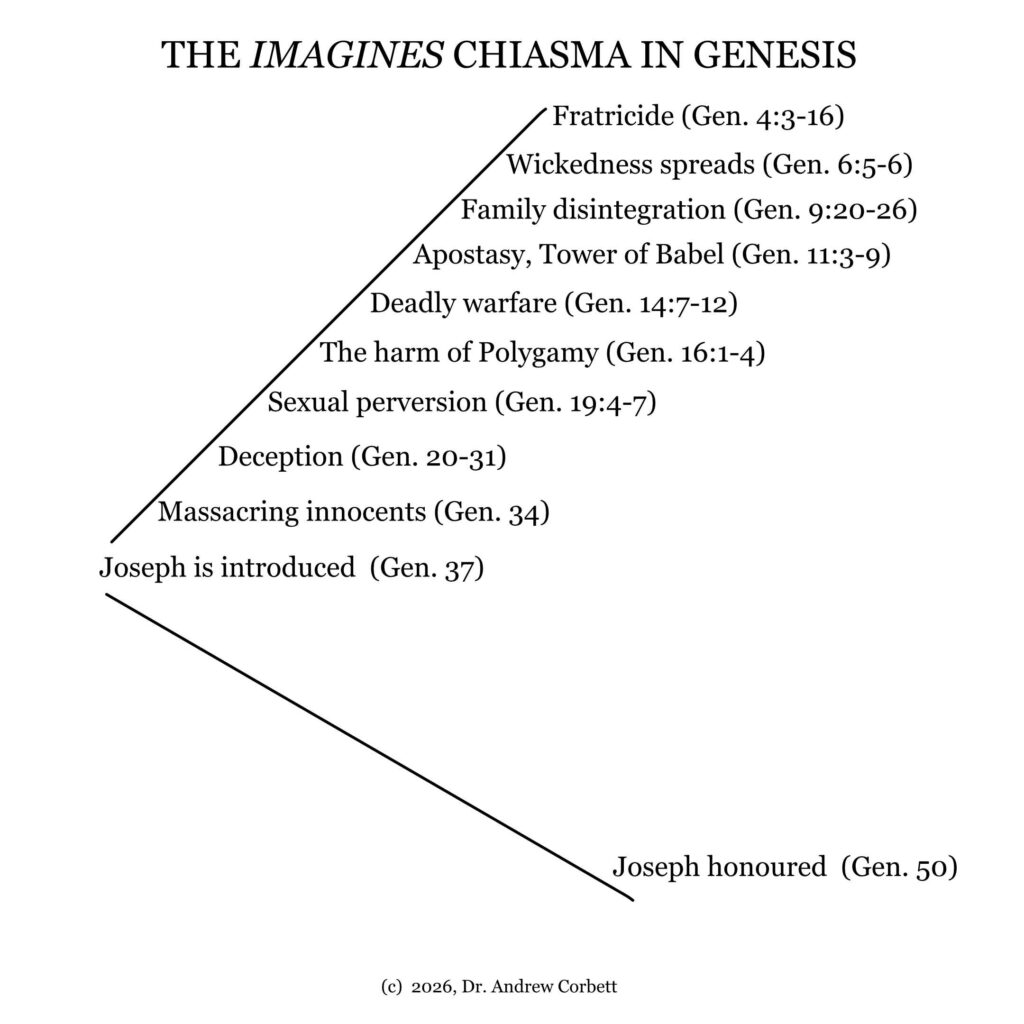
This diagram of the chiasma of imagines throughout Genesis hints at what the next chapter will focus on. Its first half halts at the introduction of Joseph, and forecasts how he is involved in the conclusion of Genesis.

© 2026, Dr. Andrew Corbett

Article 1   Article 2   Article 3  |  Article 4  |  Article 5  | Article 6

References:
[1] Arnold B. T., ed. The Cambridge Companion to Genesis. Brent A. Strawn, Chapter 10, “From Imago to Imagines: The Image(s) of God in Genesis,” 2022, 215.
[2] Brent Strawn. 2022, 219.
[3] Brent Strawn. 2022, 222.


Thursday, 5 June 2025

ECCLESIOLOGY Part 11 - DEVELOPING A HEALTHY CHURCH CULTURE


Every local church has a culture. Culture is a sociological term. It encompasses what a community regards as: proper, acceptable, and honourable. Sociologists refer to these as morÄ“s. Conversely, culture conveys what is: not proper, not acceptable, and is disgraceful and shameful. Sociologists refer to this negative behaviour as deviant. Culture celebrates what a community regards as important, and, what it frowns on. Every local church as a culture, but sometimes that culture is not entirely healthy. In this instalment in the Ecclesiology series, I am sharing some of the insights that we deal with in my church leadership seminar.


WHAT HEALTHY CULTURE ACHIEVES

The other week I saw a YouTube video of a Western tourist in Japan who showed a video of passengers on a Tokyo train. The passengers sat in an orderly fashion and were seated in silence. The tourist wondered if there was a Japanese law requiring the passengers to sit silently on the train. He found out that there was not. The reason the Japanese passengers sat on the train in silence was due to their culture. They didn’t need to be told to sit quietly – they just knew that it was the proper thing to do. This kind of positive culture is something any local church can achieve, if it works on the following two principles.

When I Kim and speak at a church for an extended weekend it is our mission to serve that church community and to help them to be even more effective in their mission to reach their community. This involves sharing on a Friday night with their youth or young adults about relationships; then sharing on a Saturday morning with Kim speaking to the ladies and myself speaking to the men; then a mid-morning leadership seminar with Board members/elders/team leaders;  a Saturday night dinner with the pastor/s elder/s; and on Sunday sharing in the morning service/s followed by an open (for anyone attend) Q&A luncheon. In the church leaders’ seminar we look at what makes for a healthy church. It is in this interactive seminar that we discuss the elements of what makes for a positive culture in a church. In essence, from my study, and the feedback we have received from these seminars, I can reduce what is needed are these two factors: firstly, the leader, and secondly, the attitude of the church.   


1. THE INDISPENSABLE RÔLE OF THE LEADER

The leader of a local church may be identified as the elder, pastor, senior pastor, senior minister, rector, or even the leader. Their title is not necessarily a critical issue. What is indispensable though is that they lead. It simply can not be overstated just how important their role is. The leader carries the weight of responsibility for the tone of a local church’s culture. It is not only the leader’s preaching which contributes to their culture-setting. It is their example –

  • How they treat people, how they deal with interruptions,
  • How they speak to their spouse and child/ren,
  • How they interact with their staff and/or volunteers,
  • How they manage their time,
  • How they admit their mistakes,
  • How they take correction,
  • How they deliver correction,
  • How they respond to tragedy,
  • How they they open their home to show hospitality,
  • How how they use those who are better than them,
  • What they laugh at – or – what they get angry at, and,
  • How they strive to improve their strengths and weaknesses. 


2. THE ATTITUDE OF THE CHURCH

While the leader is ultimately responsible for teaching sound doctrine and to exposit the Scriptures, as critically essential as this, it is not enough to ensure a positive and healthy church culture. It must be supplemented with a demonstrated explication of sound doctrine and the Scriptures. That is, a preacher can be a brilliantly powerful preacher who is an amazing teacher of God’s Word – but this is almost irrelevant if this preaching and teaching is not reflected in their godly attitude. When a leader consistently models a godly attitude it has an incalculably positive effect on their church’s attitude. Therefore, the senior leader must preach, teach, and model the biblical description of a godly attitude. This description is found in Colossians 3:12-17.

(12) ¶ Put on then, as God’s chosen ones, holy and beloved, compassionate hearts, kindness, humility, meekness, and patience,
(13) bearing with one another and, if one has a complaint against another, forgiving each other; as the Lord has forgiven you, so you also must forgive.
(14) And above all these put on love, which binds everything together in perfect harmony.
(15) And let the peace of Christ rule in your hearts, to which indeed you were called in one body. And be thankful.
(16) Let the word of Christ dwell in you richly, teaching and admonishing one another in all wisdom, singing psalms and hymns and spiritual songs, with thankfulness in your hearts to God.
(17) And whatever you do, in word or deed, do everything in the name of the Lord Jesus, giving thanks to God the Father through Him.
COLOSSIANS 3:12-17

If I was to list these attitude qualities, and then ask you, “How would you feel if your church was described by others as:

+  Compassionate

+ Kind

+ Humble

+ Meek

+ Patient

+ Forebearing

+ Forgiving

+ Loving

+ Harmonious

+ Peaceful

+ Thankful

+ Biblically literate

+ Wise

+ Prayerful and Pious (worshipful)

+ Sincere and holy?

Conclusion: The Gospel informs us that a culture can change. People can change. But what is needed are champions of cultural change who embrace the Church’s God ordained charge to be counter-cultural. When there is a champion of change – and better still – a champion team of change – building a healthy culture within a church is absolutely possible. And as this culture continue to be pursued I suspect that there will be many people who will be attracted to this church’s Christ-fragrance. Please pray that it does!

Amen.


Complementary Audio Podcast

Friday, 30 August 2024

DUMB PRAYERS THAT I HAVE PRAYED AND GOD HAS ANSWERED OVER THE YEARS


Over the past nearly 29-years of pastoring Legana I have occasionally mentioned that one day I would write about “the dumb prayers that I’ve prayed.” It’s not really that they are all ‘dumb’ prayers, it’s that they are the kind of prayers that are guaranteed to be answered by God (because they are “surrendered” prayers) but have not been fully considered what God’s answer might entail. I do not consider the more well-known and obvious “dumb” prayers – such as praying for revival to bring in hundreds of lost/lonely/broken souls into the kingdom and then being surprised by God’s answer resulting in exhaustion, burn-out, over-stretched resources, spiritual attacks, and the inevitable pride. Neither do I consider the even more obvious “dumb” prayer for patience and humility and the resultant means (difficult people and obvious trials!) by which such a prayer can only be answered. Instead, I begin with a prayer I prayed as a teenager then others that I prayed down through the years which have led me to this unexpected point. What I hope, and pray, you might discover after you have read this is something which will might benefit you in your knowledge of God and how He often answers prayers.

.

WHAT’S THE POINT OF PRAYING THEN?

There a different ways to pray. Some prayers can be verbalised. Some prayers can be silent. Some prayers are spontaneous. Some prayers are prepared. Some prayers are prayed in private and are clumsy. Some prayers are prayed in public and are clever. Some prayers are long. Some prayers are short – even just one word. Whatever way you pray, there are three things you need to keep in mind.

¶ “And when you pray, you must not be like the hypocrites. For they love to stand and pray in the synagogues and at the street corners, that they may be seen by others. Truly, I say to you, they have received their reward. But when you pray, go into your room and shut the door and pray to your Father who is in secret. And your Father who sees in secret will reward you. ¶ “And when you pray, do not heap up empty phrases as the Gentiles do, for they think that they will be heard for their many words.
JESUS THE CHRIST, Matthew 6:5-7

Firstly, when we pray, we are talking to God. When praying at a public occasion we are still praying to God and we are praying on behalf of those present. Out of respect for those who are present these public-occasion prayers should be well considered. This is why I recommend writing such prayers out and reading them with passion when prayed in public. Otherwise, the pray-er often sounds confuddled with mindless phrases such as this prayer I have heard many times:

“Father God, oh Father God, Father God Lord, I [pause] I come to You to pray Father God, Father God Lord. Yeah [pause] Amen.”

(Perhaps this should go in the obvious dumb prayer category because I have no idea what is being prayed for.)

Secondly, when we pray, particularly in private, our words don’t particularly matter. There are not ‘right’ words to use in prayer. Prayer is not magic. Prayer is not like a Harry Potter spell. Prayer is coming from your spirit to God’s Spirit (Rom. 8:261Cor. 2:11). God hears your heart when you pray.

Thirdly, God always hears our prayer but does not always answer our prayer/s they way we want. Prayer should be an expression of worship for God and trust in Him. When we pray we should also trust God with the timing of His answer not just the ‘how’ of His answer. One of the most inspirational books on prayer that I ever read — which had an enormous influence on my life — wasn’t even a book on prayer! It was the story of Dawson Trotman. As a young man he came to Christ and together with a few other guys they began praying for people, then nations, to come to Christ. Before his tragic drowning death as he rescued a young drowning girl, he had remarked that nearly everything he had prayed for some twenty-years earlier had been answered positively by God. “I now have” he said, “one regret – not that I didn’t pray enough, but that I didn’t pray for enough!” Dawson Trotman became one of Billy Graham’s intercessors and the founder coordinator of evangelism follow-up ministry called the Navigators

The point of praying is that we are invited by our heavenly Father to extend the reign of His Son over the earth through the ordinance of prayer. When we pray “Thy kingdom come!” we may not fully grasp either importance or the impact of our praying. 


WHAT’S ‘PRAYING IN THE SPIRIT’ THEN?

Christianity is the only ‘religion’ that regards prayer as a God-focused and God-empowered conversation. Jesus taught that after He had ascended back to the Father that it was imperative for His disciples to wait for the outpouring of the promised gift of the Holy Spirit who had been with the disciples up until that point, but when He would be poured out into the earth He would be in the disciples (Jn. 14:17). Other religions regard prayer quite differently. Some religions teach adherents that prayer is like meditation and needs to be mindless, while other religions teach their adherents that prayer involves the recitation of certain words sometimes in a language unknown to the pray-er such as Latin or Arabic. But Christianity teaches worshipers of the Creator and LORD to pray “in the Spirit” (Eph. 6:18Jude 20). This can be (i) praying a Spirit-gifted language that involves the Spirit-baptised believer speaking in tongues to God in prayer (1Cor. 14:2); or, (ii) praying in your heart-language in a way that the Spirit leads you to pray (1Cor. 14:15).

¶ Likewise the Spirit helps us in our weakness. For we do not know what to pray for as we ought, but the Spirit Himself intercedes for us with groanings too deep for words.
Romans 8:26


WHAT’S GOD DOING IN ME WHEN I PRAY THEN?

When C.S. Lewis’s wife, Joy, was dying of bone cancer, Jack (C.S.) was seen praying everyday in the nearby Anglican chapel. The Rector asked him if he was praying to change God about Joy’s prognosis? Jack replied, “No, I’m praying for God to change me!” Since prayer is a worshipful conversation with God, there is a high likelihood that when we pray throughout our day as our spirit communes with God that our spirit is also ‘hearing’ unconsciously from God. This perhaps is even more pronounced when we pray in tongues to God. Therefore, what may surprise praying worshipers is just how much they positively change as they wait on God in prayer seeking His face rather than His attention (Jn. 15:7). 


MY DUMB PRAYERS

I consider a ‘dumb’ prayer to be one that the pray-er had not fully considered the implications of how God might answer that prayer. The unconsidered implications are especially its cost, discomfort, inconvenience, and potential suffering. At one point I was prayerfully begging God to redeem and rescue the hurting, lost, lonely and broken people of my community. Those who have experienced my pastoring will be aware how God answered that prayer and how at times it was overwhelming. Then I developed a deep concern for the unwell. Again, those who are aware of my pastoral journey will know that I began a season some time ago, when for every significant health issue that someone came to me for prayer, was actually put on me. On several occasions this resulted in me being hospitalised. The list of ‘dumb prayers’ below are only the first half of these answered prayers. I am leaving the second-half — the implications — to your imagination. These are some of my ‘dumb’ prayers over the years that God has answered and as a result I have been transformed and become more responsive to God’s will:

🥺 Father, send me wherever You want – but please don’t make it an easy place. Make it a really hard place spiritually. Make it a place where few of Your servants are prepared to go! [Prayed before Kim and I moved to Tasmania.]

🥺 Lord God, fill me with Your love. Give me Your compassion for the hard-to-love. Help me oh God to truly see people and to truly hear them! [Prayed after Kim and I moved to Tasmania.]

🥺 Jesus, help me to understand Your Word. Show me what Your Word really says and to see past what I have been taught and told Your Word says to see what Your Word truly says! [Prayed regularly while in Tasmania.]

🥺 Holy Spirit, please rescue the lost, the lonely, the broken, the hurting, the confused, and the unloved! Holy Spirit, please bring them into the Kingdom of Christ through Your church! Help me to love them, heal them, and care for them. In the meantime, please fill Your people with Your love and power to be the hands and the feet to offer the love, the care, and the Father’s adoption to these needy people. [Prayed very recently while in Tasmania.]

🥺 Lord GOD, give me the time I need to complete this PhD with Monash and help me to navigate each of the challenges that will arise in doing so! [Prayed very regularly in Tasmania at the moment.]

🥺 Father, help me to hear Your voice and to heed Your Word! In fact, help me to make a difference both now and for the next four centuries by what I will leave behind [Prayed presently while preparing to depart Tasmania for wherever God will lead us.]

🥺 God, have Your way in my life! Make me, shape me, and break me, to be conformed to Your will! [Prayed presently while preparing to depart Tasmania for wherever God will lead us.]


PRAYING FOR GOD’S WILL TO BE DONE IS NEVER DUMB

I am a Pentecostal, but I do not hold to the Word-of-faith / Prosperity-gospel. As a Pentecostal I believe that the gifts of the Spirit are still available and will be so until the eschaton (“the Last Day” referred to in John 6:39-445411:2412:48).Thus, I believe that the Bible teaches that the Holy Spirit still performs miracles – including transforming lost souls into saved saints. But I also believe – not because I am a Pentecostal, but because I am a Bible-believing Christian – that God is good and always does good. This means that God has a good will and that I need to pray according to His will — even when I do not like His will! My ultimate example to pray according to God’s will is the record of Jesus in Gethsemane just before He went to the cross. And therefore, so should we.

Again, for the second time, He went away and prayed, “My Father, if this cannot pass unless I drink it, your will be done.”  And again He came and found them sleeping, for their eyes were heavy. So, leaving them again, He went away and prayed for the third time, saying the same words again.
Matthew 26:42-44

Thus, praying for God’s will to be done in your life is never dumb!

Your Pastor,

Andrew

Let me know what you think below in the comment section and feel free to share this someone who might benefit from this Pastor’s Desk.