
¶ Blessed be the God and Father of our Lord Jesus Christ,
who has blessed us in Christ with every spiritual blessing in the heavenly places,
even as He chose us in Him before the foundation of the world,
that we should be holy and blameless before Him.
In love He predestined us for adoption to himself as sons through Jesus Christ, according to the purpose of His will.
Ephesians 1:3-5
The seeds of God’s plan were sown in the Garden of Eden, but the one which was central to His entire plan was: that His eternal Son would, at just the right time (Gal. 4:4), enter our world as a newborn baby (Gen. 3:15; Isa. 7:14; 9:6; 1Pet. 1:20) to be our Saviour (Isa. 53). And then He and His Father would send the eternal Holy Spirit into our world to establish and oversee the Church that Jesus Christ would take as His Bride (Eph. 5:23; Rev. 19:7). This foundational Edenic seed was germinated on the Day of Pentecost, described in Acts 2. And this is where we will jump ahead to in our story…

¶ When the day of Pentecost arrived, they were all together in one place.
And suddenly there came from heaven a sound like a mighty rushing wind,
and it filled the entire house where they were sitting.
And divided tongues as of fire appeared to them and rested on each one of them.
And they were all filled with the Holy Spirit and began to speak in other tongues as the Spirit gave them utterance.
Acts 2:1-4

Around AD 30, on the Day of Pentecost, the promised Holy Spirit was “poured out” and the New Testament church was birthed. After the apostle Peter had preached to the massive crowds that had travelled from around the world for this Jewish festival, 3,000 people were converted to Christianity (Acts 2:41). Gatherings of new Christians then formed in the homes of new Christians who lived in and around the walled city of Jerusalem where the teachings of Christ and the messages that He had entrusted to His apostles was shared. These new believers would also gather together regularly in a precinct of the Temple to be taught by the apostles.
And day by day, attending the temple together and breaking bread in their homes,
they received their food with glad and generous hearts,
praising God and having favour with all the people.
And the Lord added to their number day by day those who were being saved.
Acts 2:46-47
The early Church grew rapidly. But with growth there are always growing pains. And the fledgling Church now had to deal with several serious conflicts…

There was not a needy person among them,
for as many as were owners of lands or houses sold them
and brought the proceeds of what was sold and laid it at the apostles’ feet,
and it was distributed to each as any had need.
Acts 4:34-35
The Church now had a relief ministry which was funded by the great generosity of its wealthier members. But this led to two immediate and dangerous problems. The first was that some wealthy donors were giving with very deceptive motives. In Acts 5 we are told of two such donors who were disciplined by the apostle and the Holy Spirit for their deception (Acts 5:1-10). This result was felt by all the Church.
And great fear came upon the whole church and upon all who heard of these things.
Acts 5:11
But what started out as a good initiative, the distribution of food and aid to those in need, soon became the cause of another conflict in the Church.
¶ Now in these days when the disciples were increasing in number,
a complaint by the Hellenists [non-Israeli, Greek speaking,
Jewish converts to Christianity] arose against the Hebrews
because their widows were being neglected in the daily distribution.
Acts 6:1
Again, rapid growth of the Church caused further growing pains. Every problem which is solved in life, as well as within a church, leads to further growth. In this instance the apostles realised that they were not the solution. They needed ‘to stay in their lane’ – that is, they needed to keep doing what God had called them to do and let others called to deal with this particular problem be a part of the solution. In this instance the apostles appointed ministers (Greek word, diakonēo from where our word deacon comes from) to practically resolve this food distribution complaint (note that those they selected had Greek [Hellenist] names).
And the twelve summoned the full number of the disciples and said,
“It is not right that we should give up preaching the word of God to serve tables.
Therefore, brothers, pick out from among you seven men of good repute,
full of the Spirit and of wisdom, whom we will appoint to this duty.
But we will devote ourselves to prayer and to the ministry of the word.”
And what they said pleased the whole gathering, and they chose Stephen,
a man full of faith and of the Holy Spirit, and Philip, and Prochorus, and Nicanor,
and Timon, and Parmenas, and Nicolaus, a proselyte of Antioch.
Acts 6:2-5
Growth and success always stirs up sinful attitudes amongst those prone to violate the 10th Commandment – do not covet. The envy of the Jewish religious authorities toward the growth of the Church would create the next greatest problem for the early Christians to deal with: persecution.

¶ And Stephen, full of grace and power, was doing great wonders and signs among the people.
Then some of those who belonged to the synagogue of the Freedmen (as it was called),
and of the Cyrenians, and of the Alexandrians, and of those from Cilicia and Asia,
rose up and disputed with Stephen. But they could not withstand the wisdom and the Spirit with which he was speaking.
Then they secretly instigated men who said, “We have heard him speak blasphemous words against Moses and God.”
And they stirred up the people and the elders and the scribes,
and they came upon him and seized him and brought him before the council,
and they set up false witnesses who said, “This man never ceases to speak words against this holy place and the law.
Acts 6:8-13
Stephen, one of the seven original deacons of the Church, faithfully shared the truth of the gospel with these religious leader before whom he was tried and then executed as a martyr (Acts 7:57-60). But as he was being martyred while kneeling, he cried out to God to forgive his persecutors and one of those in charge of this execution was profoundly affected by what Stephen did (Acts 7:60—8:1).
But Saul was ravaging the church, and entering house after house,
he dragged off men and women and committed them to prison.
Acts 8:3
Far from slowing or stopping the rapid growth of the Church, this wave of persecution actually helped to accelerate it! Christians were scattered from Jerusalem out to the far-flung corners of the Empire and everywhere they went they preached about Jesus (Acts 8:4). And then a strange thing happened, the chief persecutor of the Church, Saul of Tarsus, was dramatically converted to Christianity! And the impact of his conversion to Christ is why we are Christians today!
Now as [Saul] went on his way, he approached Damascus, and suddenly a light from heaven shone around him. And falling to the ground, he heard a voice saying to him, “Saul, Saul, why are you persecuting me?” And he said, “Who are you, Lord?” And he said, “I am Jesus, whom you are persecuting. But rise and enter the city, and you will be told what you are to do.”
Acts 9:3-6
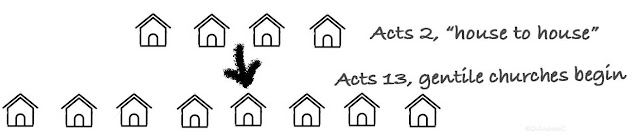

It was always Christ’s intention that His Church be a global Church for people from all nations (Matt. 28:18-20; Acts 1:8). When Saul (a Jewish name) changed his name to Paul (a gentile Roman name) the Church began to experience not just growth, but massive multiplication and expansion. Under the apostle Paul’s leadership, gentile churches were planted across the Empire and established in Roman households (which housed quite large family networks with additional servants and stewards). These householder-led family homes provided a ready-made leadership structure for these new churches and provided a stepping stone into the Church’s next stage of growth and globalisation. The apostle Paul would even describe each local church as being a household yet connected with the other churches around the world through adhering to common leadership and doctrine and being built upon Christ and His Word.
So then you are no longer strangers and aliens,
but you are fellow citizens with the saints and members of the household of God,
built on the foundation of the apostles and prophets, Christ Jesus Himself being the cornerstone,
in whom the whole structure, being joined together, grows into a holy temple in the Lord.
In Him you also are being built together into a dwelling place for God by the Spirit.
Ephesians 2:19-22


In the second century, the Church continued to expand across the Empire through the ready-made leadership structure and influence of householders. After the death of the apostles, regional bishops were considered their replacements. Through the ensuing centuries, the bishops would hold several important council meetings whereby statements were formulated or agreed to which several are now referred to as creeds (from the Latin, creedo, which means I believe). These ecumenical (applies to all churches) creeds include: the Nicene Creed, the Apostles’ Creed, and the Athanasian Creed. Then, around AD 312, the would be Emperor of Rome, Constantine, won a decisive military battle which led to him in AD 324. He credited this victory to a dream he had about placing the “chi-rho” cross as an emblem of Christianity on each of his army’s shields. He then secured the Empire under his control after he defeated his contender, Licinius. “In that position … he could now enforce ‘One God, One Emperor, One Church’” (WORLD HISTORY ENCYCLOPAEDIA).
According to Christian historian Eusebius, the troubled Constantine sought help in prayer to his father’s god.
Constantine then had a vision of a cross of light emblazoned against the sun and saw the words
In hoc signo vinces: “In this sign you will win.” Constantine ordered the monogram of Christ to be painted on his soldiers’ shields.
When he later engaged Maxentius, Constantine won a decisive victory.
CHRISTIAN HISTORY INSTITUTE, David F. Wright
With Emperor Constantine’s conversion to Christianity, an era known as Christendom commenced. Constantine then endowed churches to pay for ministers, build churches and basilicas, and have some bureaucratic roles in his government. But over time this lead to people becoming bishops or bureaucrats who sought power and glory for themselves rather than Christ.


Pay careful attention to yourselves and to all the flock,
in which the Holy Spirit has made you overseers, to care for the church of God,
which he obtained with his own blood.
I know that after my departure fierce wolves will come in among you, not sparing the flock;
and from among your own selves will arise men speaking twisted things, to draw away the disciples after them.
Acts 20:28-30
The Medieval period is sometimes referred to as the Dark Ages predominantly because much of the Church had become politicised and led by men who did not know God. In this period when the ‘light’ of Christ’s Church largely went dark, God raised up various men and women who remained faithful Christ and His Word.
THE REFORMATION BEGINS
Englishman, John Wycliffe (14th century) is referred to as the Morning Star of the Reformation. He translated the New Testament into English which made it accessible to common people. Later, William Tyndale (15th century) translated the entire Bible into English. Meanwhile, in Italy, Dominican Friar, Girolamo Savonarola (late 15th century) began to publicly preach against the wickedness of the Church’s corrupt bishops and called people to repentance and to turn to faith in Christ. In Germany, another monk, Martin Luther (16th century), had discovered through his lectures to his students from Paul’s Epistle to the Galatians, that the Roman Church had actually been teaching things that did not agree with the Bible. In France, John Calvin (16th century) was inspired by Luther’s sermons and lectures to search the Scriptures for himself and found that much of what the Pope had been promoting was contrary to God’s Word. Then some time after this, Count Nicolaus Ludwig Reichsgraf von Zinzendorf (17th century), the founder of the Herrnhuter Brüdergemeine Christian mission, and leader of what became the Moravian brotherhood, rediscovered what it meant to be a Spirit-filled and Spirit-empowered missionary to those who had never heard of Christ. He played a significant role in leading the Anglican minister, John Wesley (18th century), to Christ. During the Wesleyan revival from 1740 to 1780, hundreds of thousands of people were converted to Christ. His followers played a key role in the decision to send the First Fleet to colonise Australia and establish it as a Christian country. By this time various “denominations” of the Church had been formed under the direction of the Holy Spirit to further help the Church to remain well organised and focused on evangelising and discipling the nations of the world


During the late 18th century the seeds for what became known as the enlightenment would be sown where much of the Church’s authority and teachings were challenged and rejected by secular-minded thinkers who regarded science and rational thought superior to what they regarded as the superstitious ideas of the Roman Church. But there was also an increased awareness from a growing number of Christian thinkers who considered that what the Official Church had been teaching was not what the Bible actually taught and that its teaching was even often contradicted by the Bible! In addition to this, there was even a campaign in the late 1800s by some ‘enlightenment’ theologians to regard the Bible as not divinely inspired, and that much of its history was actually just mythology rather than factual. This became known as liberalism.

Liberal theologians began to dominate the teaching staff of many seminaries which meant that those training for professional church ministry were now graduating with the belief that the Bible was not divinely inspired, and therefore was not authoritative – which meant that much of its ethical statements, were not really applicable today. The abandonment of the reliability and authority of the Scriptures meant that the Church’s ministry as “salt and light” to its world was replaced by the false notion that people did not need God or His Word to guide their lives. Thus, in the 1960s, the “sexual revolution” began. This resulted in the 1970s decisions by governments around the Western World to introduce such things as no-fault divorce. This was based on the false idea that marriage and sex was about personal happiness rather than holiness (the responsibility to do what is right and good). This then meant that if you were in a marriage that did not make you happy, you could divorce without you or your spouse being “at fault”. With this abandonment of Biblical ethics by societies and their elected legislators, David Rietveld contends in his book, Being Christian After Christendom, that the era which began with Constantine had come to an end.
This may mean that the Church of today in the Western world is now operating in a culture that not only thinks that Christianity is irrelevant, but in the minds of many, is actually “repressive and dangerous” – because we believe that life and its aspects (including sexuality) have been designed by God for a particular four-fold purpose. How then do we now act as Christians – who are committed to Christ and His Word as we are trying to live obediently to God in a cancel-culture world whose leaders are opposed to us?
Do not be conformed to this world, but be transformed by the renewal of your mind,
that by testing you may discern what is the will of God,
what is good and acceptable and perfect.
Romans 12:2

When we meet each Sunday we do so in obedience to Christ’s Word (Heb. 10:24-25). When we sing our worship we do so in obedience to God’s Word (Col. 3:16). When we preach and teach God’s Word we do so in obedience to Christ’s Word (2Tim. 4:1-3). When we together in each others homes for prayer, Bible study, and fellowship, we are doing so to be formed into disciples of Christ as His Word commands us (1Thess. 5:11).
God’s Word describes believers as “brothers and sisters”. This means that those who are part of a local church are like a family. And in a world where family is increasingly becoming a rare experience, our church can be the means by which some of the deepest yet unrealised longings of the human soul can be met — and increasingly so into the future as our culture comes to realise that what they thought would satisfy their deepest longings has not. And this is the story of the Church that God is still writing with you and I being written into it.
Pastor at Large,
Andrew
Let me know what you think below in the comment section and feel free to share this someone who might benefit from this Pastor’s Desk.


