CHANGING PARADIGMS
(Apologies for the length of this article, and the big words used.)
Now these things happened to them as an example, but they were written down for our instruction, on whom the end of the ages has come.
First Corinthians 10:11
 As I reflect on my recent pastoral anniversary
 I've had cause to reflect on three of my most significant pastoral paradigm shifts. I think I was about 17 years of age when I approached my then pastor, Joseph Bowes, to talk about the growing sense of God's call on my life to pastor. I had assumed that all young men about that age felt a similar call. Pastor Bowes informed me that this was not the case. It was around this time in the 1980s that I first met Pastor Trevor Chandler who had become an annual visitor to our Geelong church (as he came down from Queensland to Victoria for INTERMIN). But this time (the 1980s) was a bizarre time for Bible Prophecy pundits. It was Trevor Chandler who first sowed the seeds into my soul to investigate rather than blindly accept Dispensational Futurism (which was the predominant view in most Evangelical and Pentecostal churches at the time). And I did.
My investigation has been shaped by a commitment to the four classic principles of hermeneutics and my interactions with a family member involved in a cult. It was these two factors which led me to write two books about Bible Prophecy (the first one published in 2004 and now has sold over 20,000 copies) and hundreds of articles published on
my website which have so far received over 1.13 million views. My conclusions about eschatology is the third of my pastoral paradigm-shifts and has greatly enhanced my pastoring. Here's how.
but in these last days he has spoken to us by his Son, whom he appointed the heir of all things, through whom also he created the world.
Hebrews 1:2

I undertook a College course in Eschatology (from the Greek word,
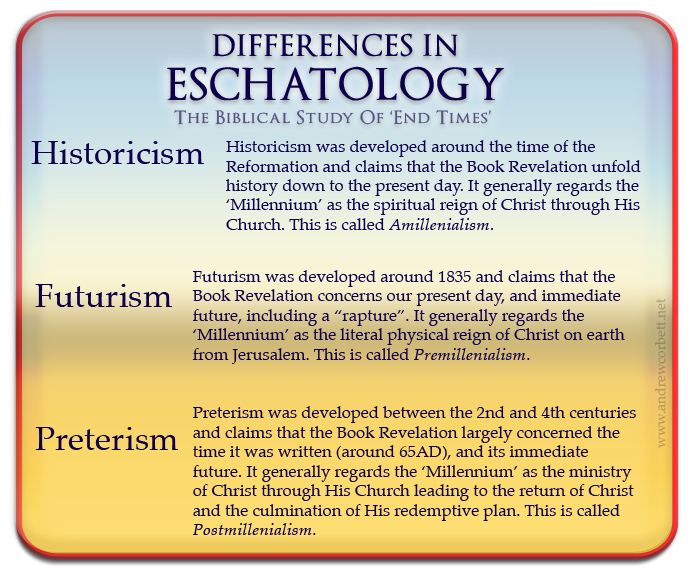
eschaton meaning 'last things') in 1991. Even though the course was delivered by a 'Futurist' College, the course coordinator exposed his students to various views about Bible prophecy. Futurism (refer to the graphic below for a description of these terms) did not fair well under rigorous scrutiny in this course. We were required to read
Options In Eschatology by Prof. Millard J. Erickson, and
The Revelation of Jesus Christby Dr. John F. Walvoord. The first book dismantled 'Pre-Millennial Futurism' and showed why it lacked Biblical credibility. The second book was about Pre-Millennial Futurism, including a Pre-Tribulation Rapture. The course coordinator showed the irreparable problems with Dispensational Pre-Millennial Futurism, but the College required that Dr. Walvoord's book be read and understood as the position we were required to accept.


After completing this formal study in Eschatology, I had a clearer view of what
I didn't believe than what I did. My doctoral research was largely in Church History. This exposed me to the progress of Christian thought down through the centuries. It became increasingly obvious that what most Christians held to today regarding Bible prophecy, the ancient Christians had never heard of!
And he seized the dragon, that ancient serpent, who is the devil and Satan, and bound him for a thousand years, and threw him into the pit, and shut it and sealed it over him, so that he might not deceive the nations any longer, until the thousand years were ended. After that he must be released for a little while.
Revelation 20:2-3

Dispensationalism is a way of looking at the Bible. It divides the Bible in a series of dispensations of time and attributes a different means of salvation within each dispensation. Under the Dispensation of Law, a person was saved by keeping the Law. Under the Dispensation of Grace, a person is saved by faith in the finished work of Christ. The idea of Dispensationalism at first sounds reasonable. But as I became increasingly familiar with Church History and the art and science of Hermeneutics (how we interpret the Bible), I found Dispensationalism (which most Pentecostals hold to) untennable. On both counts, I found that Dispensationalism appealed to Church History by reinterpretting it. For example, Jerome (347-420) used a Latin word that sounds like 'rapture' in English, and this was used to justify the Rapture doctrine. Biblically Ezekiel refers to a people which in Hebrew sounds like 'Rosh' which Dispensationalists claim refers to modern day 'Russia'.


When I began to dig a little deeper I found that even the verses used to support the idea of a 'rapture' were generally about either the Roman bombardment of Jerusalem where random people would be killed (and the Jewish Historian, Josephus, describes) or the final resurrection. But the most disturbing aspect of Dispensationalism was its dependence on its new ways of interpretting the Bible. For its interpretation to work, it had to invent some new 'laws' of interpretation including,
The Law of Double Reference also called,
The Rule of Dual Fulfilment. One proof-text is offered in support of this:
Isaiah 7:14 "Behold the virgin shall conceive". It is claimed that this was first fulfilled with Isaiah the Prophet's wife, then again with the Virgin Mary. But there are some serious problems with this idea. Firstly, there is no hint in Scripture that Isaiah's wife was the intended fulfilment of this prophecy (and I strongly doubt that she was a virgin!) and there is a plain statement in
Matthew 1:21 that Mary of Nazareth was the (not "a") fulfilment of the Isaiah prophecy. But this novel rule/law of Bible interpretation is the foundational principle for the belief that God has merely suspended His Old Covenant with Israel and temporarily instigated a New Covenant with the Church. Dispensationalism claims that God has two existing covenants with two groups of people- (i) Israel, and (ii) The Church.
There is neither Jew nor Greek, there is neither slave nor free, there is no male and female, for you are all one in Christ Jesus. And if you are Christ's, then you are Abraham's offspring, heirs according to promise.
Galatians 3:28-29

While I was grappling with all this, my father inlaw died suddenly. I was asked to take the funeral. I had had many conversations with my Hungarian father-inlaw about spiritual things and had met with deep resistance. After the funeral, my mother-inlaw, who I deeply appreciate, expressed her hope that my father-inlaw would be given a second chance to turn to Christ in the Millennial Kingdom on Earth. She had long been persuaded by the teachings of Charles Taze Russell (the founder of the Watchtower Bible and Tract Society). This led to me trying to have a genial written conversation with her about this aspect of Eschatology. Every time I tried to discuss the applicable Scriptures with her, I met with a novel way of interpreting the Scriptures which seemed to take the plain meaning of the text and twist it into an entirely different meaning. This led me to appeal to the classic principles of Bible interpretation.

It was at this point in the ongoing discussions with the my mother-inlaw as we were discussing the finer aspects of Matthew 24, that I realised I was doing the very thing that I was accusing my mother-inlaw of doing: I was reading into the text of Scripture rather than listening to what the text was intending to give out.
Truly, I say to you, this generation will not pass away until all these things take place.Matthew 24:34

It was
Matthew 24:34 which drove this error home to me. I had been taught to read this verse as if it was saying "that"
generation, rather than what it actually says -
"this" generation. The ramifications of this straight-forward reading are immense and were not lost on the most vocal atheist of the twentieth century, Bertrand Russell, when he was debating C.S. Lewis about Christianity. It was this verse which he used to describe Jesus as either a mere mortal who was deluded, or as a manipulative con-artist who was deceptive. This led C.S. Lewis to essentially concede the debate and later comment about this verse-
I find this the most embarrassing verse in the Bible.
C.S. Lewis
I spent a lot of time researching
this verse and trying to reconcile how Jesus could be God in the flesh yet so wrong in His prophecy recorded in this verse. Coincidentally I also began my series on the Book of Revelation (around 2002). I was determined to only take out of these Scriptures what God had intended to be taken out. I would use the first four principles of hermeneutics and try keep my preconceived ideas out of the text. And while I was working through this huge problem with
Matthew 24:34 I was discovering a whole set of new problems with the Book of Revelation
if we merely apply the principles of sound hermeneutics to it.
Blessed is the one who reads aloud the words of this prophecy, and blessed are those who hear, and who keep what is written in it, for the time is near.
Revelation 1:3
Exactly the same "problem" occurs in reading the Book of Revelation as occurs in Matthew 24. I had been taught that when Revelation used language like, "soon", "near", "at hand", "now", "this hour", it actually didn't mean it. In fact, what it actually meant was exactly the opposite to these words mean! The only reason plausible for doing this was that a plain reading of the text didn't fit the Dispensational (Futurist) paradigm! I was resolute to research Biblical eschatology exegetically (taking out of the text only what was originally put into it) rather than eisegetically(reading things into the text). Here's what I discovered, and why it became my biggest pradigm-shift.
MATTHEW 24
Matthew 24 was a conversation between Jesus and His disciples on the Mount of Olives. Hence, it is referred to as
The Olivet Discourse. The discples point out the Temple to Jesus and how impressive it was. But Jesus dismisses this and declares that it will be dismantled stone by stone. In utter dismay, the disciples ask three questions: (i) When will this happen? (ii) What will be the sign of Your 'coming' (Greek word,
parousia)? (iii) When will this age (Greek word,
aionos) end? Understanding these three questions is essential to understanding this chapter. Jesus proceeds to answer to each question. Consider that. He answered, in detail, each of the three questions. If I was preaching this point right now, I would labour it! And the reason I would do so is because there are some who suggest that after Jesus has answered their questions He then declared that He didn't really know the answers because He was speaking out of His humanity, not His divinity! I find this opinion of Christ in Matthew 24 nearly blasphemous. (
I explain why in this YouTube video.) I would also point out
what the disciples asked, not
what we think the disciples asked.
¶ As he sat on the Mount of Olives, the disciples came to him privately, saying, "Tell us, when will these things be, and what will be the sign of your coming and of the end of the age?"Matthew 24:3
1.When will these things be? Jesus gives detailed descriptions of what was about to happen and then plainly stated the answer to this question:
this generation shall not pass away until all these things take place (
Matt. 24:34). A Biblical 'generation' is 40 years. If we consider that Jesus spoke these words in 30AD, He has just plainly stated all these things would be fulfilled by 70AD.
2. What will be the sign of Your coming? Note that the disciples did not ask- When will You return? The Greek word ὑποστρέφω (hupostrepho) is the word they would have used if they had asked When will You return? But instead, they asked When will You 'parousia'? This word means, reveal, appear, come, but specifically in this context it means, to come in judgment. The disciples had good reason to ask When will You come to judge?because the destruction of the Temple was the pinnacle of God's judgment on Israel in the Old Testament. This is the climax of the Book of Jeremiah.
3. What will be the sign of the end of the age?Despite the King James Version translating this word as "world", the disciples did not ask Jesus When will the end of the world be? Jesus has just said that the Temple would be destroyed and the immediate question from the disciples was, When will this (Temple) age end?
A part of Christ's answer was that the sun would be darkened, the moon will not give forth its light, and the stars would fall from the sky (
Matt. 24:29). Using the hermeneutical principles of Scripture interpretting Scripture we note that in
Genesis 37:9 Joseph dreamed a dream about the sun, moon and stars bowing down to him and this was immediately interpretted as the Israel and his family. Later the prophet Isaiah in describing Israel's rebellion would say that the sun, moon, and stars no longer shine their light (
Isaiah 13:10), and Ezekiel would describe rebellious Israel as having their light "blotted out" so God says -
"I will cover the heavens
and make their stars dark;
I will cover the sun with a cloud,
and the moon shall not give its light."Ezekiel 32:7
And Joel says-
The sun and the moon are darkened,
and the stars withdraw their shining.
Joel 3:15
What many may not realise is that when Jesus says,
Then the sign of the Son of Man will appear in the Heavens (
Matt. 24:30), that He was referring to
Daniel 7:13, where it foretells of the Son of Man coming "up" on the clouds of Heaven (not "down"). The expression "the Lord is coming", often associated with His glory depicted as "clouds" was used throughout the Old Testament. For example,
Isaiah 19:1-
¶ An oracle concerning Egypt.
Behold, the LORD is riding on a swift cloud
and comes to Egypt;
and the idols of Egypt will tremble at his presence,
and the heart of the Egyptians will melt within them.

Thus, Jesus was not talking about His
return to resurrect and judge the world (described in Matthew 25), but was describing His judgment on Jerusalem and the abolishing of the Old Covenant (the Temple, the Priesthood, and the sacrifices), which were indeed done away with in 70AD when the Romans destroyed Temple stone by stone just as Jesus had said. If you're interesting in learning more about this, I wrote a book about it! It's available either as an
eBook, or as a
paperback.
READING THE BIBLE LITERALLY
One of the most obvious problems with Dispensational Futurism is that its predictions based on its interpretations have consistently been wrong. This undermines the credibility of the Bible in the minds of some. As a pastor, I want those whom God has charged me to shepherd to have good reasons to have confidence in the Bible so that when life's storms and difficulties come, they will find the comfort and peace of God in the words of Scripture. To achieve this I need to help my congregation to understand how to read the Bible. The goal is to read the Bible literally. But there are two types of literal reading. The first is wooden literal where no allowance is made for metaphors, synedoches, idioms, allegories, parables, poetry, apocalyptic symbolism, perspectives, hyperboles, or narratives. The other type of literal is intended literal. This is where allowance is made for these types of literature and the goal is to discover what the author intended - not what the words the author used could mean.

A few years after my
Understanding The Book of Revelation had been released, one interested reader in it (
The Most Embarrassing Book In The Bible) flew from Brisbane to Launceston to discuss it with me. For him, its contents were not merely theoretical. As I explained in
The Most Embarrassing Book In The Bible what the future holds for the believer according to the Book of Revelation, especially in the life to come, he shared with just why this was so important to him. He was dying! He had drawn great comfort from discovering that everything in the first 19 chapters of Revelation had been fulfilled whichgave him confidence that the remaining chapters would similarly be fulfilled. But, as this book had been out for a few years, he wanted to personally check if I still stood by its contents. I did and I do. This illustrates the immediate pastoral application of sound eschatology grounded in equally sound hermeneutics. This view is known as
Preterism (as distinct from Full-Preterism which regards
all prophecy as being fulfilled).
But this paradigm-shift came at a price. I was no longer able to hold ordination with the denomination I was serving in due to their emphatic Futurist Eschatological stance. However, it has been more than compensated for with untold dividends as many people have come to see why we have good reasons to believe what the God of the Bible has said in His Word. As I reflect on each of my three biggest pastoral paradigm-shifts, they have each arisen from a deep desire to faithfully serve God and His people by being faithful to His Word.
¶ I charge you in the presence of God and of Christ Jesus, who is to judge the living and the dead, and by his appearing and his kingdom: preach the word; be ready in season and out of season; reprove, rebuke, and exhort, with complete patience and teaching. For the time is coming when people will not endure sound teaching, but having itching ears they will accumulate for themselves teachers to suit their own passions, and will turn away from listening to the truth and wander off into myths.
Second Timothy 4:1-4
Ps. Andrew
 Most people think of life as merely limited to the time between the cradle and the grave. That is, from birth to death. Little wonder then that when someone's life is cut short from their expected time of death, it seems like an utter travesty, a tragedy, a gross injustice. But what if our lives do not merely consist of the time between the cradle and the grave? What if it is, as I continued on the whiteboard, that our lives never end. The grave is not the end. It is merely a change.
 The reason we sense such great loss when someone's life seems to be cut short is that there is an intuitive sense within each of us that life is not supposed to end. As I began to explain this, several of the students teared up, and one began to quietly weep. I could tell that this was not merely theory to them. I further explained that our ultimate eternal destiny lay in either of two directions. One of those directions was to defy God's authority over our lives and choose independence and its consequence for eternity, or to choose the other direction which involves humbling ourselves and accepting God's offer of forgiveness and adoption and reaping the gracious consequences of that choice.
 After I explained this I summarised the students' questions with a more confronting question about human suffering: Why me!?When someone we don't know suffers, we may feel some sympathy for them but it doesn't affect us deeply. However, when someone we love suffers, we are very sympathetic and even empathetic as we begin to feel something of their pain. But when we suffer, it's not just our pain that we feel, it's also the ache of injustice that is added which we feel deeply. All of this reinforces that we intuitively know something is very wrong with the way the world is.

 When children become token trophies, society is in deep, deep trouble. These become the children that parents have but don't raise. Because children are designed to be raised they hurt a lot when they are not. And just like the worse kind of problems, the ones that start quietly and unnoticed yet insidiously, this utterly preventable problem only gets any attention when its full-blown cancerous-like traits become so obvious that even its most vocal deniers can no longer ignore it. Someone needs to find the baton.
 I am writing to parents and would-be parents with this urgent plea: take hold of the baton. And I am especially writing to those parents who are followers of Christ: pass on the baton, for it is a sacred trust.
  Having a child is relatively easy compared with raising a child! And because we live in an outsourcing world, it seems that the incompatible baton-abandoning idea of having children and then outsourcing their upbringing is hardly questioned. The situation has now become dire. Children who should have been trained, as well as taught, by their parents are now suffering emotionally, intellectually, and socially. As a result they are being medicated, counselled, amused, virtualised and duped. And for the most part, much of this is all entirely avoidable if parents parented.
 Estimates vary on much time a father spends talking with each of their children. Some research suggests that it's around 10 minutes a day. But if we take our 'utilitarian' talk ("Come here" "Clean up your room" "Do your homework" "Pass the salt" and so on) out of the totals it could even be less than 3 minutes a day! This is dropping the baton and it's got to stop. If you're a parent, you have a rewarding job and you may also have a paying job. Like any rewarding endeavour, it is proportional to effort invested - not just time. A baton holding parent knows that each of their children needs alone time with them as they talk about their worlds. It's important for our children to understand our world just as it's important for us to know theirs. This requires the dying art of conversation - the exchange of heart and mind with another person through the magic of listening. This is often best done at the end of their day, sitting on their bed. And our children also need socialising with their parents - being polite, attentive to, sensitive to, and considerate of, those they are with. This is often best done at the dinner table each night.
 When parents realise that God has given them a sacred baton to pass onto each of their children, they accept responsibility for teaching their children to read, to write, to reason, to express, to do math, to spell correctly, to learn where the countries of the world are, to eat well, to exercise well, to get along with others, to work, to care, to draw, to sing, to play, to share, to be generous, to listen, to apologise, to do science experiments, to learn another language, to discover the past, and to worship the LORD of Hosts. In this light, their child's Christian School teachers, Music teacher, Sports Coach, Pastor, Children's Pastor and Youth Pastor each help the parentto teach their child.




 As I reflect on my upcoming pastoral anniversary I've also had cause to reflect on three of my most significant paradigm shifts over my pastoral career. I began to formally prepare for pastoral ministry in 1983 when I undertook my first Theological subject with ICI College. After completing two Advanced Certificates with them, I completed my Bachelor of Arts in Biblical Studies in 1996 with Emmanuel College. I was then invited to undertake Doctoral Studies with Cambridge Graduate School which I completed in 2002.


 I cite these notable experiences among the many I enjoyed so that there may be an understanding that I was, am, and will be, ever open to what the Holy Spirit can do. In 1990 I was credentialed with the Assemblies of God as a pastor. This was an amazing time to join a really great movement. The period from 1977 to 1997, under the leadership of Pastors Andrew Evans and Phil Hills, the Assemblies of God in Australia movement had grown from 140 churches to over 800!


 In 2006 I was invited to speak in London. I had been wrestling with how I could harmonise my undoubted Pentecostal experience with my emerging Reformed theology. My visit to England at this time helped to galvanise how this was possible. The Peniel Pentecostal Church held to Reformed theology and yet had a healing and miracles service each Friday in which people travelled from all over the U.K. to attend. The Pastor was clearly gifted. The first Friday night we were there we saw some extraordinary miracles. I still recall them to this day in amazement. The pastor spoke about the grace of God being the source of any miracle. Just as with salvation, there was nothing we could do to merit a miracle. Healing, he argued was not in the Atonement - but was an act of God's grace. I had prior to this began to explore this very notion, but it was now becoming very clear to me. God did not heal anyone because they got the words of the right prayer spoken, or because they had paid their tithes, or because they had fasted - or because they had done anything, except ask in faith (trust) - and even this was the result of God's grace.