by Dr. Andrew Corbett, 13th April 2026, from Melbourne, Australia
Brent Strawn’s thesis about the imago hinges on his argument that it does not refer to one particular original human, but the collective of humans which he refers to ‘imagines’ to refer to the plurality of those in the imago Dei. He states:
“Limited as they [the five Genesis references to the imago Dei] are nevertheless indicates that the “image of God” has two distinct referents: the divine (creator) and the human (creation), each of which is complex. The image of God, that is, is not not even in Genesis all by itself a singular entity but, rather, a plural one. There is not just one imago Dei but many images of God.” [1]
I find Strawn’s terminology elegant. Since he argues that the imago is introduced in Genesis 1 as a preeminent motif he furthers his argument by pointing out that the ongoing Genesis narrative reveals that its account of the imagines is immediately disappointing (as we have discussed when considering the Fall). The Fall and the subsequent stain of sin on humanity separated humankind from GOD and diminished peoples ability to reflect GOD’s character. Genesis describes this. The stain of sin after the Fall is seen immediately in the next chapter, Genesis 4 and forms a starting point for a major chiasma in Genesis. Consideration of the first recorded sin after the Fall is therefore a significant key to understanding how it relates to the conclusion of Genesis. This is why Strawn refers to Genesis 3 to 50 as “the unfolding” of its revelation of the imago through its descriptions of its imagines.
Put differently: if the image of God notion is somewhat unclear in Genesis (which it is), despite the helpful ancient Near Eastern background (which, while helpful, may not be determinative), perhaps the meaning of the imago is answered only in the unfolding of the book. [2]
The First Sin After the Fall
The first recorded sin after the Fall was fratricide – when Cain murder his brother Abel. (A brother murdering his brother is known as fratricide.) Strawn comments, “The most egregious transgression, given its sheer novelty, is Cain’s murder of his brother Abel in Gen 4.” [3]
In the course of time Cain brought to the LORD an offering of the fruit of the ground, and Abel also brought of the firstborn of his flock and of their fat portions. And the LORD had regard for Abel and his offering, but for Cain and his offering he had no regard. So Cain was very angry, and his face fell. The LORD said to Cain, “Why are you angry, and why has your face fallen? If you do well, will you not be accepted? And if you do not do well, sin is crouching at the door. Its desire is contrary to you, but you must rule over it.”
¶ Cain spoke to Abel his brother. And when they were in the field, Cain rose up against his brother Abel and killed him. Then the LORD said to Cain, “Where is Abel your brother?”
He said, “I do not know; am I my brother’s keeper?”
And the LORD said, “What have you done? The voice of your brother’s blood is crying to me from the ground. And now you are cursed from the ground, which has opened its mouth to receive your brother’s blood from your hand. When you work the ground, it shall no longer yield to you its strength. You shall be a fugitive and a wanderer on the earth.”
Cain said to the LORD, “My punishment is greater than I can bear…
Then Cain went away from the presence of the LORD and settled in the land of Nod, east of Eden.
Genesis 4:3-16
The failure of the imagines throughout ‘unfolding of the book’ reveals:
* Fratricide (Gen. 4:3-16, noted above.)
* Wickedness was great (Gen. 6)
¶ The LORD saw that the wickedness of man was great in the earth, and that every intention of the thoughts of his heart was only evil continually. And the LORD regretted that he had made man on the earth, and it grieved him to his heart.
Genesis 6:5-6
* Family disintegration (Gen. 9:20-26)
¶ Noah began to be a man of the soil, and he planted a vineyard. He drank of the wine and became drunk and lay uncovered in his tent. And Ham, the father of Canaan, saw the nakedness of his father and told his two brothers outside. Then Shem and Japheth took a garment, laid it on both their shoulders, and walked backward and covered the nakedness of their father. Their faces were turned backward, and they did not see their father’s nakedness.
When Noah awoke from his wine and knew what his youngest son had done to him, he said,
“Cursed be Canaan;/a servant of servants shall he be to his brothers.”
¶ He also said,/“Blessed be the LORD, the God of Shem;
and let Canaan be his servant.
Genesis 9:20-26
* Apostasy (Tower of Babel) (Gen. 11:3-9)
The expression in Genesis 11:4 about building “a tower with its top in the heavens” is an ominous expression of defiant rebellion against GOD. This is indicated by the statement in Genesis 11:5 about the Lord coming down to inspect what the Babylonians scheming.
And they said to one another, “Come, let us make bricks, and burn them thoroughly.” And they had brick for stone, and bitumen for mortar. Then they said, “Come, let us build ourselves a city and a tower with its top in the heavens, and let us make a name for ourselves, lest we be dispersed over the face of the whole earth.” And the LORD came down to see the city and the tower, which the children of man had built. And the LORD said, “Behold, they are one people, and they have all one language, and this is only the beginning of what they will do. And nothing that they propose to do will now be impossible for them. Come, let us go down and there confuse their language, so that they may not understand one another’s speech.” So the LORD dispersed them from there over the face of all the earth, and they left off building the city. Therefore its name was called Babel, because there the LORD confused the language of all the earth. And from there the LORD dispersed them over the face of all the earth.
Genesis 11:3-9
* Deadly warfare (Gen. 14:7-12)
Warfare is another tragic consequence of the Fall. It also degenerates into murderous and rapacious misconduct making war even more grievous. The first record of war is found early in Genesis which later involved Abram:
Then they turned back and came to En-mishpat (that is, Kadesh) and defeated all the country of the Amalekites, and also the Amorites who were dwelling in Hazazon-tamar.
¶ Then the king of Sodom, the king of Gomorrah, the king of Admah, the king of Zeboiim, and the king of Bela (that is, Zoar) went out, and they joined battle in the Valley of Siddim with Chedorlaomer king of Elam, Tidal king of Goiim, Amraphel king of Shinar, and Arioch king of Ellasar, four kings against five. Now the Valley of Siddim was full of bitumen pits, and as the kings of Sodom and Gomorrah fled, some fell into them, and the rest fled to the hill country. So the enemy took all the possessions of Sodom and Gomorrah, and all their provisions, and went their way.
They also took Lot, the son of Abram’s brother, who was dwelling in Sodom, and his possessions, and went their way.
Genesis 14:7-12
* The harm of Polygamy (Gen. 16:1-4)
Polygamy was an early result of Fall recorded in Genesis 4:19, “And Lamech took two wives. The name of the one was Adah, and the name of the other Zillah.” This was a deviation from what the Christ declared was GOD’s original intention for marriage. “He answered, “Have you not read that he who created them from the beginning made them male and female, and said, ‘Therefore a man shall leave his father and his mother and hold fast to his wife, and the two shall become one flesh’? So they are no longer two but one flesh. What therefore God has joined together, let not man separate”” (Matt. 19:4-6). Each reference to polygamy in the Bible leaves the reader with the inescapable conclusion that polygamy is not a healthy understanding of marriage. Another early Genesis account involves Abram and Sarai, where once again polygamy is presented negatively:
¶ Now Sarai, Abram’s wife, had borne him no children. She had a female Egyptian servant whose name was Hagar. And Sarai said to Abram, “Behold now, the LORD has prevented me from bearing children. Go in to my servant; it may be that I shall obtain children by her.” And Abram listened to the voice of Sarai. So, after Abram had lived ten years in the land of Canaan, Sarai, Abram’s wife, took Hagar the Egyptian, her servant, and gave her to Abram her husband as a wife. And he went in to Hagar, and she conceived. And when she saw that she had conceived, she looked with contempt on her mistress.
Genesis 16:1-4
* Sexual perversion (Gen. 19:4-7)
¶ But before they lay down, the men of the city, the men of Sodom, both young and old, all the people to the last man, surrounded the house. And they called to Lot, “Where are the men who came to you tonight? Bring them out to us, that we may know them.” Lot went out to the men at the entrance, shut the door after him, and said, “I beg you, my brothers, do not act so wickedly.
Genesis 19:4-7
* Deception (Gen. 20-31)
Deception is beyond simple dishonesty, and is a further consequence of the Fall. Genesis introduces numerous examples of deception from chapter 20. The account of Abraham and his deception about his relationship with Sarah before king Abimelech is one such example,
And Abraham said of Sarah his wife, “She is my sister.” And Abimelech king of Gerar sent and took Sarah. But God came to Abimelech in a dream by night and said to him, “Behold, you are a dead man because of the woman whom you have taken, for she is a man’s wife.”
Genesis 20:2-3
* Massacring innocents (Gen. 34)
¶ The sons of Jacob answered Shechem and his father Hamor deceitfully, because he had defiled their sister Dinah. They said to them, “We cannot do this thing, to give our sister to one who is uncircumcised, for that would be a disgrace to us. Only on this condition will we agree with you—that you will become as we are by every male among you being circumcised. Then we will give our daughters to you, and we will take your daughters to ourselves, and we will dwell with you and become one people. But if you will not listen to us and be circumcised, then we will take our daughter, and we will be gone.”
¶ Their words pleased Hamor and Hamor’s son Shechem. And the young man did not delay to do the thing, because he delighted in Jacob’s daughter. Now he was the most honored of all his father’s house. So Hamor and his son Shechem came to the gate of their city and spoke to the men of their city, saying, “These men are at peace with us; let them dwell in the land and trade in it, for behold, the land is large enough for them. Let us take their daughters as wives, and let us give them our daughters. Only on this condition will the men agree to dwell with us to become one people—when every male among us is circumcised as they are circumcised. Will not their livestock, their property and all their beasts be ours? Only let us agree with them, and they will dwell with us.” And all who went out of the gate of his city listened to Hamor and his son Shechem, and every male was circumcised, all who went out of the gate of his city.
¶ On the third day, when they were sore, two of the sons of Jacob, Simeon and Levi, Dinah’s brothers, took their swords and came against the city while it felt secure and killed all the males. They killed Hamor and his son Shechem with the sword and took Dinah out of Shechem’s house and went away.
Genesis 34:13-26
Despite the growing stain of human sinfulness becoming increasingly violent and depraved through the unfolding of Genesis, Yahweh’s unfolding plan of redemption is also evident, and, despite the growing stain of human sinfulness GOD’s creation of humankind as imagines had not been lost or diminished. GOD’s Plan of Redemption has culminated in the finished work of Christ the Son in reconciling the redeemed to GOD the Father.
Long ago, at many times and in many ways, God spoke to our fathers by the prophets, but in these last days he has spoken to us by his Son, whom he appointed the heir of all things, through whom also he created the world. He is the radiance of the glory of God and the exact imprint of his nature, and he upholds the universe by the word of his power. After making purification for sins, he sat down at the right hand of the Majesty on high, having become as much superior to angels as the name he has inherited is more excellent than theirs.
Hebrews 1:1-4
The Chiasma of Imagines in Genesis
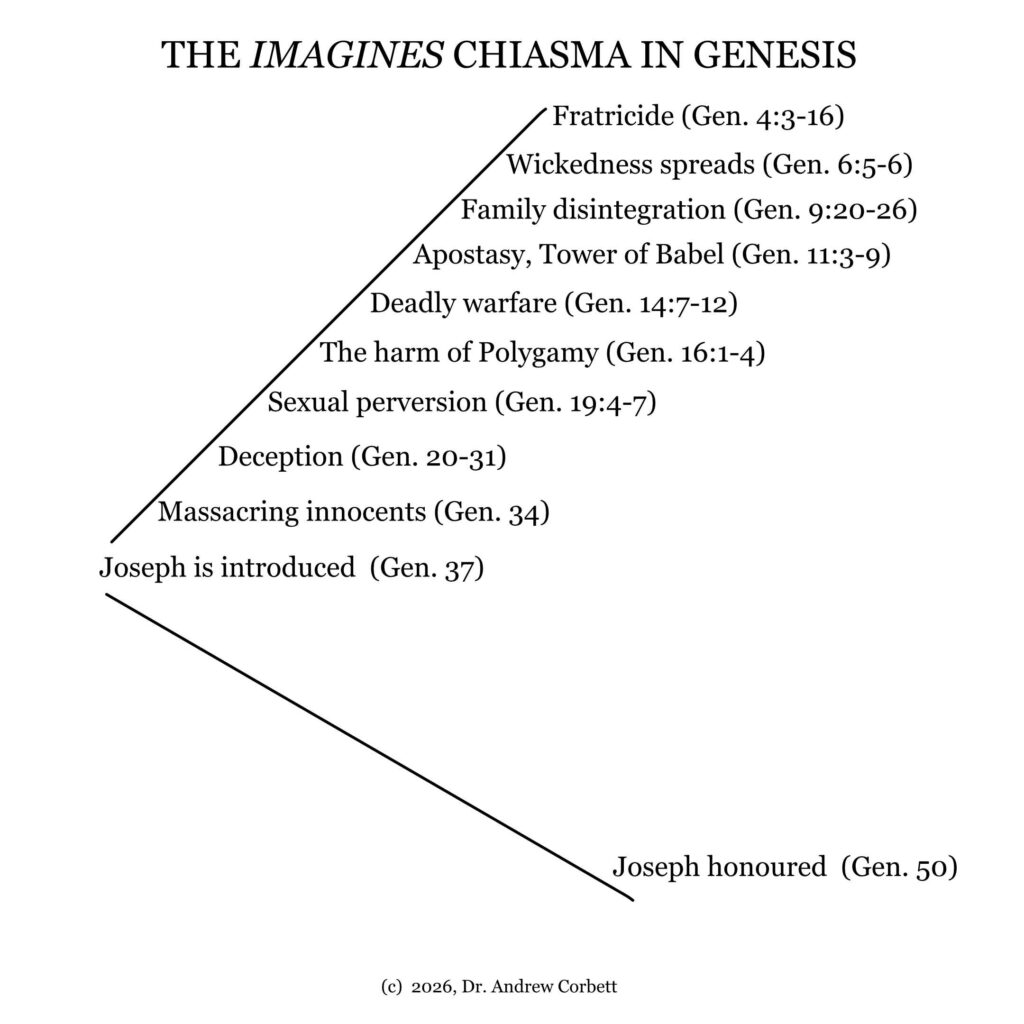
This diagram of the chiasma of imagines throughout Genesis hints at what the next chapter will focus on. Its first half halts at the introduction of Joseph, and forecasts how he is involved in the conclusion of Genesis.
© 2026, Dr. Andrew Corbett
Article 1 | Article 2 | Article 3 | Article 4 | Article 5 | Article 6
References:
[1] Arnold B. T., ed. The Cambridge Companion to Genesis. Brent A. Strawn, Chapter 10, “From Imago to Imagines: The Image(s) of God in Genesis,” 2022, 215.
[2] Brent Strawn. 2022, 219.
[3] Brent Strawn. 2022, 222.


 What is also overlooked about the creation of the woman is that her creation was the trigger for a heavenly creature’s pride and rebellion who then orchestrated to manipulate a nachash (serpent) to be able to speak and carry out the the temptation of the ’Ishah (
![“by his sin Adam lost the image of God in which he was made,” - Augustine, De Genesi ad literam (written in the early years of the fifth century) vi.27f. - “should not be taken to mean that none [of the image] remained in him, but that it was so deformed that it was in need of reformation.” - Retractations ii.24. Augustine died (in 430) before this retrospective survey was completed.](https://www.findingtruthmatters.org/wp-content/uploads/2026/03/IDRTG-Pt04-37-1024x576.jpg)