Showing posts with label mission. Show all posts

Friday, 11 August 2023

THINGS THAT CHRISTIANS CAN'T TALK ABOUT, Part 2 - DEPRESSION

 THINGS THAT CHRISTIANS CAN'T TALK ABOUT, Part 2 - DEPRESSION


All of us feel sad at some point – even people who are usually happy most of the time will have moments of sadness. Usually for most people there will be some understandable cause of it. This might include the loss of a loved one, a certain disappointment, an accident, or sympathy for friend or family member’s struggles. This kind of sadness is temporary. Yet there is a kind of sadness that lingers for weeks or months which leaves a person physically drained, perhaps teary, thinking dark thoughts, feeling desperately lonely and debilitated. This is usually when clinicians consider someone is experiencing ‘depression’ and it is one of those things that Christians find difficult to admit to or even talk about. Perhaps this is because Christians are supposed to be filled with the joy of the Lord, and able to cast all their anxieties onto the Lord, and therefore, presumably, be immune from such depression. But two facts make this untrue. Firstly, even many of the heroes in the Bible seem to have experienced some form of depression at least for a moment; and secondly, we each probably know of a godly follower of Christ who has done everything right yet still experiences recurring seasons of depression. I consider this topic to be one of the main things that Christians can’t talk about and probably should, and to this end I have some wisdom to offer in how we should go about it.

¶ Why are you cast down, O my soul,
and why are you in turmoil within me?
Hope in God; for I shall again praise Him,
my salvation  and my God.
My soul is cast down within me;
therefore I remember You
from the land of Jordan and of Hermon,
from Mount Mizar.
¶ Why are you cast down, O my soul,
and why are you in turmoil within me?
Hope in God; for I shall again praise Him,
my salvation and my God.
Psalm 42:5-611

ABOUT DEPRESSION

Depression is not a ‘one size fits all’. It effects people differently. Some experience a lack of appetite while others experience an abnormal increase in appetite. Some experience continual suicidal thoughts, while many do not. Some are easily brought to tears, while others experience repeated bouts of anger. Some experience a heightened sense of anxiety while others are able to remain functional in their jobs and responsibilities.

Depression often universally results in prolonged negative, dark, unhealthy thoughts; and, social withdrawal. It frequently leaves a person feeling lonely (or alone), as if no-one cares, and a loss of motivation. However, depression can be treated so that its symptoms are dramatically lessened and even eradicated through either through: medication, counselling, prayer, a change of diet, and regular physical exercise, – or a combination of these. I list several therapeutic remedies other than pharmaceuticals because, while I have good reason to believe that there is some benefit that can be attained from prescribed anti-depressant medication (largely due to my own interactions with those who have greatly benefited from taking it, and also my interactions with the many doctors who have have reported to me the health benefits from their patients who have also taken such medication). But I suspect that many people now look exclusively to pharmaceuticals to solve their health problems. I must admit, over the past few years my cynicism about multi-national pharmaceutical companies’ motives for wanting people to think this way has only magnified. This is why I appreciate those medical doctors who take a holistic approach to helping their patients overcome their depression rather than just prescribing a life-long course of antidepressant pharmaceuticals.


BIBLICAL HEROES WITH DEPRESSION

One of the most startling examples of a man of God who had been used mightily by God, yet experienced a season of depression was the prophet Elijah. He lived in Northern Israel after the civil war which saw the ten tribes of Israel to the north of Jerusalem separate from the two southern tribes appoint their own king and establish their own Kingdom (to be known as ‘Ephraim’ or ‘Israel’) distinct from the Kingdom in the line of David and Solomon in the South (which became known as ‘Judah’). In First Kings 18 Elijah challenged the 450 prophets of Ba’al to a duel to see who was the true GOD. The context involved offering a slain bullock on an altar of wood and see which god or GOD would respond with fire to accept the burnt offering. The 450 prophets of Ba’al, despite their incantations, their enchantments, their spells (1Kings 18:26), and then finally the shedding of their own blood through cutting and lancing (1Kings 18:28), did not answer them or consume the sacrificial offering with fire. Elijah then offered them some unhelpful advice – 

And at noon Elijah mocked them, saying,
“Cry aloud, for he is a god.
Either he is musing, or he is relieving himself,
or he is on a journey,
or perhaps he is asleep and must be awakened.”
First Kings 18:27

 After these false prophets had finished and conceded that they (and their god, Ba’al) had failed, Elijah then asked for the sacrificed bullock and the altar of wood to be saturated in water twice over. Then Elijah cried out a short but profound prayer –

¶ And at the time of the offering of the oblation,
Elijah the prophet came near and said,
“O LORD, God of Abraham, Isaac, and Israel,
let it be known this day that you are God in Israel, and that I am your servant,
and that I have done all these things at your word.
Answer me, O LORD, answer me,
that this people may know that you, O LORD, are God,
and that you have turned their hearts back.”
First Kings 18:36-37

What happened next would have impressed Steven Spielberg (1Kings 18:38)!


I suspect that there would have been a large component of dehydration, malnutrition, and exhaustion, in what happened next to Elijah. He heard that the wicked queen Jezebel who worshiped Ba’al had ordered that Elijah be executed (1Kings 19:1-2). In fear for his life, Elijah fled to the Southern Kingdom to hide from Jezebel’s assassins (1 Kings 19:3). In the pit of despondency Elijah prayed that he might die (1Kings 19:4). And what we see next is that GOD began to address the cause of Elijah’s depression (not just his symptoms).

  1. God gave Elijah sleep (1 Kings 19:5a).
  2. God gave Elijah company (an angel, 1 Kings 19:5b).
  3. God gave Elijah gave Elijah food and water (via the angel, 1 Kings 19:6).
  4. God reestablished Elijah’s mission and gave him something constructive to do which involved him interacting with people are realising that his negative assessment of the situation was wrong (1 Kings 19:715-18).  

Elijah is one example of many others recorded in the pages of Scripture who also experienced depression and who experienced almost exactly the same response from God (examples include Jeremiah, and Paul the Apostle).


BIBLICAL INSIGHTS FOR IMPROVING MENTAL HEALTH

"Rubin’s Picture" - What do you see? Two things? Or the one thing that is actually there but is easily missed?
I am not being naively simplistic about the remedy for depression. (Being simplistic with someone who is battling each of these topics that Christians can’t talk about is a large contributor to why some Christians are reluctant to talk about these issues!) But I see something in the opening chapters of Genesis that I find extremely helpful in managing moods and mental health. Sometimes you have to a little closer at something to realise what you’re actually looking at!

¶ And they heard the sound of the LORD God
walking in the garden in the cool of the day,
and the man and his wife hid themselves from the presence of the LORD God
among the trees of the garden.
Genesis 3:8

Firstly, From this verse in the opening chapters of the Bible we see that God had created a paradisiacal environment for mankind to enjoy. (Mankind was not created to live apart from nature (gardens and wildlife). If all you ever see throughout your day is a screen, concrete and steel, your soul is being malnourished which then depletes our mental health!)

Sunrise over Mount Arthur in the background from Legana with apple orchards in the mid-ground, and native trees in the foreground

Secondly, mankind’s world was one in which they enjoyed a regular interaction with God. (Mankind was not created or designed to live without a vital communion with our Maker. Our prayerful interaction with God is nourishing for our soul.)

Thirdly, it appears that Man and GOD regularly walked together as they spoke with each other. There was a physical manifestation of God which enabled the first man and woman to “hear the sound of the LORD walking in the garden”. The simple act of walking and talking with God as you do is a spiritually replenishing activity. (Mankind was created to take a long daily stroll with God). Even several generations after Adam this was something that Enoch practised (Gen 5:2224) and benefited greatly from doing it.

Fourthly, Mankind were given an extensive fruit tree garden from which they could enjoy fresh, unprocessed whole foods. (Mankind was created and designed to eat a diet consisting largely unprocessed whole-foods. Our high-sugar, high complex-saturated fat, high processed diets have a negative impact not just on our physical health, but also on our mental and emotional health.)

Fifthly, Mankind was meant to live with a clear conscience by obedience to God and His Word. (Mankind was created monarchial, that is, royal. We were created in the Sovereign King of the Universe’s image to co-rule this world as His vice-regents. The serpent and its manipulating master, the Evil One, had nothing to offer our original parents except lies. Yet they willingly chose to reject the Truth and accept an outlandish lie. Today, the Evil One and his minions continue to dupe God’s Image bearers with malicious lies. Accepting these lies can only lead to poor mental health. This is why being grounded daily in the truth found in God’s Word is therapeutic for our souls and nourishing for our mental health.)


TALKING ABOUT IT

As with each of these topics, I want to encourage you to talk about these things — but I especially want to encourage you (and hopefully model) how to listen to those who do open up about their struggles. Sometimes the greatest gift we can give someone in those moments is a listening ear and the knowledge that someone cares enough to take the time to seek to understand what they are going through. And, as I have already stated here, and will repeat in Part 3, we should not offer judgment or simplistic answers. It’s my conviction that there are many lonely people in our church and especially outside of our church who long for someone who might offer them these two gifts of a listening ear, and understanding. I hope you can join me in being one of these gift givers.

Pastor at Large,

Andrew

Let me know what you think below in the comment section and feel free to share this someone who might benefit from this Pastor’s Desk.


READ PART 3, DIVORCE

Friday, 14 July 2023

SOME WALLS NEED TO BE TORN DOWN AND SOME WALLS NEED TO BE REBUILT

SOME WALLS NEED TO BE TORN DOWN AND SOME WALLS NEED TO BE REBUILT

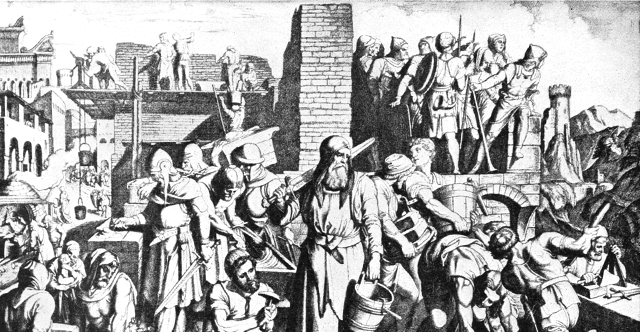
One of the most remarkable examples of great leadership given in the Bible is that of Nehemiah. Others may claim that the feats of King David were greater and these people may have a point. But I have word to say in favour of Nehemiah and offer several reasons for regarding him as the greater leader. Firstly, King David was a builder while Nehemiah was a re-builder. As any builder can tell you, building is far easier than rebuilding. King David was a military commander whose soldiers were compelled to obey his orders. But Nehemiah was a public servant, a royal wine-waiter, who had no power to compel anyone – yet dozens of people willingly assisted him to fulfil his leadership vision. King David executed his opponents. Nehemiah used his wits to avoid and even ignore his opponents and outsmart his critics. King David’s lust and arrogance nearly undid all the good he had done. Nehemiah’s refusal to be corrupted ensured that the divine plan of redemption remained on track and paved the way for the coming of the prophesied ‘Son of David’ who would atone for the sins of all mankind. And ultimately, Nehemiah achieved this with far, far, fewer resources than the enormous wealth that King David’s military spoils afforded him. Without an army, or thousands of servants, or the wealth of a king, Nehemiah instead employed one of the most powerful strategies that any leader can use: partnership.


After Judea had ignored the warnings of the prophet Jeremiah and gone deeper into sin, evil, and wickedness, the prophesied doom of destruction of their once glorious city and their expulsion from their land was the result. The Babylonian King, Nebuchadnezzar, sent a clear message to all the surrounding nations when he had his forces utterly demolish Jerusalem and its temple after breaking down its once fortress-like wall in protection. For some seventy years the ruins of Jerusalem lay amidst its own rubble. When the Medo-Persian conquerors eventually conquered the Babylonian Empire – it was Cyrus who decreed that all Jews were now free to and their captivity in Babylon return to their homeland. But many Jews who had not been born in Jerusalem had no emotional connection with Jerusalem and did not return there. But there were a few who did choose to relocate back to their ancestral home. However, when they arrived, they were overwhelmed with the seemingly impossible task of rebuilding their grand-parents’ once beloved city.

The words of Nehemiah the son of Hacaliah. Now it happened in the month of Chislev,
in the twentieth year, as I was in Susa the citadel, that Hanani, one of my brothers,
came with certain men from Judah. And I asked them concerning the Jews who escaped,
who had survived the exile, and concerning Jerusalem.  And they said to me,
“The remnant there in the province who had survived the exile is in great trouble and shame.
The wall of Jerusalem is broken down, and its gates are destroyed by fire.”
Nehemiah 1:1-3

It would be too easy to think that Nehemiah’s concern for Jerusalem was merely architectural. And while he certainly had a deep concern for its bricks and mortar – which, to some, are literally the building blocks of a city – however, in Nehemiah’s mind, the wall and gates around the city and the buildings it safeguarded were powerful symbols of the inhabitants honour and dignity. Buildings and walls and do not make a city — people who inhabit a city is what make a city! But in those days, a city without a protective wall and gates was cause for derision by its neighbours.


Nehemiah had clearly served the Persian King well over many years. Despite being exiled from his ancestral homeland, he had earned a reputation with the king over that time as a diligent and loyal man of integrity. He was someone in whom the king could trust. However, after receiving the distressing news of Jerusalem’s pitiful state from his recently returned brother he was moved to tears of sadness. This lasted for days and jeopardised his impending scheduled service in the king’s presence.

¶ As soon as I heard these words I sat down and wept and mourned for days,
and I continued fasting and praying before the God of heaven.
Nehemiah 1:4

Despite being merely a wine-waiter, Nehemiah had decided that he was the one who would do something to rebuild the enormous damage that had happened to his ancestral home. His years of closely watching the king ruling his vast empire gave him a first-hand look at what high-level and strong leadership looked like and helped prepare him for this important task. But still, Nehemiah looked to the Lord for His guidance and strength.

O Lord, let your ear be attentive to the prayer of your servant,
and to the prayer of your servants who delight to fear your name, and give success to your servant today, and grant him mercy in the sight of this man.”
¶ Now I was cupbearer to the king.
Nehemiah 1:11

Coming into the king’s presence while looking upset was a risky thing to do. When the king then asked why he was sad, Nehemiah demonstrated his spiritual depth.

¶ In the month of Nisan, in the twentieth year of King Artaxerxes, when wine was before him,
I took up the wine and gave it to the king. Now I had not been sad in his presence.
And the king said to me, “Why is your face sad, seeing you are not sick?
This is nothing but sadness of the heart.” Then I was very much afraid.
I said to the king, “Let the king live forever! Why should not my face be sad,
when the city, the place of my fathers’ graves, lies in ruins, and its gates have been destroyed by fire?”
Then the king said to me, “What are you requesting?” So I prayed to the God of heaven.
Nehemiah 2:1-4

The result was that the king appointed him as his first governor of Jerusalem after hearing his request.

And I said to the king, “If it pleases the king, and if your servant has found favor in your sight,
that you send me to Judah, to the city of my fathers’ graves, that I may rebuild it.”
Nehemiah 2:5

Nehemiah's Unusual Gifts and Abilities


The king’s response to Nehemiah’s request tells us a lot about Nehemiah and his years of faithful service to the king. It also tells us about his role clearly meaning much more to the king than just as a royal wine-waiter! Nehemiah had demonstrated a very rare ability of being able to lead and manage(It is very unusual for a leader whose main responsibility is to cast vision, set tone, and keep his team on track; and, to also manage the details and the people involved to ensure that the leader’s vision is being fulfilled. Leaders move people. Managers maintain people.) But Nehemiah was such a leader. Those he ended up leading and managing gave him their respect. And little wonder! It was obvious to them that Nehemiah was not there to ‘milk the system’, ‘feather his own nest’, or ‘advance his career’ in the public service. From the moment Nehemiah arrived in Jerusalem he set about to covertly assess the situation.

¶ So I went to Jerusalem and was there three days.  Then I arose in the night,
I and a few men with me. And I told no one what my God had put into my heart to do for Jerusalem.
There was no animal with me but the one on which I rode.
I went out by night by the Valley Gate to the Dragon Spring and to the Dung Gate,
and I inspected the walls of Jerusalem that were broken down and its gates that had been destroyed by fire.
Nehemiah 2:11-13

Nehemiah then took time to get to know those who would work with him. He formed a realistic assessment of what each person and family group could contribute either in service or finances-or both (Neh. 3:1-46-32).

¶ Then I said to them, “You see the trouble we are in, how Jerusalem lies in ruins with its gates burned. Come, let us build the wall of Jerusalem, that we may no longer suffer derision.” And I told them of the hand of my God that had been upon me for good, and also of the words that the king had spoken to me. And they said, “Let us rise up and build.” So they strengthened their hands for the good work.
Nehemiah 2:17-18


Doing the difficult is a job requirement of any leader. To lead a coalition of partners sometimes requires correcting inappropriate conduct (as any parent can tell you). Nehemiah’s mission to rebuild the wall demanding that he scold those nobles who felt that rebuilding the wall “was beneath them” (Neh. 3:5). Leaders must know how to maintain such discipline and when to exercise the fatherly skill that the apostle Paul said was an essential requirement of every overseer – how to rebuke the person saying or doing the wrong thing (Titus 1:913). Nehemiah knew that in order to maintain the morale of his ‘team of partners’, these nobles who had neglected their responsibilities and were actually taking financial advantage of the people and needed to be held to account. Thus, Nehemiah rebuked these precious nobles for their heartless ‘snobishness’ and their unwillingness to get their hands dirty!

¶ I was very angry when I heard their outcry and these words.
I took counsel with myself, and I brought charges against the nobles and the officials.
I said to them, “You are exacting interest, each from his brother.”
And I held a great assembly against them…So I said, “The thing that you are doing is not good.
Ought you not to walk in the fear of our God to prevent the taunts of the nations our enemies?”
Nehemiah 5:6-79

Should we think of Nehemiah as “task-driven”? Absolutely! He knew that in order to care for the inhabitants of Jerusalem, they had to get their city’s wall rebuilt urgently. Every parent knows this kind of leadership. There are tasks that must be done – and sometimes they must be done urgently. After years of delays, procrastination, and a lack of leadership, the task assigned to Nehemiah would eventually be completed in 52 days (Neh. 6:15).


Nehemiah assigned segments of the destroyed wall to people and families for them to rebuild. These segments equated to an average of about ten metres of the wall for them to rebuild. His strategy was elegantly simple – but required everyone doing their bit  – that is, partnering together. Rather than have a few do a lot, he had many each do a little. They partnered together and together they were able to achieve what many said could not be done! It was the great evangelist, D. L. Moody who said, “I’d rather put ten men to work than do the work of ten men!” Apologist and former cold-case homicide detective J. Warner Wallace, often says “The world does not need anymore million-dollar apologists – it needs a million one-dollar apologists!” There is a divine wisdom in having many people partnering together to achieve a vision much bigger than themselves. We see that Jesus chose and partnered with the twelve, the seventy, and then the five-hundred (1Cor. 15:6), to begin to spread the gospel of this forgiveness and eternal life through His substitutionary death on the cross—and today He is using hundreds of millions of His followers around the world to continue to partner together to complete this task.


Nehemiah was a man of impeccable character. He was a humble, servant-hearted leader who deeply cared for those he was partnering with to rebuild the walls of Jerusalem. But, despite this, as all leaders have, he had very spiteful critics. After Nehemiah had arrived in Jerusalem, he had three men, Sanballat, Tobiah and Geshem, greet him and offer to help him. However, Nehemiah saw through their ruse. He discerned that they had not come to help him but the control him. Their interest in whatever Nehemiah was planning to do very quickly turned to sinister opposition.

Sanballat and Geshem sent to me, saying, “Come and let us meet together at Hakkephirim in the plain of Ono.” But they intended to do me harm….In the same way Sanballat for the fifth time sent his servant to me with an open letter in his hand….And I understood and saw that God had not sent him, but he had pronounced the prophecy against me because Tobiah and Sanballat had hired him.
Nehemiah 6:2512

Nehemiah’s response to these toxic opponents may seem cold, impolite and perhaps even arrogant.

And I sent messengers to them, saying, “I am doing a great work and I cannot come down.
Why should the work stop while I leave it and come down to you?”
Nehemiah 6:3

But Nehemiah did exactly the right thing. He cut these people off from having access to him, and saw through their requests for a meeting as an attempt to halt what he was doing and distract him. When this failed they then resorted to slandering him, spreading lies about him, employing intimidation and threats, then sheer bullying. All of this revealed the identity of the evil spirit who was actually manipulating these three stooges. So Sanballat, Tobiah and Geshem then resorted to ridicule and mockery.

Tobiah the Ammonite was beside him, and he said,
“Yes, what they are building—if a fox goes up on it he will break down their stone wall!”
Nehemiah 4:3


And when all our enemies heard of it, all the nations around us were afraid
and fell greatly in their own esteem, for they perceived that this work
had been accomplished with the help of our God.
Nehemiah 6:16

Nehemiah not only got the city wall rebuilt, he also managed to give the despondent residents hope and encouragement. Added to this, he was able to knit them into a confident team of partners and to breakdown the “us and them” wall between the residents and the nobles. Thus, Nehemiah not only rebuilt a wall, he also broke down a few – not only the wall of oppression separating the nobles and the residents, but also the walls of fear and intimidation set up by their enemies Sanballat, Tobiah, and Geshem. By helping the citizens of Jerusalem to partner together to achieve what they had not been able to on their own, Nehemiah gave them a powerful gift for dealing with their other challenges. This is why we also believe in the power of partnership as a local church and expect that as we partner together we too may also face some of the same challenges that Nehemiah had to face. And may God give us the grace to do so.  

Amen.

Pastor at Large,

Andrew

Let me know what you think below in the comment section and feel free to share this someone who might benefit from this Pastor’s Desk.