
MANKIND’S LONGING TO CONTROL TIME
He has made everything beautiful in its time.
Also, He has put eternity into man’s heart,
yet so that he cannot find out what
God has done from the beginning to the end.
Ecclesiastes 3:11


The years of our life are seventy,
or even by reason of strength eighty;
yet their span is but toil and trouble;
they are soon gone, and we fly away.
Psalm 90:10

WHY WE CAN NOT CONTROL TIME
Before clocks were invented, people did not view time like we do today. At sun rise it was time to rise. When the sun was as high as it was going to get, it was midday. When the sun began to set, it was time to stop working. When the sun set, it was dinner time. And shortly after it was dark it time for bed. Even in ancient times sun-dials were used as a way to see where the sun was in the sky without having to stare directly at it (one is mentioned in Isaiah 38:8).
The original indoor clocks were pendulum and springs. They were not particularly reliable or accurate. Then, in the sixteenth century, smaller versions were invented without the need for a pendulum and could fit comfortably in a gentleman’s pocket. This then paved the way for the invention of the wrist watch around the time that the industrial age was in full swing (around 1868). In 1960 the first quartz watch was invented doing away with the need for winding and springs. These quartz watches are still the most accurate time-pieces available to ordinary people. From then, wrist watches (and electronic quartz clocks) became increasingly more sophisticated and able to measure time in smaller and smaller increments. In 2019, the Swiss watch maker, Patek Philippe, created a two-sided gentleman’s wrist watch that sold for $US31,000,000! It is fair to say that the buyer was a little obsessive about the quality and precision of his time-keeping.
The most expensive wrist watch ever sold.

Despite our increasingly precise ability to measure time, we are still unable to control it. In a culture that demands god-like control over every aspect our lives, our complete inability to control time is one of mankind’s greatest enigmas and frustrations. Our ability to measure it in such finely small increments and to always be aware of it by looking at our wrists – or the devices in our pockets – only adds to frustration that it is slipping by without paying any intention to our desire to let us control it!
Time is a sequence of unchanging events. This means that time is ordained and therefore what has happened has actually and really and finally happened. This is why the notion of being able to travel back in time is fanciful.

WHY WE ALL FIND TIME FRUSTRATING
“I just wish I had more time!” “I just wish we had more time together.” Our inability to control or even tame time reminds us that we are not all-powerful. In that sense, time almost mocks us all and certainly causes us to realise that any frustration we feel about its consistent and unchanging nature is a reminder that we are subjects to it — or more precisely — to the One who created it for us to inhabit for a very very good reason. The unchangeable nature of time deprives us from going back in time to the moment of our greatest (and perhaps most secret) sins or mistakes and preventing them, thus denying us the power of removing our unbearable burden of guilt and shame.
Remember how short my time is!
For what vanity you have created all the children of man!
What man can live and never see death?
Who can deliver his soul from the power of Sheol? Selah
Psalm 89:47-48
GOD’S RELATIONSHIP TO TIME

We sometimes refer to God as being outside time. Philosophical theologians refer to two theories about God’s relationship to time: the ‘A’ Theory of Time and the ‘B’ Theory of Time. In Mere Christianity, C.S. Lewis described God’s relationship with time like the reader to a book. He referred to God as being outside of the book who is able to turn to any page of that book at any time. This, in Lewis’s mind, is how one might explain God’s intimate knowledge of the future and His ability to reveal it to those who are yet to witness or experience it. This is known as the B-Theory of Time. But most theologians take issue with Lewis and argue that it is not because the future has already happened that God knows what it holds, it is rather because the future has not yet happened and yet God can still declare it through His prophets – that we know that God is omniscient (He knows all things – even those things that will be). This is known as the A-Theory of Time.
¶ “Remember this and stand firm,
recall it to mind, you transgressors,
remember the former things of old;
for I am God, and there is no other;
I am God, and there is none like me,
declaring the end from the beginning
and from ancient times things not yet done,
saying, ‘My counsel shall stand,
and I will accomplish all my purpose,’
Isaiah 46:8-10
When God created our material world and its dimension of time, He entered into it. From the moment of creation, which is described in the opening chapter of Genesis, as taking God six “days” (with each day having an evening and morning) and then resting from creating on the “seventh day” (which God is still in since it is not ascribed an evening and morning, Gen. 2:4). And to put beyond any doubt that God has entered into our dimension of time, consider the first Christmas when the Creator Himself, the eternal Son of God, became a zygote who, over time, grew into the Son of Man prophesied in Daniel 7:13-14. Christ, subjected Himself to time and conquered its fatal sting.
GOD’S GIFT OF TIME TO EACH OF US
We live in a fast paced world. We expect things to happen quickly. None of us like to be kept waiting. Even when we order something online we expect it delivered straight away. Some of us having to work two or even three jobs just to be able to pay the bills. We describe ourselves as time-poor. Yet, we all get twenty-four-hours in a day. Sixty-minutes in an hour. And sixty-seconds in a minute. Most of us need to adjust how we see, understand, and treat our time. This will involve, what will be for some, adopting a foreign and largely unaccustomed view of time that involves worship, sabbath, and deepening relationships. From this biblical perspective we will come to see time as a gift from God, not a curse, or source of frustration. Within this gift of time God teaches us how to worship in those times when it is difficult to do so. Rather than thinking this divine gift of time is ours to do with what ever we want, God uses this gift to teach us that we should gift it back to Him beginning with (but not limited to) treating Sunday as a sabbath to come together to recommit our hearts, voices, minds, and presence with God’s people, back to God. God gives us passing time to learn to deepen relationships – especially with our kin, and our friends. Time is meant for relationship building.
¶ So teach us to number our days
that we may get a heart of wisdom.
Psalm 90:12

WHEN TIME AS WE KNOW IT WILL ONE DAY END
But this gift of time will one day come to end – not just for each of us individually – but once and for all.
For this is the will of My Father, that everyone who looks on the Son
and believes in Him should have eternal life, and I will raise him up on the last day.”
John 6:40
The one who rejects Me and does not receive My words has a judge;
the word that I have spoken will judge him on the last day.
John 12:48
God dwells in a dimension that I refer to as eternity. The Triune God is the only being who inhabits this dimension. But when He created the Heavenly realm, and populated it with magnificent heavenly creatures. These beings then dwelt in His presence in yet another dimension (we might refer to super- or supra-time). In this supra-time dimension these heavenly beings do not age or grow. The Triune God created this dimension for His heavenly family in a way that some of these heavenly creatures could enter into our dimension of time.
And the angel answered him, “I am Gabriel. I stand in the presence of God,
and I was sent to speak to you and to bring you this good news.
Luke 1:19
After the “last day”, we will all be resurrected. The righteous, those who have surrendered their lives to God’s gracious offer of forgiveness and adoption, will be resurrected into eternal-life and enjoy their existence forever with the Triune God in a new dimension that God had planned from the beginning of the world. For in that coming new eternal dimension we will truly worship, truly rest, and truly love everyone of fellow redeemed. In the meantime, the gift of time that He has given to each of us in this dimension is designed by our Heavenly Father to teach and prepare us for it. See you this Sunday.

Rev. 21:1 ¶ Then I saw a new heaven and a new earth, for the first heaven and the first earth had passed away, and the sea was no more. Rev. 21:2 And I saw the holy city, new Jerusalem, coming down out of heaven from God, prepared as a bride adorned for her husband. Rev. 21:3 And I heard a loud voice from the throne saying, “Behold, the dwelling place of God is with man. He will dwell with them, and they will be his people, and God himself will be with them as their God. Rev. 21:4 He will wipe away every tear from their eyes, and death shall be no more, neither shall there be mourning, nor crying, nor pain anymore, for the former things have passed away.”
Rev. 21:5 ¶ And he who was seated on the throne said, “Behold, I am making all things new.” Also he said, “Write this down, for these words are trustworthy and true.”

Your Pastor,
Andrew
Let me know what you think below in the comment section and feel free to share this someone who might benefit from this Pastor’s Desk.


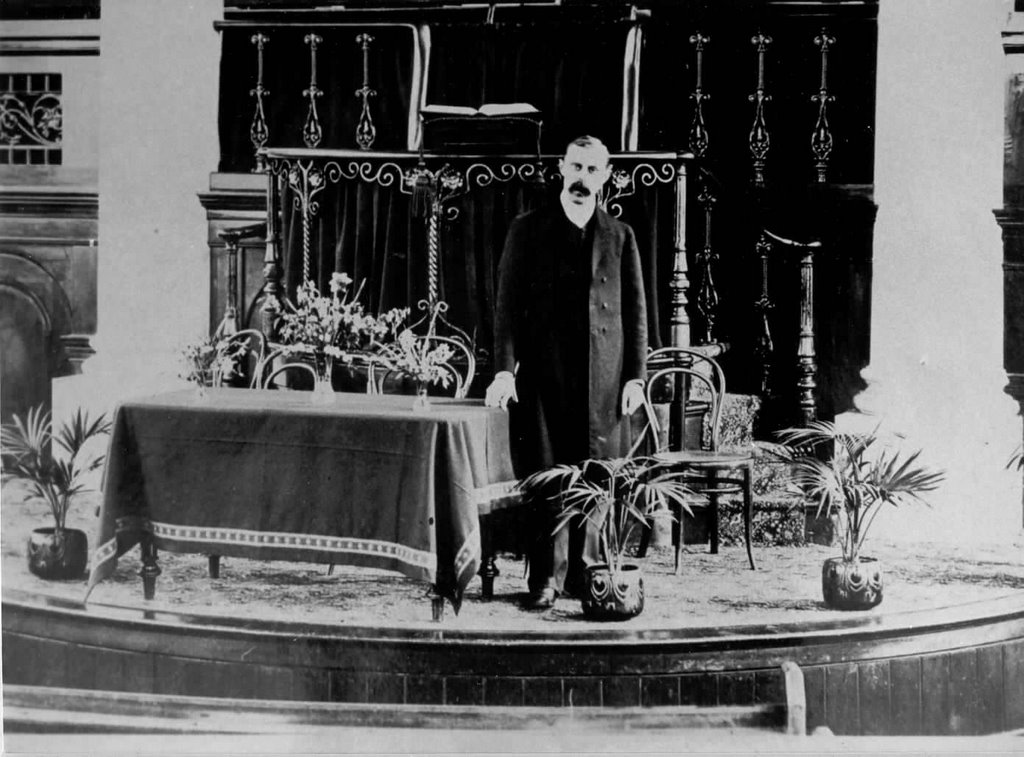

 Exciting people claim to detest routine and habitual behaviour. They thumb their noses over their sidewalk skinny decaf soy lattés at those boring people whose lives are regulated by such plain things as habits. But, on behalf of the boring people of this world, I feel it is time to offer a defence of habits and say something positive on behalf of its boring cousin: routines. You see, Habits and its cousin Routines have saved my life more than once. I have them to thank for my amazement that I can get anything done.
 Jesus had two outstanding habits. He often went out by Himself to pray. Dr Luke tells us that He often went out at night to pray to His Father all night. Jesus made spiritual disciplines a habit. From about the age of 15, over these past 35 years I have tried to copy Christ's practice of making certain spiritual disciplines a habit. I honestly cannot recall a day in my life in all that time when I have neglected the habit of reading Scripture. I confess, there have been times when I have practiced this spiritual discipline because it was a habit rather than for more noble reasons. But I can also say that in not just a times I have received delightful illumination that has nourished both my soul and mind.
 I was marvelling recently about how much the 74 year old F.W. Boreham did. Not only did he preach at least twice a week, he wrote a weekly column for the Melbourne Age Newspaper, the Hobart Mercury, produced a book a year, was a regular contributor to at least six monthly journals or periodicals, read a book a week, and made pastoral house-calls four afternoons a week. I'm staggered at his output. But then again, I swim in a culture of 24/7 social-media, 16 Free-to-air television channels, several million YouTube videos, several billion webpages, and what seems like hundreds of (mostly trivial) emails everyday - which all seem to hinder me from using my time well. Even with all my technological "time-saving" devices, I doubt that I get a fraction done of what people a generation ago achieved. Nevertheless, even though I struggle, there is hope.
 Leading up to Christmas, some dear folk asked me what I would like for Christmas. Under pressure to keep up with the demands on my time, the first thing that came to mind, but not past my lips, was, "More time!" Knowing I will never get more time, I am left to pray what the Scriptures tell me to do - redeem the time. Some prayers are not meant to be prayed but this one is!
 Have you ever wasted time? Whether you have or haven't is determined by answering the should question. With the time that you have what should you be doing? If your answer is other than what you should be doing then your answer might be describing what wasting time looks like. And this is where I encounter many of my problems with time. When I should do something, but really really really don't want to, I find things that urgently require my attention. I find them. They are not all ignoble. But they successfully occupy my time when I should be doing something else.
 From my observations of people who seem to manage pressure, and therefore time, well, I notice that they are able to withdraw from their time-bank when they need to. This of course means that they have made adequate deposits into it. In other words, they invest their time well. Reading a book, watching a movie, having a coffee with a colleague, going for a walk, throwing a ball with your son, taking your wife out to dinner, might seem like a waste of time, but they might also be investments of time. The Bible doesn't use the wordinvestment but it does use a three-letter word which means the same thing.