Saturday, 10 September 2022

LOOKING BACK OVER THE PAST TWO HUNDRED YEARS OF OUR CHURCH'S HISTORY FROM 2222


As Kim and I enjoyed our weekly coffee-date this morning at Stillwater, she looked out ruminatively across the water at all of the development that has taken place over the past 200 years where the North and South Esks merge to form the Tamar River.

I wonder if the settlers who came here two hundred years ago” she asked, “could have imagined the silos would have been built over there and then turned into a luxury hotel, or that two bridges would have been built here, or that their tiny village would grow into a large city?

What’s more interesting” I responded, “is if anyone today can envision what it will all look like in another two hundred years!

And my response then got me thinking. Could it be possible to imagine what Launceston will end up looking like in another two hundred years—and, what about our church? What will our church will look like in two hundred years time? As I mused throughout the rest of the day on this question my thoughts went to the future. In 2222, Tasmania’s population on current trends will be 4.5 million. Hobart will have a population of 2 million. Launceston will have a population of 1.34 million. The Tamar River will have population centres on either side of it which will be connected by a series of bridges and tunnels. Tasmania will be connected to the mainland by a “strunnel“ similar to, but much larger than, England’s connection to France through their chunnel. Tasmania’s climate, soil conditions, and abundance of fresh water will lead to it becoming a major international food-bowl. In 200 years, after several periods of devastating natural disasters and military conflicts in various parts of the globe, Tasmania will have opened its heart wide to immigrants from all over the world. This will lead to tens of thousands of people who had also moved here after the collapse of the Islamic world a century earlier. Thousands of Indian families will have also made Tasmania their home. Added to this, there will have been a migration of thousands of Chinese families after the collapse of the formerly oppressive Communist regime. Historians will look back over this period and note that it was a series of spiritual revivals where tens of thousands of people converted to Christianity and churches all across Tasmania were burgeoning. It was the Tasmanian churches of the 23rd century that led many social and cultural reforms where prisons were largely emptied as a result of the change in the moral climate, marriage was once again considered the sacred covenant union of a man and his wife, the rate of violence against women almost unheard of, and wives who became mothers were highly honoured and supported.

Imagine the Friday Pastor’s Desk, written by Legana Christian Church’s 15th Senior Pastor, writing just before the church’s 205th Annual Thanksgiving Sunday…


Your Pastor,

Andrew

Let me know what you think below in the comment section and feel free to share this someone who might benefit from this Pastor’s Desk.


An antique ‘photo’ of what used to be the entrance to the auditorium taken near the turn of the 21st century.
As we prepare for our 205th Annual Thanksgiving Weekend, a tradition that dates back two centuries beginning in 2017, we again pause to give thanks for the goodness of God and the sacrifices and faithful service of our forefathers and those who pioneered our church. This is why, for this week’s Pastor’s Desk, I have decided to use the ancient technology of email and the ‘internet’ to send out my Pastor’s Desk as it would have been done by the pastor in 2017. It was just five years ago (2217) that we gathered to open our last building project, our multi-storey auditorium and ministry centre complex. We all remember 
that Thanksgiving Sunday when 15,000 of us gathered over our five services that Sunday as the Holy Spirit moved powerfully in each service. The Text by our guest speaker was- 

The one who offers thanksgiving as his sacrifice glorifies Me;
to one who orders his way rightly
I will show the salvation of God!”
Psalm 50:23


A NEW CHAPTER BEGINS

Not only will we be continuing the tradition of setting aside the second weekend in August to give thanks to God for all that He has done for us as a church, as all of my predecessors have done, this weekend will also mark the goodness of God as I retire and we install our next Senior Pastor. And as we look forward to the future we will, as is our tradition, commission our new pastor by reading the charge written by my predecessor 200 years ago. The text for Thanksgiving services this Sunday, as selected by our guest speaker, will be Psalm 95:2-3 – 

Let us come into His presence with thanksgiving;
let us make a joyful noise to Him with songs of praise!
For the LORD is a great God,
and a great King above all gods.
Psalm 95:2-3

Our next pastor will be our church’s 16th pastor in our two hundred and thirty-five year history. We have all had an opportunity to hear and meet him and his family. All two-hundred and eighty-three of our church’s staff have given their endorsement for his appointment, and our elders issued a statement a few weeks ago expressing their commendation of him as well noting that at the age of just 32 he has had extensive international leadership experience. We remember that the last time he shared with us, he talked about how the Lord had clearly called them to come to Tasmania and that he even had a historic connection with our church sharing that his great, great, great, great grandfather also pastored our church two centuries earlier! His grasp of being fluent in several languages will enable him to connect well with our Chinese, and Spanish congregations without the usual need for an interpreter. This was also reflected in his last message with us when he selected the text Revelation 7:9-10 –

¶ After this I looked, and behold, a great multitude that no one could number, from every nation, from all tribes and peoples and languages, standing before the throne and before the Lamb, clothed in white robes, with palm branches in their hands, and crying out with a loud voice, “Salvation belongs to our God who sits on the throne, and to the Lamb!”
Revelation 7:9-10


PRACTICALITIES

Please be praying for our guests and dignitaries who will be joining with us for Thanksgiving services this Sunday – especially our Prime Minister that she will be touched by the Holy Spirit, our State Governor, and our State Premier (even though both our Governor and Premier grew up in our church and coincidentally were baptised here as young teenagers in the same Baptism Service). Could each of our Service Attendant Teams meet 45 minutes before each of their rostered services on the fifth floor of our Ministry Centre (MC), and could our elders gather for prayer before each service in our Board Room located adjacent to my office on the sixth floor. To avoid congestion in the eastern multi-storey underground car park, please use the western multi-storey car park instead. Several dignitaries will be arriving by HV (hover vehicles) and be using the HV landing pads on the roof of the MC. Remember –

[We are] to bring to light for everyone what is the plan of the mystery hidden for ages in God, who created all things, so that through the church the manifold wisdom of God might now be made known to the rulers and authorities in the heavenly places. This was according to the eternal purpose that he has realized in Christ Jesus our Lord!
Ephesians 3:9-11

See you Sunday,


Your pastor.
August 9th, 2222

Friday, 2 September 2022

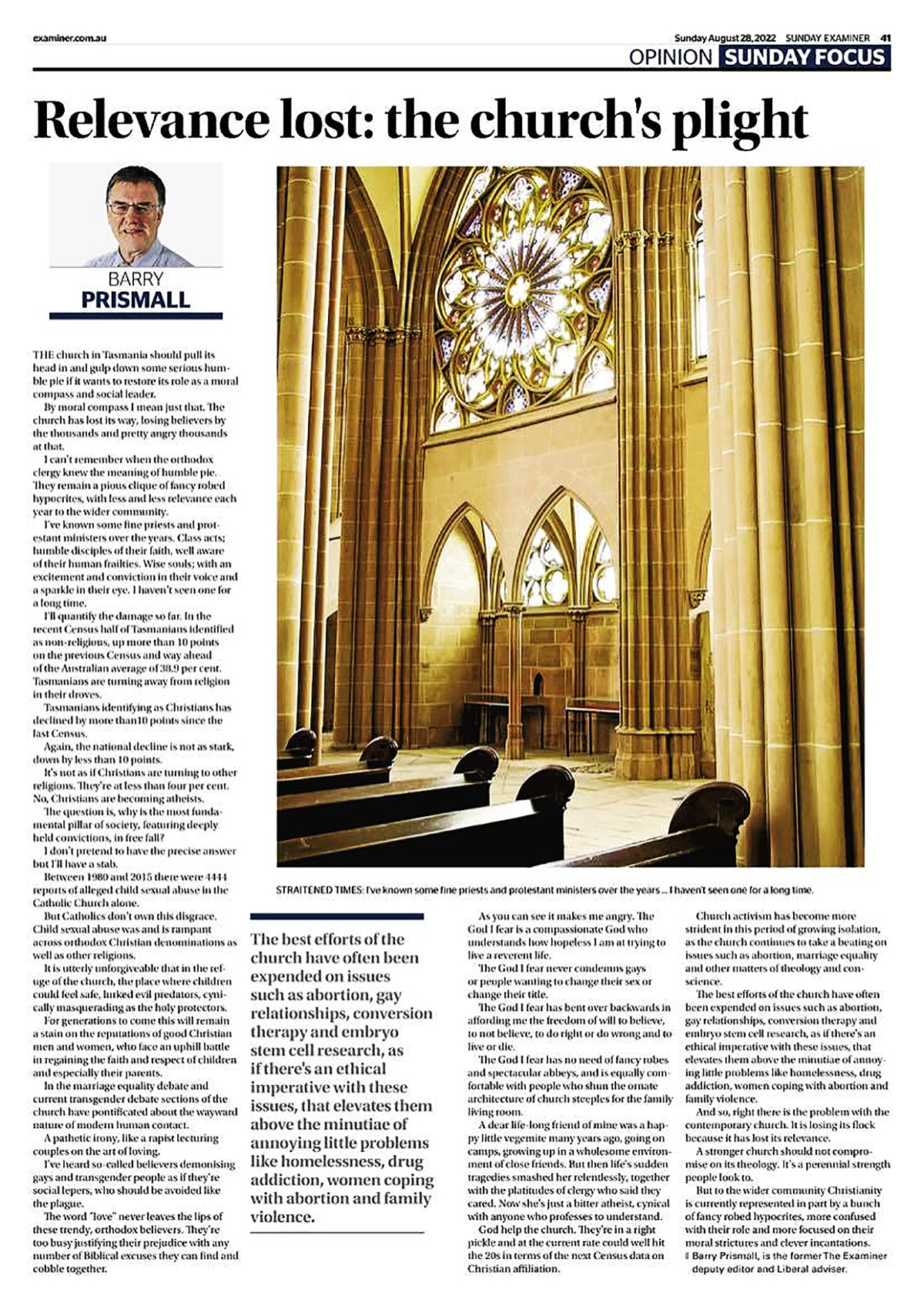
RELEVANCE INTACT: The Tasmanian Church's Place

NOTE: This is a critical review of Barry Prismal’s Sunday Examiner Opinion piece published Sunday August 29th 2022, which complies with Section 41 of The Australian Copyright Act 1968 which states: Division 3—Acts not constituting infringements of copyright in works, 41  Fair dealing for purpose of criticism or review – A fair dealing with a literary, dramatic, musical or artistic work, or with an adaptation of a literary, dramatic or musical work, does not constitute an infringement of the copyright in the work if it is for the purpose of criticism or review, whether of that work or of another work, and a sufficient acknowledgement of the work is made. The Australian Copyright Council has advised: “criticism and review involves making a judgment of.the material concerned, or of the underlying ideas.” Therefore, you can use either the whole work(if it is needed) or a part of it for criticism or review.


Tasmanian churches play a vital role in our state as a moral compass and social leader. Our moral compass was given to us 2,000 years ago by Christ when He then commissioned the Church to preach, teach, and care in His Name. The Church’s role as a social leader was thus modelled and instigated by Jesus who had embraced the shunned, condemned oppressors of the vulnerable, and upheld the sacredness of every human life and taught His followers to do likewise. 
Two thousand years later, Tasmanian churches continue to gather weekly and proclaim the good news (“the gospel”) which Jesus taught; to care for the poor and homeless, feed the hungry, welcome refugees, and provide thousands of young Tasmanians with an education. This is why the former Examiner deputy editor in recently described the Tasmanian Church as “the most fundamental pillar in society.” But, then he went on to describe it as being led by “
a pious clique of fancy robed hypocrites, with less and less relevance each year to the wider community” (28/8/2022). The basis for his sharp criticism of the Tasmanian church is grounded in his assessment that it has not recalibrated its moral compass to align itself with culture’s progressive values. Here’s why I take issue with the esteemed former deputy editor’s assessment.

¶ “Woe to you, when all people speak well of you,
for so their fathers did to the false prophets.
Luke 6:26

I know many of the pastors who serve across our state. These men and women are my colleagues. They serve tirelessly and gladly for very little recognition—but recognition or acclaim is not their motive. Their week-in-week-out efforts in preaching uplifting messages of hope makes a valuable contribution to the social capital and mental health of our state – let alone their efforts in weekly food and relief distributions, emergency and crisis housing, hospital visitation, marriage and family counselling, and overseeing after-school care programs. These are the areas where the best efforts of the church are mostly expended with nearly all of the necessary funding coming from the voluntary donations of those in their church communities.

And He will place the sheep on His right, but the goats on the left. Then the King will say to those on His right, ‘Come, you who are blessed by My Father, inherit the kingdom prepared for you from the foundation of the world.
For I was hungry and you gave Me food, I was thirsty and you gave Me drink, I was a stranger and you welcomed Me, I was naked and you clothed Me, I was sick and you visited Me, I was in prison and you came to Me.’
Then the righteous will answer Him, saying, ‘Lord, when did we see you hungry and feed you, or thirsty and give you drink? And when did we see You a stranger and welcome you, or naked and clothe You? And when did we see You sick or in prison and visit you?’
And the King will answer them, ‘Truly, I say to you, as you did it to one of the least of these my brothers, you did it to Me.’
Matthew 25:33-40


Collaboratively the churches of Tasmania are working together to address some of Tasmania’s social ills such as domestic violence, sexual abuse, and toxic masculinity resulting in violence against women. This involves the UPSTREAM Initiative, the development of the ARK Children’s and Youth Respite Centre in Launceston (for young people traumatised by domestic violence), and several drug rehabilitation centres such as Missiondale. For several years now the Tasmanian church has played an active role in providing and supporting several women’s shelters under the auspices of AnglicareCatholic CareBaptcare, to name a few.


While the church in Tasmania continues to address Tasmania’s most urgent social issues, as mentioned above — and does so relatively quietly — it is often only heard and seen in the public square when it is responding ethical challenges. That is, when the church is put on the defensive. Mr Prismall begins his conclusion about why the church is no longer relevant in Tasmania by stating, A stronger church should not compromise on its theology. It’s a perennial strength people look to.” 
Here is where Mr. Prismall and I agree!

But it strikes me from his list of criticisms and his clear unawareness of all that the Tasmanian church continues to do to address the spiritual, social, ethical and cultural malaise of our state, that he reveals that he does not understand that when we speak up on matters of sex, gender, and marriage, we are doing so on the basis of both Christ’s teaching and His foundational commission for us to do so!

Jesus Christ made it very clear that it was He and His Father who created the original human pair (Matt. 19:4Jn. 1:3), and it was He and His Father who designed and established the boundaries for human sexuality and it was He and His Father who instituted marriage as the lifelong, self-sacrificing, commitment between a husband and his wife (Matt. 19:4-6). Jesus Christ gave grave warnings about sexual immorality and its eternal consequences for a human soul (Matt. 15:19). 

 on earth has been given to Me.
Go therefore and make disciples of all nations, baptising them in the name of the Father
and of the Son and of the Holy Spirit, teaching them to observe all that I have commanded you.
And behold, I am with you always, to the end of the age.”
Matthew 28:18-20, Christ’s “Great Commission to His Church”

To uphold the teaching of Jesus and to be obedient to His commission for us, is not, as Mr Prismall suggests, the Tasmanian church deviating from its rich theology, it’s upholding its rich theology! In fact, it was the efforts of the early church in proclaiming the sanctity and sex and marriage that revolutionised how men behaved and women were treated, as the late sociologist, Professor Rodney Stark pointed out in his landmark book, The Rise of Christianity.

I also share Mr. Prismall’s disgust for those who takes their ordination vows ‘cynically’ and instead of serving as protectors of the vulnerable they turn out to be evil predators. During the Royal Commission into the Institutional Responses to Sexual Abuse of Children, established in January 11th, 2013, I read each of the reports as they were published. This was a heart-breaking exercise. 

But Mr Prismall has asserted that this level of abuse is continuing within Tasmanian churches. He also asserted that every denomination is equally still culpable. This is factually incorrect on both counts. I consider the Bishop of the Anglican Church in Tasmania a close friend. I also consider the Archbishop of the Catholic Church a close friend. What Mr Prismall may not be aware of is that when Bishop Condie arrived in Tasmania and was installed, he made a very public commitment to make full restitution to any victim of sexual abuse by the predatory behaviour of an Anglican priest or teacher – even if it meant that the Anglican church in Tasmania risked going into bankruptcy! The very thing that Mr Prismall has called the church to return to is the very thing that Bishop Condie has done over the past five years or so! And I can say the same thing about the Catholic Church in Tasmania under the also relatively recent appointed Archbishop Porteous.

¶ “Whoever causes one of these little ones who believe in Me to sin,
it would be better for him if a great millstone were hung around his neck
and he were thrown into the sea.
The words of Jesus warning against anyone who harms a child who follows Christ, Mark 9:42

Closer to home for our church, when we had outgrown our previous church building and were preparing our existing auditorium, we deliberately designed it to be as transparent as possible enabling anyone outside to be able to look through its large windows, or to go online and watch was happening live on our websiteYouTube, and/or Facebook. We also installed security cameras throughout our facilities to ensure there were no ‘hidden’ places where a vulnerable child could be at risk. 


Mr. Prismall makes much of the census figures showing that the number of Christians in Tasmania has declined by 10% since the last census. What the census doesn’t reveal though is that the sector of the church that has suffered the greatest decline are the very churches who have done precisely what Mr Prismall has called for! That is, the very churches who have recalibrated their moral compass and endorsed the euphemistically called “marriage equality” and “non-binary-genderism” and “terminating the unborn” – are the churches that have lost members in “droves”.

When Mr. Prismall says, “I’ve heard so-called believers demonising gays and transgendered people as it they’re social lepers, who should be avoided like the plague” – he may have – and he also may be correct in his assessment that they were not really Christians. But I do wonder if he has interpretted disagreement with hatred? On a side note, his metaphors – social lepers and the plague – are curious terms since it was the early Christians who embraced lepers and established a long tradition of care for lepers, and it was the early Christians who stayed in the midst of the plagues to care for the sick and the dying.

The Christian Church has always had uphill battles to fight. Christ warned His original disciples that the populace would treat them just as the populace was treating Him (Lk. 21:17Jn. 15:1816:2). Ultimately the crowd’s hatred of Jesus (Jn. 8:3719:18) led them cry for His death – which the Romans were happy to oblige with (Jn. 7:11719:16). Despite the constant uphill battles that the Christian church has had to deal with, by the power of the promised Holy Spirit it has more battles than it has lost – even when it has endured persecution, martyrdom, and banning (as it is currently in fifty countries around the world).  And I’m reasonably confident the Tasmanian church will also win more battles than it will lose as it marches on uphill into the centuries to come.


Your Pastor,

Andrew

Let me know what you think below in the comment section and feel free to share this someone who might benefit from this Pastor’s Desk.

Saturday, 20 August 2022

The GOOD SAMARITAN AND THE INN KEEPER

Based on an address given to the members of the Tasmanian House of Representatives and the members of the Tasmanian Legislative Council at the official opening of the Third Session of the Fiftieth Tasmanian Parliament, delivered on Tuesday August 16th in St. David’s Cathedral, Hobart.

TWELVE GROWS TO SEVENTY-TWO

¶ After this the Lord appointed seventy-two others and sent them on ahead of Him,
two by two, into every town and place where He Himself was about to go.
Luke 10:1


Jesus’ followers had grown from His original twelve disciples to 
another sixty followers. As Christ prepared for His impending death which would occur in a matter of weeks, He addressed these seventy-two disciples giving them clear instructions on their first preaching expedition. But among this loyal band there was someone who had snuck in as a spy sent from the leaders of the Temple on a mission to find evidence to justify their bitter determination to murder Jesus! (Jerusalem’s religious leaders had been unsuccessful in their previous attempts to “catch” Jesus say or do something sinful. Note also Matt. 22:15Mark 3:212:13Luke 11:53-5420:20John 8:6.) This spy was described by Luke as a lawyer — not the “Yes your Honour” sort of lawyer, but someone who was probably an off-duty priest who would been called upon by enquirers coming to the Temple seeking clarification on how to truly obey GOD. And as the recently commissioned seventy-two disciples had returned from their preaching expeditions in the nearby towns and villages they reported the astounding results of their ministries there (Lk. 10:17). Jesus the Christ responded, “turning to the disciples he said privately, ‘Blessed are the eyes that see what you see! For I tell you that many prophets and kings desired to see what you see, and did not see it, and to hear what you hear, and did not hear it.’” This is when the intruding priest-lawyer made his move:

¶ And behold, a lawyer stood up to put Him to the test, saying,
“Teacher, what shall I do to inherit eternal life?”
He said to him, “What is written in the Law? How do you read it?”
Luke 10:25-26


WHAT JESUS SAID TO THE SEVENTY-TWO

The lawyer-priest thought he was being clever setting what he thought was a trap for Jesus. But as he discovered, a person’s true intelligence is measured not just by what they know, but by the kind of questions they ask. His question to Jesus met with an immediate question from the Christ. The lawyer’s question was actually the best question anyone could have asked the Lord. Yet it soon became apparent that he himself did not even understand the question he was asking.

The concept of everlasting life was introduced into Jewish thinking in the writings of the Prophet Daniel

And many of those who sleep in the dust of the earth shall awake,
some to everlasting life, and some to shame and everlasting contempt.
Daniel 12:2

This is the question embedded into every human soul. It is asked in different forms (such as, ‘What is the meaning of life?’ ‘Is there a point to my life?’ ‘How can I be truly happy?’ ‘What happens to me after I die?’) and it is clumsily answered in even more forms (such as, ‘Life is all about the now…When you die you just go six-feet under and that’s it…God, if there is a god, just wants you to be good…). The lawyer-priest’s question was far more profound than he realised. As he asked it there were seventy-two people listening in on this exchange between this spy whose question was an attempted means to entrap Christ. Perhaps to his surprise Jesus immediately asked him a question which would soon lead to this priest-lawyer’s heart being exposed for all to see.

And he answered, “You shall love the Lord your God with all your heart
and with all your soul and with all your strength and with all your mind,
and your neighbour as yourself.”
And He said to him, 
“You have answered correctly; do this, and you will live.”
Luke 10:27-28

If Jesus had given the first half of His response to the religious-lawyer that may have been the end of their conversation. But the conjunction to the first half of His response — do this, and you will live — put the legalist on the back foot. Jesus had just exposed the very obstacle that was deep in his spiritually dead soul that was hindering him from obtaining the eternal life that he had originally enquired about. The lawyer had a head-knowledge of what God required of those who sought to live righteously when he cited Deuteronomy 6:4 and Leviticus 19:18 in his answer to Jesus — but he did not have this as a heart-knowledge resulting in genuine compassion for others. Sensing the gaze of the seventy-two onlookers he now sought to justify himself.

¶ But he, desiring to justify himself, said to Jesus,
“And who is my neighbour?”
Luke 10:29

WHO IS MY NEIGHBOUR?

The Jewish leaders had a very strict understanding of who God accepted and who God rejected. Obviously, they taught, God had accepted the Jews as His favourite – particularly Jewish men. Jewish women were sort of accepted, but only as second-class members of God’s people. This obviously also meant that unless a gentile (a non-Jew) converted to Judaism they could not be accepted by God. Therefore, God rejected all gentiles — and He especially rejected Roman gentiles — but He reserved His ultimate rejection for Samaritans!

When the lawyer-priest asked a question back at Christ, “Who is my neighbour?” he may have naively thought that he had asked Jesus a “Gotchya!” question. But Christ exposed the lawyer’s bigotry with a great deal of tenderness by telling one of His greatest parables not just to the priest-lawyer but also the seventy-two disciples who were listening intently to this dramatic exchange.


WHEN HE SAW HIM, HE HAD COMPASSION

Jesus replied, “A man was going down from Jerusalem to Jericho, and he fell among robbers, who stripped him and beat him and departed, leaving him half dead.
Luke 10:30 ESV

In the original Greek of Luke 10:30 it describes the man (anthropos) with a little Greek work tis which means a certain man. He is not identified as a Jew, or a Greek, or a Gentile. We are not told what his skin colour was. We are not told his age. We are not told his social-class. We are not told what his Muttersprache (mother-tongue) was. He is identified by Christ with the identity that is common to all people because the Greek word anthropos is also the Greek word for human being – male or female. People do not need another identifying label to be immeasurably valuable other than the one we all share — human being.

This person was going down from Jerusalem to Jericho even though he was heading north. In one sense he was going down because Jerusalem is 2,500 feet above sea-level and Jericho, in the Jordan Valley, is 800 feet below sea-level. But in another sense, Jews regarded Jerusalem as the holy City that was the dwelling place of God on earth. Yet just outside the precincts of this supposedly holy territory was a stretch of road leading to Jericho that had become notoriously dangerous due to the thieves and robbers who preyed on its travellers. The lawyer was expecting Jesus to answer his question of “who” was his neighbour but instead Christ answers the question that the lawyer should have asked.


WHEN THEY SAW HIM, THEY DID NOT HAVE COMPASSION

Christ’s story begins a with a priest travelling down that same road. This was probably more pointed that us modern readers might immediately appreciate. The lawyer, who was probably a priest, could have injected at this point in the story by pointing out that since the man was “half dead” this gave justification for the priest to avoid such a man since a priest was not permitted to have contact with a dead person while on temple duty. But the priest in this story is not travelling to Jerusalem. He was clearly off-duty because he was travelling down the road to Jericho. And even the next character in this story had no excuse, because he too was travelling down this road.


WHEN THE SAMARITAN SAW HIM, HE HAD COMPASSION ON THE JEWISH MAN

The scandalous twist in Christ’s story comes when He describes a Samaritan — a Samaritan — as the righteous hero! This Samaritan was a businessman. He had places to be and people to see. Yet, despite his pressing commitments he stopped to tend to this severely beaten and wounded man – who was probably a Jew! He disinfected the man’s wounds by pouring wine over them. He cleaned away the blood from the many gashes the man had suffered and then applied oil to man’s wounds to stop the bleeding and reduce the swelling to enable the healing process to begin to mend. And while he could have thought that he had now done enough, he then placed the man on his donkey and carried him to an inn (which were themselves often dangerous places and would not have batted an eye-lid to extort a visiting Samaritan) where he remained the night taking care of the beaten man and then took from his purse two denarii to pay the inn-keeper the equivalent of two days wages for him to care for the beaten traveller – and promised to pay whatever else was needed when he returned.


HE ENTRUSTED THE INN-KEEPER TO CARE FOR THE HURTING AND BROKEN MAN

Jesus asked the lawyer-priest which of the three showed compassion for the abused man (Luke 10:36). The story that Jesus told not only answered the lawyer’s question- Who is my neighbour? It answered the greater question embedded in the lawyer’s original answer which he had cited from Leviticus 19:18, “You shall love your neighbour as yourself.” The question the priest-lawyer should have asked was not the Who is in? and Who is out? question, but, How can I obey Leviticus 19:18 by truly obeying this command to love my neighbour?

And while Jesus highlighted three characters in this story, there is a fourth character who is worth considering especially considering the audience to this exchange was the seventy-two disciples who would go on to become the founding members of the redeemed community—theChurch—that Christ was about to establish.

Each of the characters in this story reveal something about God’s heart for people. The Priest character represented heartless religion that was all about outward show and the approval of people. The Levite, who served within the Temple as assistants to the Priests represented the religiously devout who take care of the day-to-day things pertaining to a worship service and its ceremonies, yet are so caught up in their religious duties that they no longer truly see hurting people who need their care. The Samaritan was a member of what the Jews considered to be justifiably the most despised people on the planet. There are striking similarities between the Samaritan and Jesus. But it is the inn-keeper who should catch our attention. He is the one to whom the Samaritan entrusted the care of the hurting man. It is to him that the Samaritan promises the necessary financial and material provision necessary to care the hurting and broken man. The inn-keeper represents the Church.

It seems that the seventy-two gathered disciples certainly did get the point of Christ had just taught. The Who is my neighbour? question was answered and acted up when the Church embraced Gentile converts into Christianity and in a very literal application of what Jesus taught, they literally set up hospitals to care for the literally wounded people they came across. 

Today, we can recognise that Jesus is the Antitype (Ultimate Expression) of the Good Samaritan. He still finds the hurting, lost, confused, abused, beaten, and broken of this world along life’s highways and brings them to His various “inns” (local churches) for us to care for them. He still ensures all the necessary resources will be made available to His Church for this to happen. I rather like to hope that in this story the Jewish inn-keeper was moved by the compassion of the Samaritan and became his co-compassionate representative in much the same that our church should similarly be representatives of Christ’s great compassion for all people too.


CHRIST’S CHALLENGE TO THE LAWYER WAS ALSO HIS CHALLENGE TO THE SEVENTY-TWO AND STILL HIS CHALLENGE TO US!

Which of these three, do you think, proved to be a neighbour to the man who fell among the robbers?”
He said, “The one who showed him mercy.” And Jesus said to him, “You go, and do likewise.”
Luke 10:36-37


May God give us the grace to be such a local church for the hurting and wounded of this world to find the healing for their aching souls that only Christ can provide!


Your Pastor,

Andrew

Let me know what you think below in the comment section and feel free to share this someone who might benefit from this Pastor’s Desk.